

Image © Adobe Images
The details of October's jobs print leave the doves on the Monetary Policy Committee exposed.
A fall in UK unemployment and a beat on pay growth have stripped the Bank of England's dovish majority of the labour market slack it leaned on when holding interest rates in September.
"For the MPC, however, today's data will speak to a labour market that has less slack than previously envisaged. The case for insurance hikes, in our minds, is growing especially with CPI on course to top 4% in the coming months," says Sanjay Raja, Chief UK Economist at Deutsche Bank.
Raja reads private sector pay as firming beneath the headline, with the three-month annualised rate running above 4% since March 2025.
Unemployment fell to 4.7% in the three months to August from 4.9%, against a consensus for a rise to 5.0%.
Regular pay grew 3.7% on the year, a tenth above consensus, the employment rate rose to 75.3% and economic inactivity fell to 20.9%.
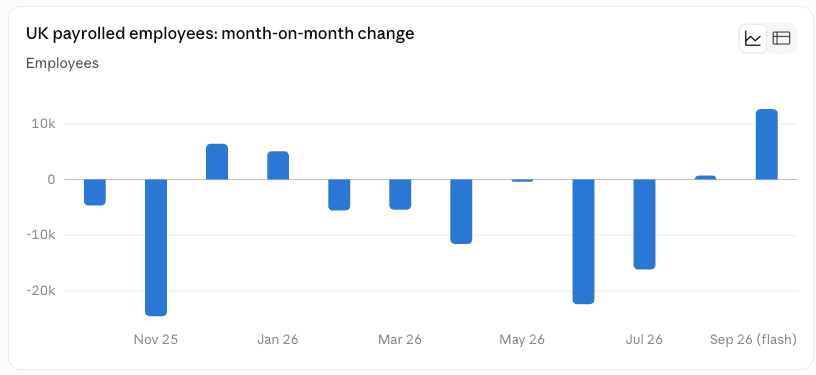
Payrolled employees rose 13,000 in September, and August's reported fall of 26,000 was revised to a gain of 1,000.
"A consensus of sorts seems to be emerging among MPC members that the situation now warrants some policy tightening but less than is priced in," says Investec.
Pound sterling rose in response to the data while the policy-relevant 2-year bond yield rose to 4.936%, putting it a stone's throw away from the 2026 highs that lie below the benchmark 5.0% level.
Vacancies are the dissenters' remaining ground, falling 21,000 to 691,000 in the three months to September, a level last seen outside the pandemic in 2014, with the ONS reporting that smaller firms cite labour costs as a brake on recruitment.
"Raising rates would pile further pressure on an already fragile jobs market without doing much to bring down energy prices," says Martin Beck, Chief Economist at WPI Strategy.
Beck reads private sector regular pay, which grew 3.0% against 6.3% in the public sector, as around the pace consistent with inflation returning sustainably to 2%.
Richard Carter, head of fixed interest research at Quilter Cheviot, says the wage figures offer some reassurance, "even if it is very unlikely to clear the way for lower rates".
Markets priced a 5 November rise at above 90% ahead of the release, with a cumulative 100 basis points over the coming year taking Bank Rate to 4.75%.
"Resilient UK growth has reinforced market expectations of a near-term rate rise, but limited domestic cost pressures still argue against the scale of tightening priced by markets," says Lloyds Bank.
Huw Pill, the Bank's Chief Economist and the Committee's most established hawk, said last week he is sceptical the UK requires four hikes, according to MUFG.
The Inflation Test
The Committee held Bank Rate at 3.75% on 16 September by six votes to three, with Megan Greene, Catherine Mann and Pill outvoted.
"Labour demand had remained weak and there was still judged to be a margin of slack in the labour market," say the minutes, which record unemployment at 4.9% at the time.
The same minutes put underlying private sector wage growth at "around 3½%", a pace judged "slightly above the target-consistent estimate presented in the February 2026 Report", with firms in the Bank's Decision Maker Panel expecting 3.4% over the coming year.
Swati Dhingra, the Committee's arch-dove, voted with the majority alongside Governor Andrew Bailey, Sarah Breeden, Clare Lombardelli, Dave Ramsden and Alan Taylor.
Dhingra named winter energy pricing and the wage settlement round as her two unknowns at a National Institute of Economic and Social Research conference on 24 September.
"I think the timing issue here is that we're going to know from the winter energy pricing what happens there, we're going to know much more about wage settlements and where they end up at," she said.
September inflation data follow on Wednesday with consensus at 3.4%, up from 3.1%, and Deutsche Bank makes its November call conditional on no significant miss.
Berenberg expects a single 25 basis point rise on 5 November and nothing after it, while Barclays, Investec and Pantheon Macroeconomics look for November and February to take Bank Rate to 4.25%.