

Image © Pound Sterling Live
The Swiss franc is undermined by 0% base rate and a misfiring safe-haven bid, but France and an AI rout could shift the narrative.
The Swiss franc is set to stay soft against the pound, weighed by a 0% interest rate at the Swiss National Bank (SNB) and a safe-haven bid that has misfired during this month's market stress.
The weakness is written into the Pound to Swiss Franc rate, which has climbed from 1.03 in early March to a peak near 1.11 at the start of October and trades at 1.1006 today.
The advance has come in a series of higher lows, with the 100-day moving average, a gauge of the medium-term trend, rising through 1.0883.
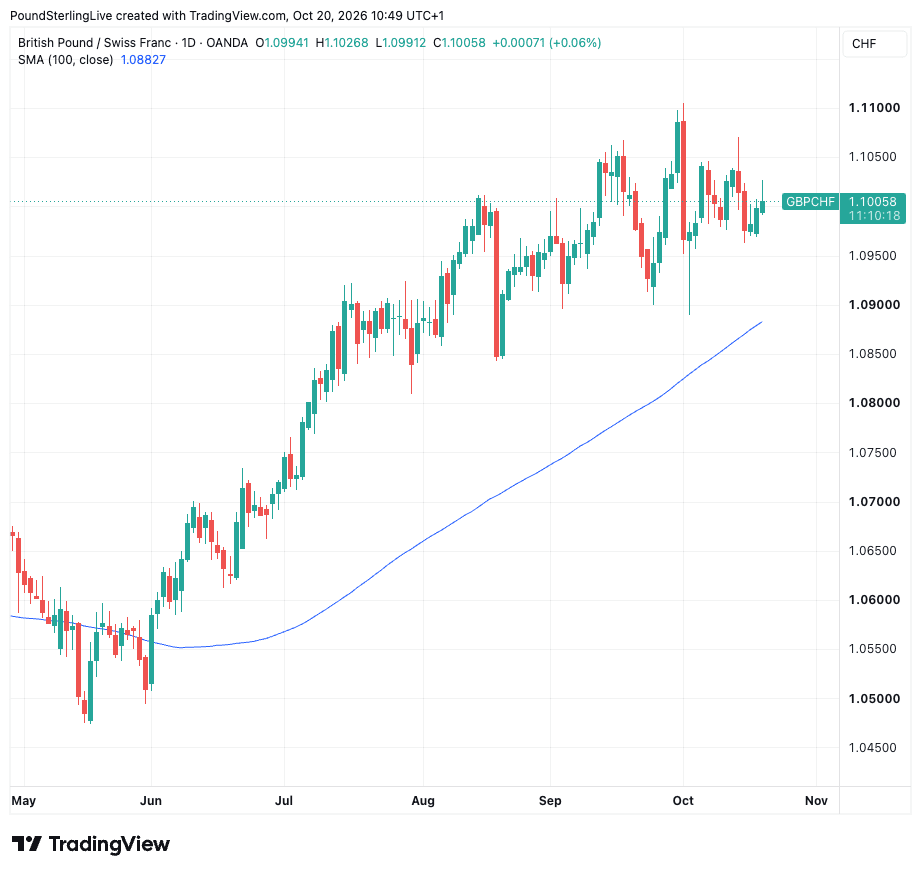
Above: Pound-franc has built a series of higher lows since May, with the 100-day moving average rising beneath.
The SNB left its policy rate at 0% on 24 September, and its inflation forecasts assume the rate stays at zero over the entire forecast horizon.
Swiss inflation of 0.8% in August sits comfortably within the SNB's definition of price stability, allowing it to hold at zero while the Federal Reserve and the European Central Bank raise rates.
The SNB also says the franc's recent depreciation is supporting the economy, a signal it is comfortable with a softer currency.
A currency that costs nothing to borrow, and whose central bank welcomes its decline, is a natural source of funding for investors seeking yield elsewhere.
"As the JPY strengthens, the CHF is likely to remain the preferred funding currency for carry trades. This view is reinforced by our expectation that the Swiss National Bank keeps policy rates at 0% through at least year-end, preserving the CHF's role as a low-yielding funding currency," says a recent research note from OCBC, the Singapore-based bank.
Sterling is a natural destination for that money, with the Bank of England expected to raise rates as the SNB holds.

Daniella Arcadipane, Senior Currency Specialist at Indigo
Moving a life-changing sum abroad? You won’t be doing it alone.
One specialist explains every step in plain English and stays with it until the money lands. FCA authorised, FRN 594433.
Talk to a specialistOfficial figures on Tuesday strengthened that expectation, showing the UK labour market in better shape than forecast:
• Unemployment fell to 4.7% in the three months to August, from 4.9%.
• Average earnings growth rose to 3.7%, from 3.6%.
Both measures had been expected to hold steady, and the data supports the case for a hike at the Bank of England's 5 November meeting, which Wells Fargo expects to take Bank Rate to 4.00% against the SNB's 0%.
"The Bank delivering on expectations of a rate hike should be a sterling positive – cementing its status as a G10 high-yielder," says ING in a recent update.
A hike would widen the yield gap that rewards investors for borrowing francs to hold pounds, the engine behind pound-franc's climb since March.
The SNB looks set to keep its side of that gap wide.
"While there has been some talk in the market that the SNB could announce a rate hike at its next policy meeting in December, the consensus currently views this as highly unlikely given the fiscal jitters in the Eurozone and its impact on safe haven demand for the CHF," says a recent note from Rabobank, the Dutch bank.
Rabobank ties the SNB's patience to haven demand for the franc, and that demand has proved intermittent this month.
The Franc's Safe-Haven Bid Misfires
The franc's first test came on 12 October, when a sell-off in semiconductor stocks coincided with escalating tension in the Middle East.
"The Swiss franc was the main disappointment among G10 safe-haven currencies, with USD/CHF rising by 0.54% to 0.8346," says a morning note from Natixis, the investment bank.
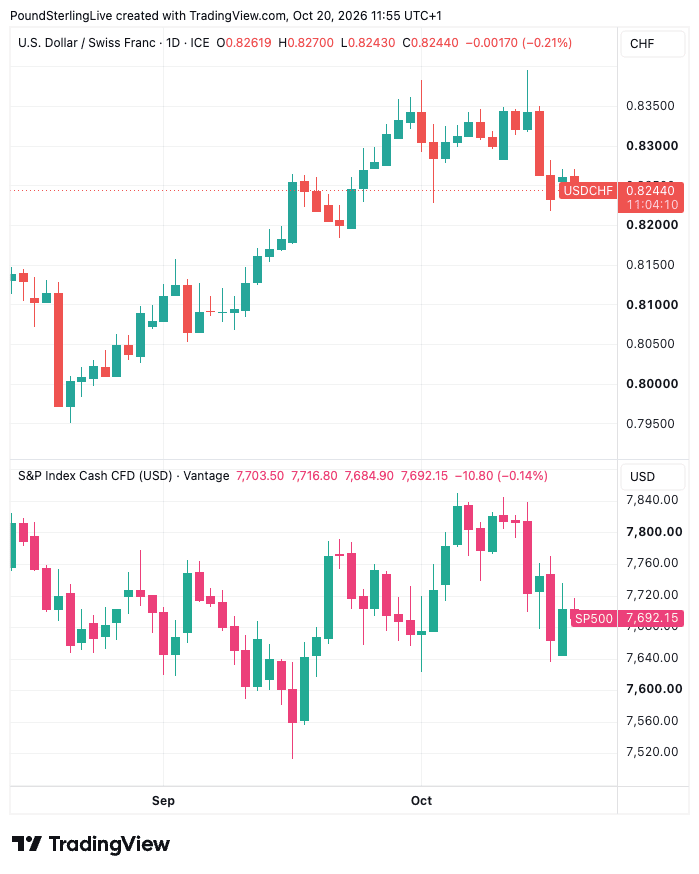
Above: USD/CHF and the S&P 500 (lower panel), a proxy for risk sentiment. The relationship is not as clear-cut as might have been the case in previous months.
Crédit Agricole CIB says haven demand flowed into long-dated bonds that day.
The franc rallied two days later, when stress in the debt of AI companies pulled the dollar lower, and Corpay says the sell-off in AI stocks sent investors to the yen and the franc.
The source of each shock decides which currency the haven money finds.
When the stress originates in US assets, as with AI company debt, investors cut their dollar exposure and the franc gains.
When the stress comes from energy and geopolitics, the dollar takes the haven role.
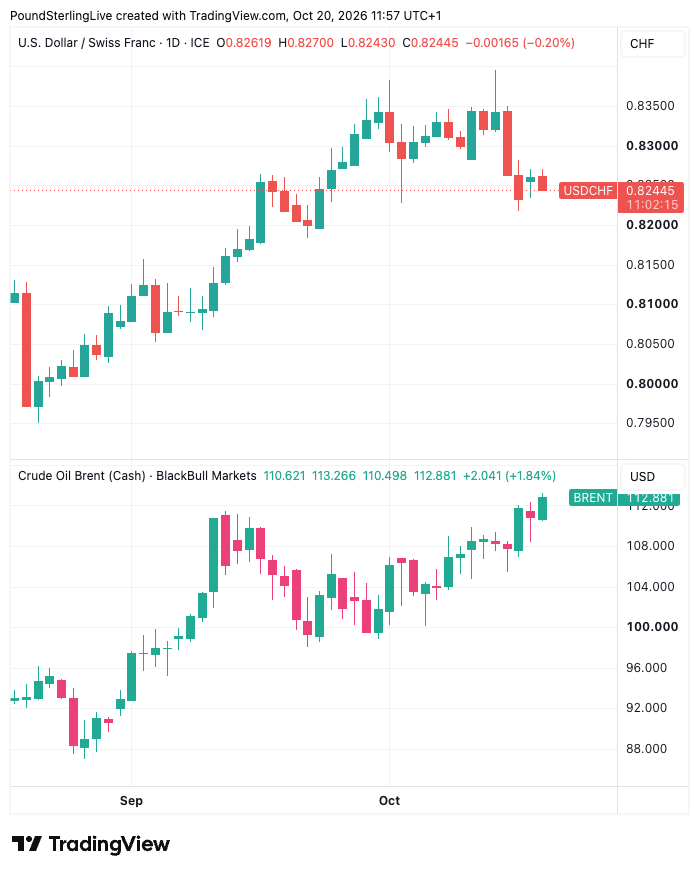
Above: USD/CHF and brent crude prices in lower panel. High energy costs are proving a headache for CHF bulls. Note how recently the impact has been less severe, most likely due to French sovereign bond worries driving Euro-centric CHF safe-haven demand.
"The USD is a safe haven currency and the US economy is energy-independent and so the USD benefits from the wars," says Commonwealth Bank of Australia in its weekly FX strategy.
High global bond yields add to the franc's burden, with US ten-year yields at around 5.1%, near their highest in more than two decades.
MUFG says these yield levels make investors reluctant to pay a premium for defensive currencies such as the franc while market volatility stays contained, a reluctance that rising volatility would reverse.
The zero rate and the misfiring haven bid feed each other: the higher yields climb elsewhere, the more it costs to hold a currency that pays nothing in yield.
The franc's best run came in the first week of October, when pound-franc fell from near 1.11 to 1.09 and Rabobank argued the outperformance settled the debate in favour of the franc's haven role.
Pound-franc has since recovered most of that drop.
Rabobank also flags the risk of SNB intervention should franc buying accelerate this autumn, a backstop that caps how far a haven rally can run.
Daniella Arcadipane, Senior Currency Specialist at Indigo
Moving a life-changing sum abroad? You won’t be doing it alone.
One specialist explains every step in plain English and stays with it until the money lands. FCA authorised, FRN 594433.
Talk to a specialistAn AI Rout and France's Crisis Could Revive the Franc
A deeper correction in AI stocks would revive the franc's haven bid, because it hits US assets and the dollar directly.
"The biggest beneficiary again looks to be the Swiss franc, where lower core interest rates and narrower rate differentials between Switzerland and the rest of the world allow the franc to recover," says Chris Turner, Global Head of Markets at ING.
A rout of that kind would pull global rates lower and narrow the yield gap that makes the franc cheap to borrow, working on both sources of its weakness at once.
Stress in AI funding markets persists.
"Concerns over business models of the high-yield US data centre providers remain, with Coreweave's 2032 bond still trading at 80 cents on the dollar. This represents the key threat to dollar strength," says Turner in Tuesday's FX Daily.
Corpay says AI-related stocks now make up roughly half the S&P 500's market value, which places this week's earnings at the centre of the franc outlook.
Tesla, Meta and IBM report quarterly results on Wednesday.
A franc rally driven by an AI rout would push pound-franc beyond the shallow dips seen this month.
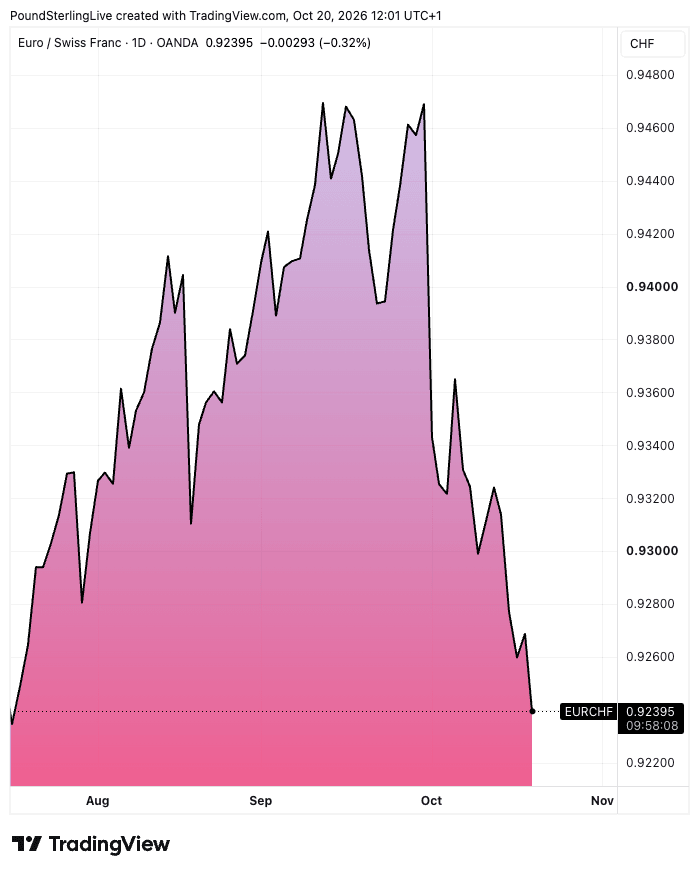
The Euro has fallen against the Franc as France's debt concerns build.
France's fiscal crisis is the second route to a stronger franc, and it runs through the euro.
The gap between French and German ten-year borrowing costs, the favoured measure of French stress, has widened to around 148 basis points, near levels last seen in the eurozone debt crisis.
France's lower house votes on the revenue side of the 2027 budget today, and Moody's reviews the country's credit rating on Friday.
The franc is the market's preferred hedge against that stress, with the Euro to Franc rate at 0.9248.
Natixis says the one-month EUR/CHF risk reversal, which measures the premium paid for protection against euro losses, has collapsed to -1.02 from around -0.25 in August, "as macro investors crowded into CHF as their preferred EUR-bearish vehicle."
ING expects the SNB to resume buying euros against the franc in an extreme French scenario, around 0.90-0.91 in EUR/CHF.
French stress reaches pound-franc through two channels, because the pair moves with both the pound-to-euro rate and euro-franc.
The franc gains against the euro, and so does the pound: sterling's rise to a 16-month high against the euro last week more than offset the franc's euro gains and kept pound-franc near its highs.
ING's extreme scenario, with French spreads at 250 basis points and the ECB forced into emergency measures, sees EUR/GBP at 0.82, which equates to 1.2195 in pound-to-euro terms.
French stress therefore threatens pound-franc if the franc's gains against the euro outpace the pound's.
Turning to the pound, the main risk is that UK rate expectations run ahead of what the Bank of England delivers.
"We continue to doubt the BoE delivering that [100bp of tightening], especially following the comments from Chief Economist Huw Pill who stated this week that he is sceptical that the UK will require four 25bp rate hikes," says MUFG.
UK inflation data on Wednesday is the next test, with BofA forecasting a rise to 3.5% in September from 3.1% and Pantheon Macroeconomics expecting 3.4%.
The 28 October Budget follows.
"Markets may have underestimated the headroom of the chancellor in the upcoming Budget, creating a more positive narrative for the pound," says Barclays in its weekly UK note.
Pound-Franc Consolidates Below 1.11
Our call last month, that 1.09 would act as a floor for a return towards 1.1060, played out, with the pair exceeding that target at the start of October.
Our house view is that the UK's relative economic outperformance carries the pound higher into year-end, provided the Budget passes without incident.
Near-term, we expect pound-franc to consolidate below the early-October peak near 1.11, with franc rebounds stalling at the 1.0960-1.0970 area that held last week.
Deeper support sits at 1.09, the late-September and early-October floor, with the 100-day moving average rising through 1.0883 beneath it.
A Budget that passes as a non-event and a Bank of England hike on 5 November would open a break above 1.11 and fresh multi-month highs.
Forecasts Point to a Softer Franc
Today, the Dollar to Franc rate is at 0.8245, and Crédit Agricole CIB expects the franc to weaken over the next three months:
• USD/CHF at 0.84, a cent and a half above spot
• EUR/CHF at 0.95, two and a half cents above spot
The French bank says a revival in franc-funded carry trades is possible if risk aversion stays contained, and names a fresh spike in eurozone sovereign credit risk as the main threat to its call.
"EUR/CHF has stabilised in narrower ranges around 0.93 following the sharp adjustment endured at the start of the month," says Crédit Agricole CIB in its weekly FX note.
Other dollar-franc forecasts also sit above spot:
• Commonwealth Bank of Australia: 0.85 in three months
• UOB: 0.86 in 12 months
• Goldman Sachs: 0.87 in 12 months
OCBC is the exception at 0.82 in three months, close to spot.
Euro-franc forecasts from ING and Rabobank at 0.93 sit just above spot, while MUFG's 12-month forecast of 0.925 is in line with spot, and the bank expects the franc to soften near-term before strengthening in 2027.
Set against pound-to-dollar forecasts of 1.31 from Crédit Agricole CIB and 1.32 from Commonwealth Bank of Australia, the dollar-franc forecasts point to pound-franc holding its gains into year-end, with the Bank of England's 5 November decision the next catalyst.
Daniella Arcadipane, Senior Currency Specialist at Indigo
Moving a life-changing sum abroad? You won’t be doing it alone.
One specialist explains every step in plain English and stays with it until the money lands. FCA authorised, FRN 594433.
Talk to a specialist