
Image © Pound Sterling Live
A decisive vote to remain in Canada has cleared the risk premium, leaving the Bank of Canada in charge.
The Canadian dollar is the best-performing major currency on Tuesday after Albertans voted decisively to remain in Canada, clearing the tail risk that hung over the currency into Monday's ballot.
CAD is up 0.36% against both the US dollar and the euro, 0.27% against the Swedish krona and 0.20% against the Australian dollar, with only the New Zealand dollar holding it to a draw.
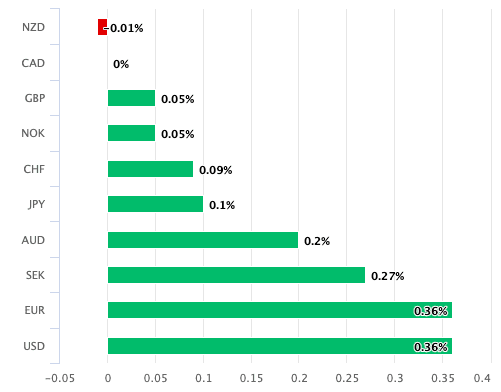
Above: Canadian dollar performance against G10 peers on Tuesday.
Alberta produces more oil than any other Canadian province, which is why a vote to begin separation proceedings carried a currency price tag.
"The separation referendum, if it succeeded, would weigh heavily on the CAD because Alberta is Canada's largest oil-producing province," said Carol Kong, FX Strategist at Commonwealth Bank ahead of the vote.
Unofficial results from Elections Alberta put support for remaining at roughly 76%, against 24% for beginning the legal process towards a binding separation referendum, on more than 1.2 million votes counted, with the official tally due on 29 October.
Prime Minister Mark Carney said Albertans had made a "clear choice" in favour of unity.
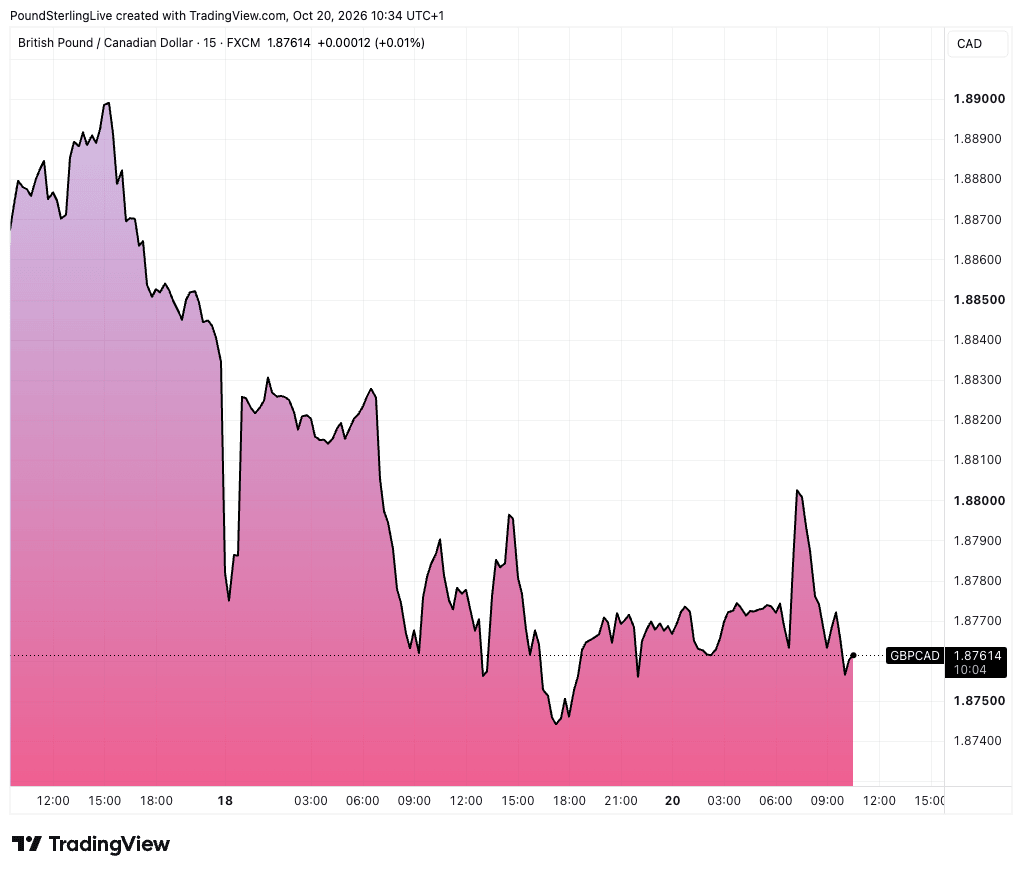
The Pound to Canadian Dollar exchange rate is the softer gainer of the G10 pack at 0.05%, though the week's damage is already done, with the pair at 1.8763 after breaking beneath the 1.8810 support band we said sellers had to clear for the fade to develop.
The U.S. dollar-Canadian dollar pair extends a run of weakness to 1.4056.
"Voters in Alberta are set to reject separation from Canada, with about 76% of counted votes in favour of remaining in Canada. The sequence lower lows is intact for USD/CAD with the pair rapidly approaching 1.4050 and extending losses to 1.6% after rolling over at 1.43 last week. Support rests at 1.4040 before the figure.
With the vote behind it, the Canadian dollar now trades on the Bank of Canada, which updates interest rate policy expectations on 28 October.
Bank of Canada Rate Pricing to Take the Reins
The case for a hike is building on recent inflation dynamics, which can offer the CAD an additional avenue of support.
Statistics Canada reported September inflation at 3.1% year-on-year, up from 3.0% and below the 3.2% consensus, with a 27.8% annual rise in gasoline prices doing the work and inflation excluding gasoline easing to 2.2%.
The Bank's preferred core measures softened, CPI-median to 1.9% and CPI-trim to 1.8%, both beneath the 2% target.
The hawkish signal came from the Bank's own quarterly surveys, where consumers' five-year inflation expectations jumped to 3.91% from 3.39% and rose to match their already elevated short-term expectations.
Business sentiment improved alongside it, with the outlook indicator recovering to -0.33 from -0.38, the share of firms expecting a recession over the coming year falling to 6% from 17% in the second quarter, and around half of firms saying they would keep passing cost increases on to customers.
Long-horizon expectations climbing to meet short-horizon ones is the de-anchoring central banks watch for, and the combination has been enough to move forecasts.
Goldman Sachs now expects a hike at the October meeting, reading the third-quarter surveys as more hawkish than it had looked for.
Rate hike expectations have moved in favour of an October move, says a daily note from MUFG, the Japanese bank, which has the Canadian dollar and the pound both supported by a hawkish repricing of their respective central banks.
Governor Tiff Macklem's weekend remarks had already lifted the odds before either release landed.
Standard Chartered Still Sees a Hold
Analysts at Standard Chartered strike a more 'dovish' stance, and now expect the Bank of Canada to sit at 2.25% through the end of 2026 and 2027, against a previous call for a cut this year and a hike next.
"We expect the BoC to stay put despite rising market pressure for rate hikes as early as this month," says Dan Pan, Economist for the Americas at Standard Chartered.
"An October hike would be justified by caution, not necessity, in our view," he adds.
For CAD, a hold and a paring of hiking odds would represent a headwind.
"Even with an October insurance hike, market pricing of the total tightening cycle is excessive," says the bank, which sees no growth catalyst strong enough to justify the 100 basis points of tightening the market has priced.
CIBC also looks for a hold, having argued in a recent update that core measures close to 2% would support one, with Canadian growth faltering again since US tariffs took effect in late August.
A hike on 28 October keeps the pressure on GBP/CAD and puts graphical support at 1.8711 in play, while a hold hands the pound back the 1.8810 band and brings October's 1.8926 high into view again.