

Image © Adobe Images
The Federal Reserve holds the key to GBP/AUD this week: a stronger dollar would lift the pair, while a dollar retreat after Wednesday's decision would drag it lower.
The Pound to Australian Dollar exchange rate has moved in step with the U.S. dollar since the spring, rising when the greenback rallies and slipping when it retreats, and that makes Wednesday's Fed decision the event to watch.
A hawkish Fed would put GBP/AUD back above 1.90 and on course for 1.9150, but with a December hike already close to fully priced, the bigger risk is a disappointment for dollar bulls that sends the pair towards the 1.8891 October low.
From a technical perspective, the blue line marking the 100-day moving average has become a magnet for GBP/AUD, with the pair crossing back and forth over it throughout October:
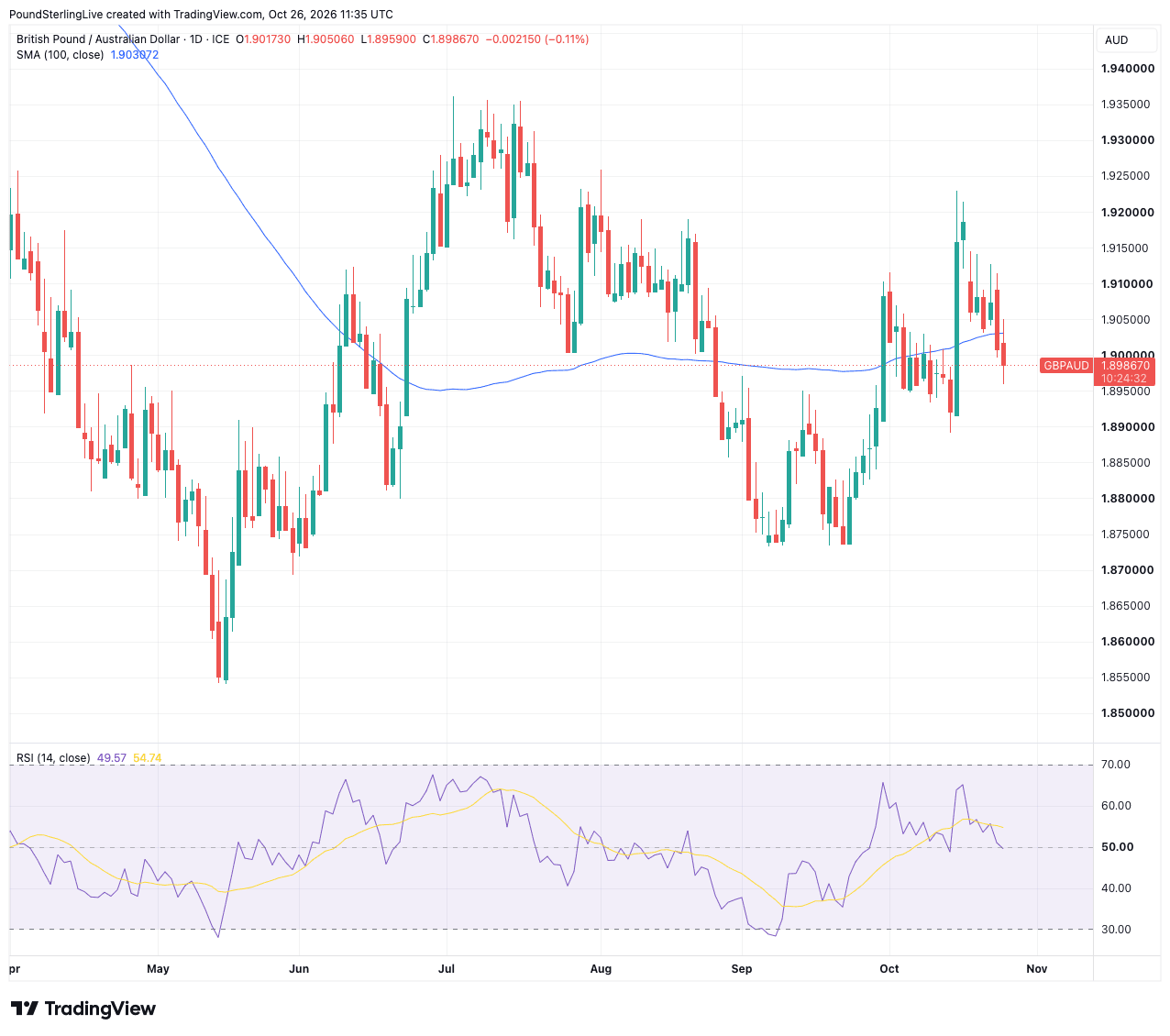
GBP/AUD daily chart. Image © Pound Sterling Live, chart created with TradingView.
GBP/AUD opens the week at 1.8987, below both the 1.90 figure and the 100-day at 1.9031, having been as high as 1.9214 at the mid-month point. The recent pullback looks to be consistent with the recent fading of the USD rally, which allowed the GBP/AUD's 100-day MA the chance to pull the pair back into its orbit.
The pair broke above the average at the end of September and has traded on both sides of it ever since, with the mid-month spike fully reversed and the month's low at 1.8891 sitting well above the September lows.
The RSI sits at 50, the midpoint of its range, confirming that momentum favours neither buyers nor sellers.
Both currencies offer yield, and both have outperformed most of their peers as a result. The cross-currency result is a static GBP/AUD, and the longer the pair hugs the 100-day, the stronger its pull becomes. From a directional angle, that leaves little visibility beyond a bet on falling volatility.
A daily close beneath the 14 October low at 1.8891 would open a deeper move towards 1.8750, while a return above 1.9214 would put the July highs back in view. Between those levels, we look for the 100-day to keep anchoring the pair.
Last week we looked for a cool-off that held above 1.9000, followed by fresh gains into month-end. The pair held 1.9000 on a closing basis all week, but the push higher never came, and Monday's dip has taken it back below that level.
The Dollar Is the Big Clue
The chart below sets GBP/AUD against the U.S. Dollar Index, and the two have moved together since the spring, rising together through September and early October and easing together since mid-month.
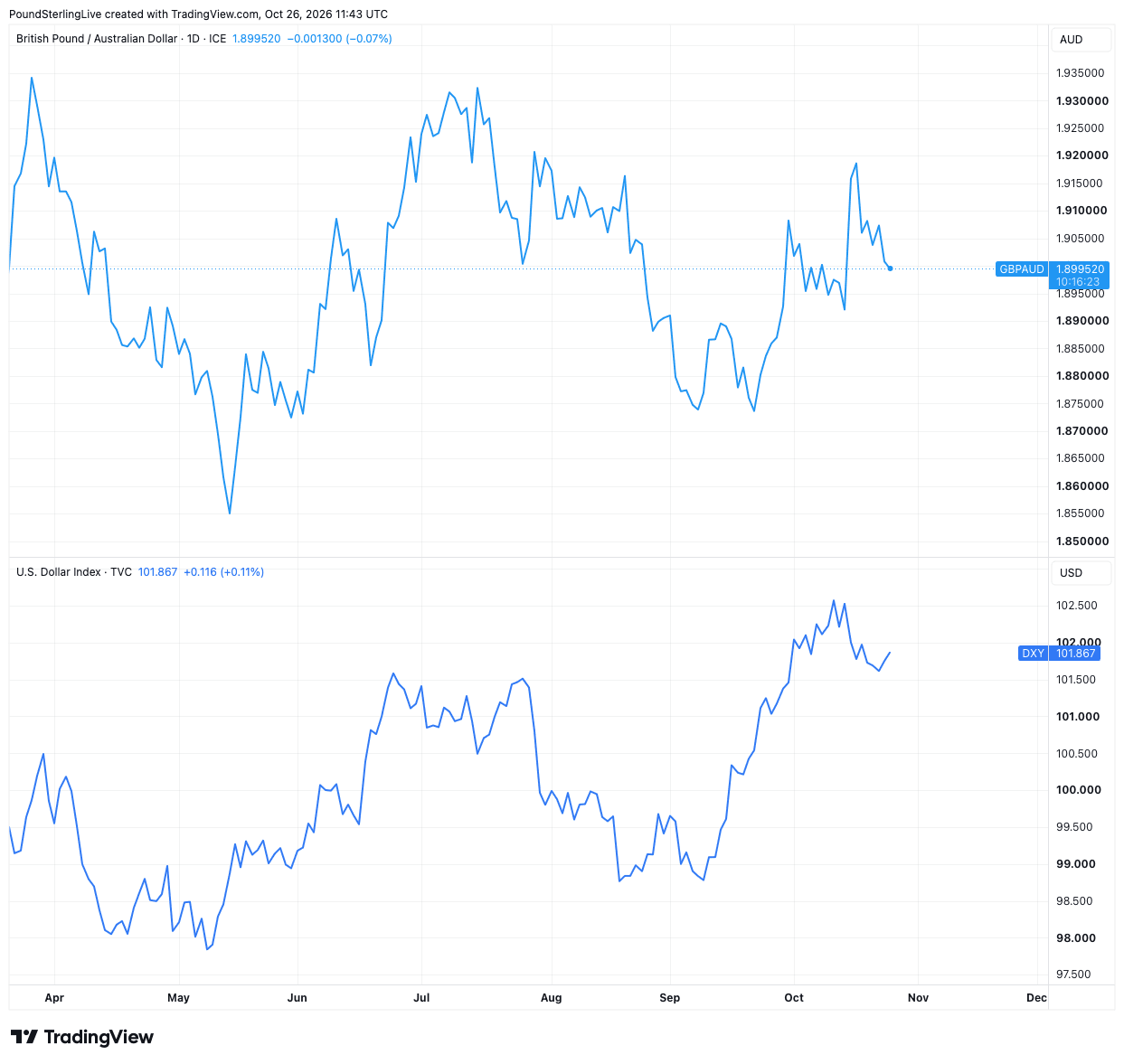
GBP/AUD (top) and the U.S. Dollar Index (bottom). Image © Pound Sterling Live, chart created with TradingView.
How does the dollar reach GBP/AUD? The Australian dollar is a high-beta currency that tends to fall harder than most when the dollar rallies and global risk appetite fades, while sterling is less exposed to those swings. Dollar strength therefore tends to weigh more on the Aussie than on the pound, lifting GBP/AUD, and dollar weakness does the reverse.
Much therefore rests with the Fed, which announces its decision at 18:00 on Wednesday. Consensus looks for no change at 3.75% to 4.00%, and a hawkish message that cements a December hike would favour GBP/AUD upside.
"We continue to see risks around G10 central bank meetings over the next few weeks as favouring the USD, potentially pushing the DXY closer to 102.00," says CIBC Capital Markets in a note of 23 October.
The downside risk is that rich Fed hike expectations are already in the price, to the extent that the dollar retreats further after the decision. Commonwealth Bank of Australia places "only a 20% chance of a hike" this week, in its weekly FX strategy of 25 October, and a Fed that declines to validate December pricing would leave GBP/AUD exposed to a drop.
Australian Inflation Tests the RBA Case
Australia's third-quarter inflation report on Wednesday is the main domestic event, with consensus looking for the RBA's preferred trimmed mean measure to rise 1.0% quarter-on-quarter and headline prices 1.2%. A print above consensus would support the Aussie and weigh on GBP/AUD, while a miss would do the opposite.
Market pricing gives a Reserve Bank of Australia hike on 3 November about a 60% chance, according to CBA, and the central bank has kept the hawkish message going. Assistant Governor Sarah Hunter said on Sunday the RBA was "not quite yet" done fighting inflation, according to Westpac.
CBA's own economists look for trimmed mean inflation of 0.9%, a touch below consensus, which would chip away at the case for a hike.
The Budget Is Sterling's Test
For the pound, the Chancellor's Budget statement at lunchtime on Wednesday is the big event, and CBA says AUD/GBP would jump if the Budget is received poorly.
Bank of America expects "a cautious, low key budget with key decisions delayed," according to its weekly note of 23 October, an outcome that would leave sterling's yield appeal intact.
With Australian inflation and the Budget pulling in opposite directions and the dollar the deciding factor, our Pound to Australian Dollar forecast sees the 100-day anchoring the pair near 1.90 unless the Fed moves the dollar, with the risks tilted lower should the decision disappoint dollar bulls.