Official White House Photo by Molly Riley
The British pound trades at its best level against the dollar since mid-September after a Democrat sweep of Congress knocked the U.S. currency, although analysts expect the losses to prove short-lived.
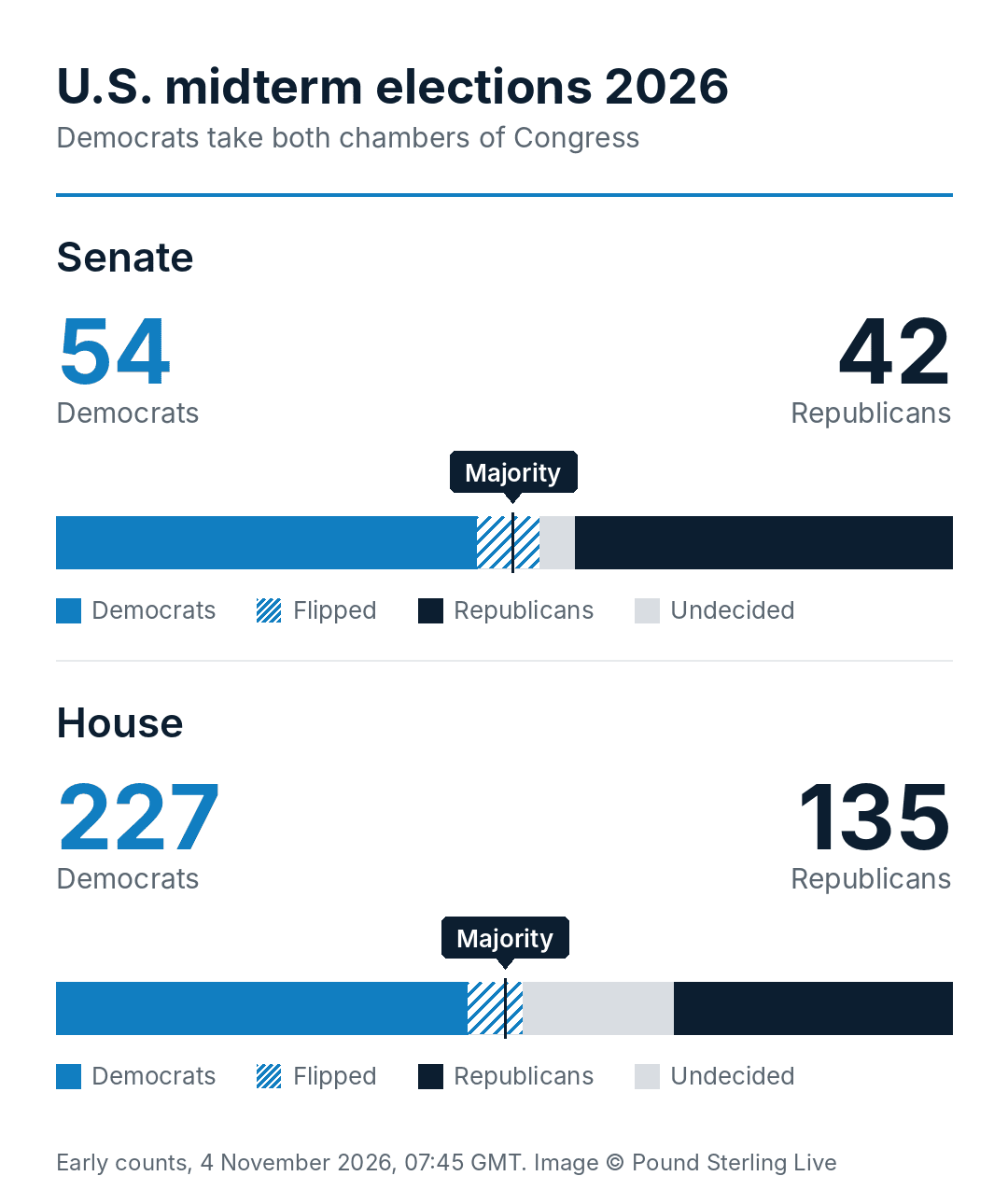
The dollar fell against the pound and the rest of the G10 overnight as early results pointed to the Democrats taking both the House of Representatives and the Senate in the U.S. midterm elections.
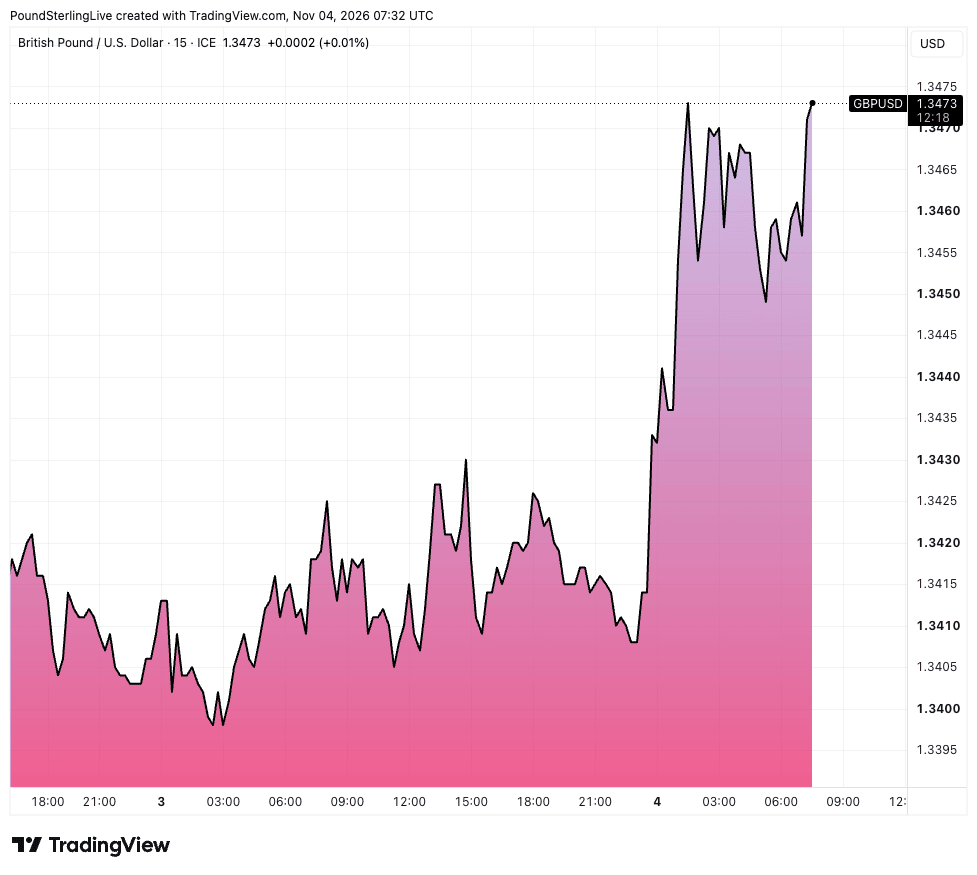
The Pound to Dollar exchange rate jumped from 1.3410 to a high of 1.3479, its best level since mid-September, and trades at 1.3473 at the time of writing, a gain of 0.44% on the day.
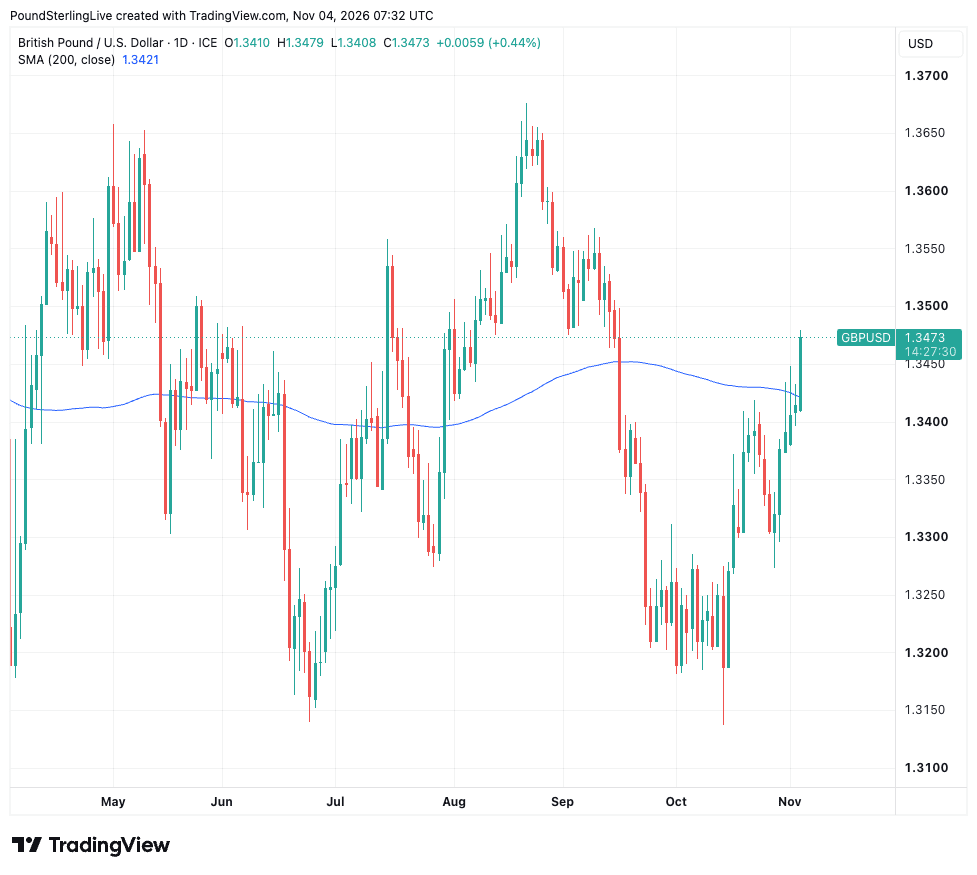
The move takes the pair back above its 200-day moving average for the first time since late September, a level that had capped the recovery through last week, as Pound Sterling Live reported on Tuesday.
Above: GBP/USD at daily intervals, showing the break above the 200-day moving average.
Early counts put the Democrats on course for at least 243 House seats, above the 218 needed for a majority, and 54 to 55 Senate seats against the 51 required for control, with flips in North Carolina, Ohio and Iowa and wins in Texas, Kansas and South Carolina.
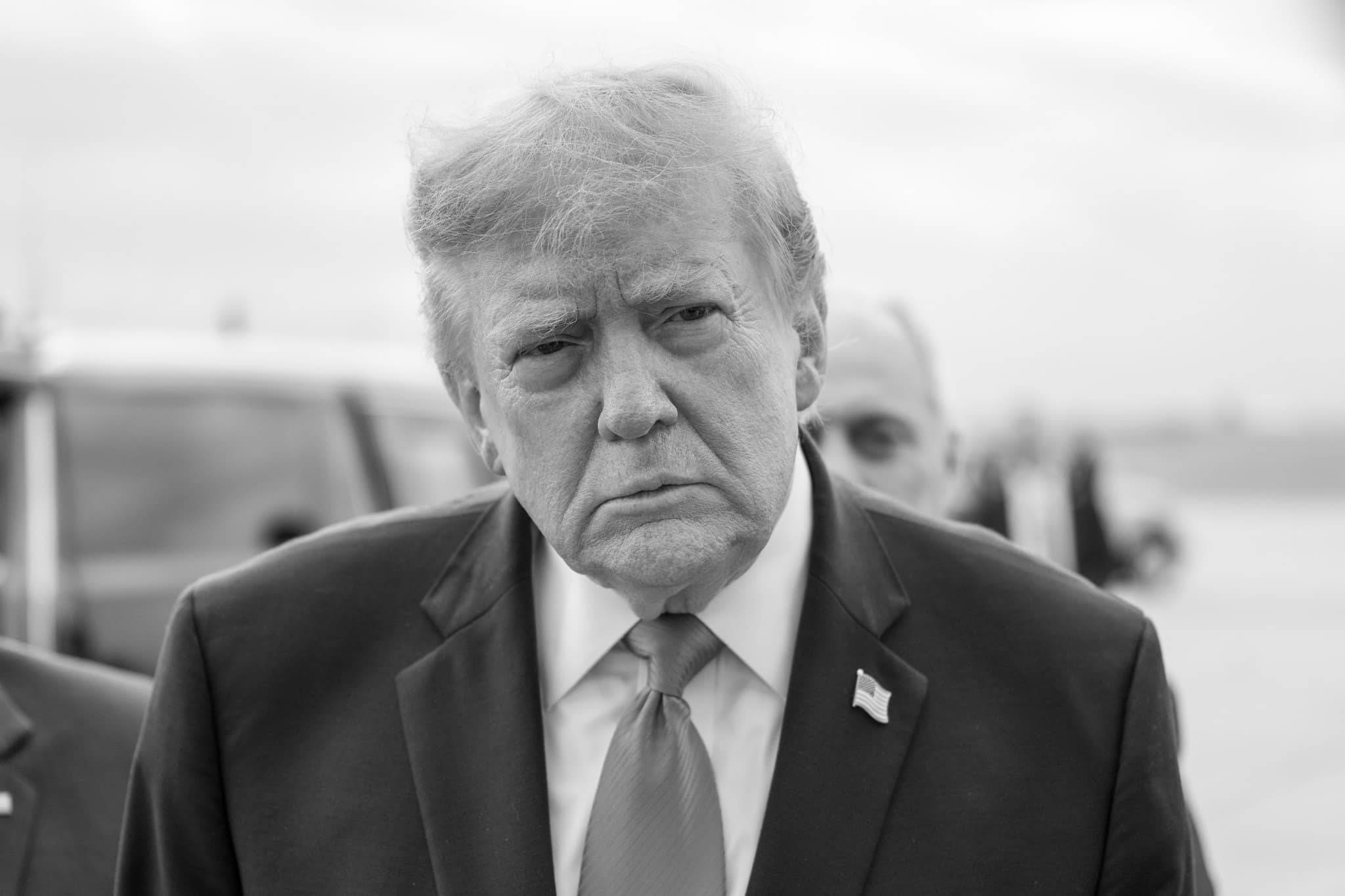
Trump has said he will acknowledge the result.
The scale of the result is what moved the dollar, "prediction markets had priced in a Democratic sweep as the most likely outcome ahead of the election day, but the party still outperformed most forecasts," says Danske Bank in its morning note.
"Markets are unwinding 'US exceptionalism' trades. Treasury yields are falling across the curve, equity futures are tumbling, and the dollar is extending its losses against its major counterparts, suggesting investors expect Democrats to rein in the administration's spending plans, subject the artificial intelligence buildout to tougher oversight, and constrain the president's trade and foreign policy moves," says Karl Schamotta, Chief Market Strategist at Corpay.
The AI channel is the one that matters for the pound-dollar rate, as Pound Sterling Live set out ahead of the vote: the AI investment boom is the key driver of U.S. outperformance, so anything that slows the buildout slows the growth and inflation that keep the Federal Reserve hiking and the dollar bid.
The vote changes the politics of that buildout because the Trump administration has backed data centre construction, and investors expect the President to veto any federal legislation aimed at the industry, says Corpay.
Many Democrats campaigning for Congress oppose the pace of expansion, so investors are reading the result as a referendum on data centre construction, and expectations for AI investment are set to ratchet lower, the note adds.
That makes a Democrat Congress, and Democrat governors in the states where the data centres are being built, the first political check on an industry that until now had Washington's support.
Futures on the tech-heavy Nasdaq 100 fell 1.6% with chips leading the decline, and the Dollar Index fell to a low of 101.3, as concerns about tech regulation under a Democrat Congress bore on AI-related names.
Analysts at Danske Bank read the move as risk-off rather than a dollar-specific selloff, and says the driver was less a higher political risk premium than renewed concern around the AI and data centre investment buildout.
Why Analysts Expect the Dollar to Recover
Commonwealth Bank of Australia expects the dollar's losses to prove short-lived because the Democrats cannot legislate around the President, "despite controlling Congress, Democrats would still need President Trump to sign legislation into law. Trump can veto legislation, while overriding a presidential veto requires a two-thirds majority in both chambers," says the bank's London open note.
Above: GBP/USD at 15-minute intervals, showing the overnight jump as the Senate results came through.
"In any case, large hyperscalers should broadly be able to manage a somewhat tougher regulatory environment. Oil prices could also rebound if US-Iran talks fail, providing further support to the USD," adds the note.
Crédit Agricole reached the same conclusion on federal AI regulation in its election day guide, "even if Democrats were able to convince enough Republicans to get on board to overcome the filibuster, which is not a guarantee even if some Republicans have become a bit more open to AI regulations, the Trump veto would loom large," says the bank, which puts the regulatory risk at state and local level through zoning restrictions on data centre construction.
That state-level risk crystallised overnight: newly elected Texas Governor Gina Hinojosa has called for a pause on new data centre development, which Commonwealth Bank of Australia judges unlikely to impose a lasting moratorium but could prompt tighter state rules, in a state Barclays had flagged as mattering more for the AI trade than control of either chamber.
Corpay also expects the overnight moves to fade as the conclusive nature of the result eases uncertainty, and says the pound, euro and Canadian dollar could soften slightly as investors rebalance after their relief rallies against the greenback.
Natixis does not expect the result to change U.S. policy on tariffs, immigration or the Iran war because foreign trade and foreign policy remain under executive control, although it expects the Democrats to place renewed emphasis on healthcare and environmental spending, which could pressure the fiscal outlook.
Danske Bank expects U.S. fiscal policy to be effectively locked until the next president, since Republicans cannot pass further deficit-widening reconciliation bills and Trump can veto budget bills from a Democrat Congress.
The macro anchor for the dollar is unchanged by the vote, "what is not speculative is the US economy posting a strong 3.4% quarter-on-quarter annualised growth rate in the third quarter, inflation remaining above target for a sixth year in a row, and the Federal Reserve readying to tighten again," says Francesco Pesole, FX Strategist at ING, in a note published ahead of the result.
Tuesday's JOLTS report reinforced the point: job openings rose 333k to 7.52 million against a 7.1 million consensus, and the 10-year Treasury yield climbed 5 basis points to 4.96% before the election result pulled yields lower again.
"Beyond the near term, however, the direction of travel for US fundamentals suggests to us that structural dollar tailwinds will likely be with us for a while," says Themistoklis Fiotakis, Head of FX Research at Barclays.
The Bank of England Is Thursday's Test for the Pound
The pound has its own catalyst on Thursday, where investment bank analysts expect the Bank of England to raise Bank Rate by 25 basis points to 4.00% with a 7-2 vote, and the guidance will decide whether sterling holds its new ground.
"If there's going to be a hawkish surprise, it would be if the Bank says something like 'some further tightening in monetary policy is likely to be appropriate over the coming months'," says ING in its Bank of England preview.
"A more dovish formulation would be if the Bank makes further hikes explicitly contingent on second-round effects: one hike as an insurance move, but anything more requiring solid data," adds the note.
Barclays flags the risk of a "dovish hike" from a Bank facing market pricing for a terminal rate near 5%, which it says could trigger technical damage given increasingly extended hedge fund positioning in sterling.
J.P. Morgan's London desk is less worried by that scenario, "easy to see a dovish kneejerk to a push-back to market pricing but I am not sure how bad for the currency that is given the current environment where other CBs (Fed, ECB etc) are also starting to push back on growth fears," says the desk, which has turned more bullish on the pound and recommends buying dips towards 1.3360.
ING notes speculators are still running reasonably large short positions in sterling, which it says allows the period of pound outperformance to continue.
Pound Sterling Live's House View holds that the pound recovers in the Budget's wake into year-end, and the break above the 200-day average is the technical confirmation that view required.
UOB's technical analysts expect the pair to test 1.3480 as long as it holds above 1.3410, "a break above this level is not ruled out, but the next resistance at 1.3510 is likely out of reach," says the bank in its daily FX Insights.
A daily close above the 200-day average at 1.3421 keeps 1.3480 and then 1.3510 in play into the Bank of England decision; a dovish set of guidance from the Bank on Thursday sends the pair back to the 1.3410 to 1.3360 area that J.P. Morgan is looking to buy.