
Image © Adobe Images
The dollar is tipped to come under pressure on the prospect of a Democrat sweep in the midterm elections, although solid US fundamentals keep the setback contained.
The dollar enters the US midterm elections at 1.3420 against the pound, and a Democrat sweep of Congress is tipped to push it lower.
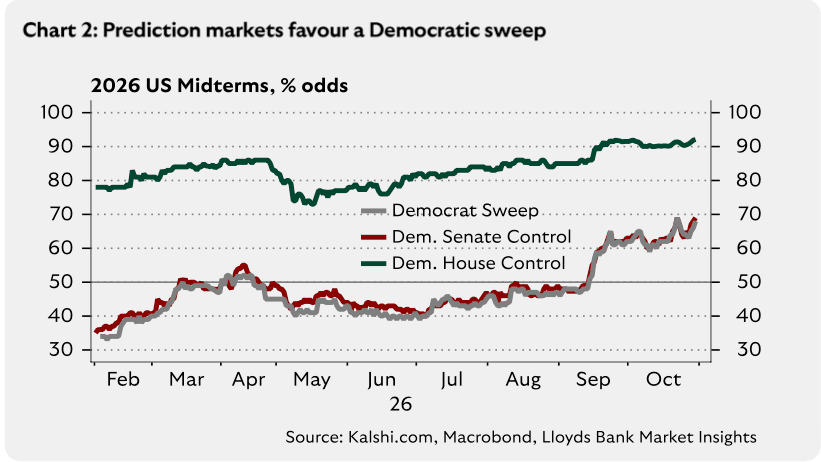
Markets have already priced a Democrat win in the House, where the party needs a net gain of four seats, so the dollar's reaction turns on the Senate, where prediction markets give the Democrats a 74% chance, according to ING.
A Democrat sweep would impact the dollar through the AI investment boom: the party has campaigned on slowing data centre expansion, and a slower buildout would cut the US growth and inflation that keep the Federal Reserve hiking.
"A blue sweep can put some pressure on the dollar. Fears of tougher regulation could weigh on AI stocks (we've recently seen how that can hit the greenback), while markets could price in greater risks of decision-making gridlock around issues such as government funding and the debt ceiling," says Francesco Pesole, FX Strategist at ING.
Pesole doubts the result triggers a structural shift, because the greenback continues to respond predominantly to the Fed story, which faces no immediate impact from the vote.
ING expects a split Congress, Republican Senate and Democrat House, to be neutral or slightly positive for the dollar.
Crédit Agricole reaches a firmer conclusion from the history, "we analysed the USD performance after US elections since 1976 and concluded that the FX market impact depended on whether the Democrats controlled the House only, or the Senate as well. In the case of the former, the USD rebounded strongly while it sold off in the case of the latter," says Valentin Marinov, Head of G10 FX Strategy at the bank.
Marinov expects any sign of the Trump administration re-escalating in Iran to lift oil and the safe-haven dollar in the days after the vote, although that support fades if the threat does.
"In the long term, we expect a legislative gridlock in the US Congress after the midterms that should undermine fiscal support for the economy and increase the risk of US government shutdowns, in a blow to the USD," says Marinov, whose bank is bearish on the dollar over the next six to twelve months.
The State Races Matter More Than Congress
Barclays argues the AI risk sits in the states rather than Washington, with the Texas gubernatorial race carrying more weight for the AI trade than control of either chamber, given the concentration of planned data centre capacity in the state and tight polling.
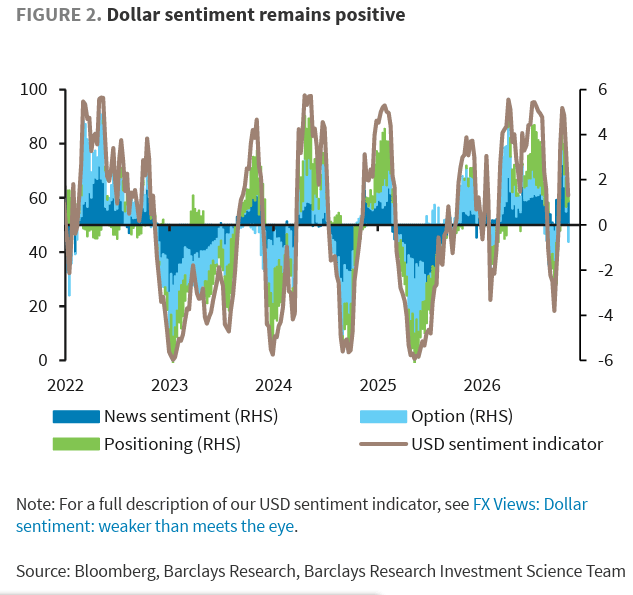
"On net, the prevailing bearish AI narrative along with a more moderate - but still present - long dollar overhang generate scope for some consolidation in the dollar, particularly if some of the state elections go the anti-AI way or if oil prices moderate," says Themistoklis Fiotakis, Head of FX Research at Barclays.
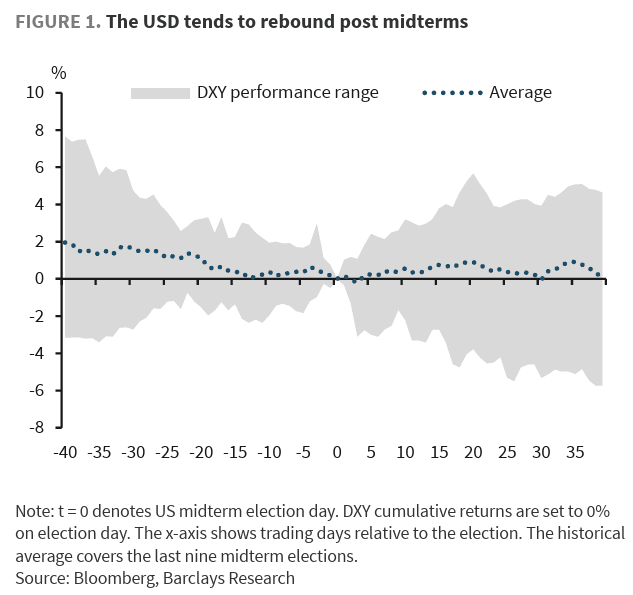
Barclays says a Democrat sweep is already the betting-market baseline and the recent AI washout may reflect those risks to some degree, which limits the scope for a fresh selloff on the result alone.
Beyond the near term, the bank sees US fundamentals keeping structural dollar tailwinds in place, with private domestic final purchases running at around 5% annualised for a second quarter and Fed pricing for two further hikes more credible than the two-plus priced for the ECB.
Danske Bank judges a Democrat sweep modestly positive for the dollar, and Dallas Fed President Lorie Logan said on Monday at least two more hikes are needed to ensure price stability.
The Pound's Own Catalyst Comes Thursday
Sterling has the Bank of England on Thursday, where J.P. Morgan's London desk expects a straightforward 25 basis point hike with two dovish dissents and has turned more bullish on the pound.
"Friday saw good sterling demand from the RM and corporate franchise but cable failed at the 200d (1.3428), a close above here would be positive, otherwise dips towards 1.3360 should be bought," says the desk in its daily note.
Barclays flags the risk of a "dovish hike" from a Bank facing market pricing for a terminal rate near 5% that hawks such as Huw Pill have warned against, and Crédit Agricole says a non-committal MPC leaves an overvalued pound vulnerable to profit-taking on stretched longs (more).
Our house view is that the pound recovers in the Budget's wake into year-end, and a dollar held back by AI doubts gives that recovery room.
The 200-day average at 1.3428 is the line the pair has to close above for the midterm result to convert into a sustained move higher.
A Democrat Senate would deliver the dollar weakness that takes the pair through 1.3428, on Crédit Agricole's reading of past elections.
A Republican Senate keeps the dollar's rate support in place and sends the pair back towards 1.3360.