Image © Adobe Images
The British pound is probing 1.20 against the euro ahead of Thursday's Bank of England decision, and the trend remains firmly higher despite stretched conditions.
The Pound to Euro exchange rate broke above 1.20 on Friday to reach a fresh 18-month high, and we look for it to hold near those levels this week as the Bank of England prepares to raise interest rates.
Thursday's decision is the week's main event for sterling, and a hike accompanied by guidance that keeps further increases on the table would give the pound fresh support at these elevated levels.
From a technical perspective, the RSI in the lower panel of the chart shows the pair remains deeply overbought at 83, yet the 21-day moving average, the blue line, continues to rise steeply beneath it:
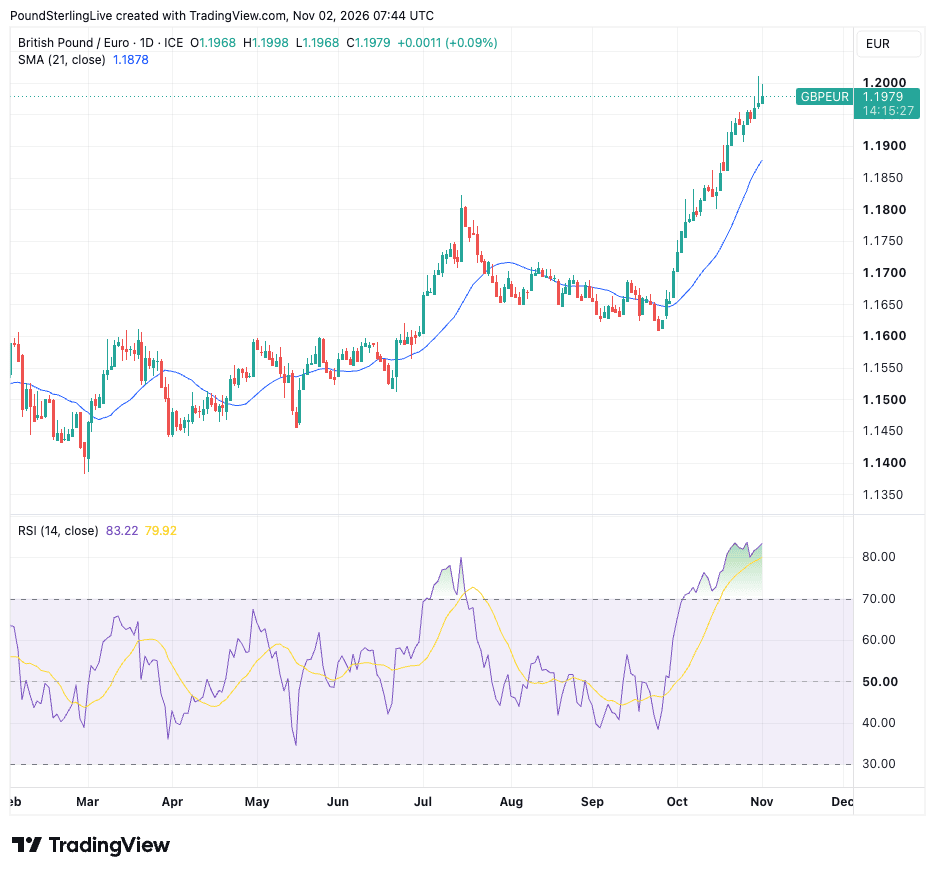
GBP/EUR daily chart. Image © Pound Sterling Live, chart created with TradingView.
GBP/EUR trades at 1.1979 at the start of the new week, after Friday's advance took it as high as 1.2016.
Pound Sterling Live's Week Ahead Forecasts have repeatedly called for a pullback on the basis of overbought readings in recent weeks, and the pair has instead continued to climb. Overbought conditions can persist for long periods when a trend has fundamental support, and we will not stand in the way of this one.
A pullback and consolidation will come in time, but the charts suggest any weakness will be soft. The 21-day average sits at 1.1878 and is rising quickly, so a retreat to that line would amount to a dip of less than 1% and still leave the uptrend intact.
We look for GBP/EUR to hold above 1.19 this week, with dips towards the 21-day likely to attract buyers. A daily close beneath the 21-day would signal a deeper consolidation and change Pound Sterling Live's near-term Pound to Euro forecast.
Further out, Pound Sterling Live's medium-term view is that GBP/EUR is resetting into a higher range that will incorporate 1.20, with the upper reaches of that range in the mid-1.20s.
Last week Pound Sterling Live looked for a measured pullback and consolidation, but the pair dipped only to 1.1902 on Monday before rallying to reach the 1.20 objective by Friday, well ahead of the year-end timeline Pound Sterling Live set.
What the Bank of England Must Do to Extend the Rally
Should the Bank of England raise interest rates at 12:00 on Thursday and signal that further hikes are possible, the pound would gain a fresh source of support. Consensus looks for an increase in Bank Rate to 4.00% from 3.75%, which would be the first hike since August 2023.
Sterling's reaction will turn on the guidance more than the decision itself: hawkish guidance that points to further increases tends to lift a currency, but markets already price four hikes over the coming 12 months, according to Lloyds, so a message that pushes back on that pricing would weigh on sterling.
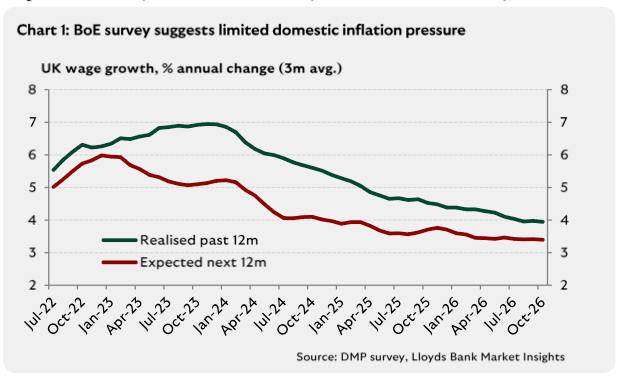
"We see an expected Bank of England rate increase as an insurance hike rather than the start of a tightening cycle," says Hann-Ju Ho, Senior Economist at Lloyds, in the bank's Market Insights Weekly of 30 October. Lloyds expects a 6-3 vote, with Governor Andrew Bailey and Deputy Governors Lombardelli and Ramsden switching sides to secure the hike.
The Bank enters the meeting with the Budget out of the way. Chancellor John Healey's statement reduced fiscal headroom to £14.5bn from £23.6bn, broadly in line with expectations, and sterling strengthened against the dollar and euro without major volatility, according to Lloyds.
Eurozone Inflation Tests the ECB's December Plans
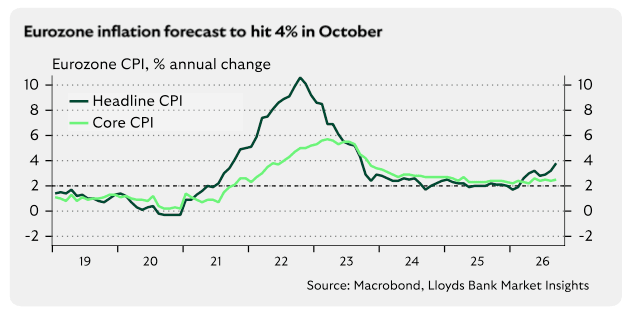
Wednesday's flash inflation estimate for October is the euro's main event, with consensus looking for headline inflation to rise to 3.9% from 3.8% and core inflation to hold at 2.5%. A print above consensus would support the euro and a miss would weigh on it.
Lloyds forecasts 4.0% for the headline measure and 2.6% for the core, and says the risk of second-round effects "has increased, leaving the door open for the ECB to increase interest rates further in December."
UK and eurozone PMI revisions on Monday and Wednesday are second-tier and unlikely to move the pair.
France Stresses to Underpin the Euro's Slide
The euro will remain under pressure against the pound until France gets its public finances in order, judging by the narrowing gap between UK and French government borrowing costs.
The premium investors demand to hold 10-year UK government bonds over their French equivalents has fallen from about 1.1 percentage points in July to 0.36 points at the end of October. EUR/GBP has fallen in step over the same period, from above 0.86 to 0.8338.
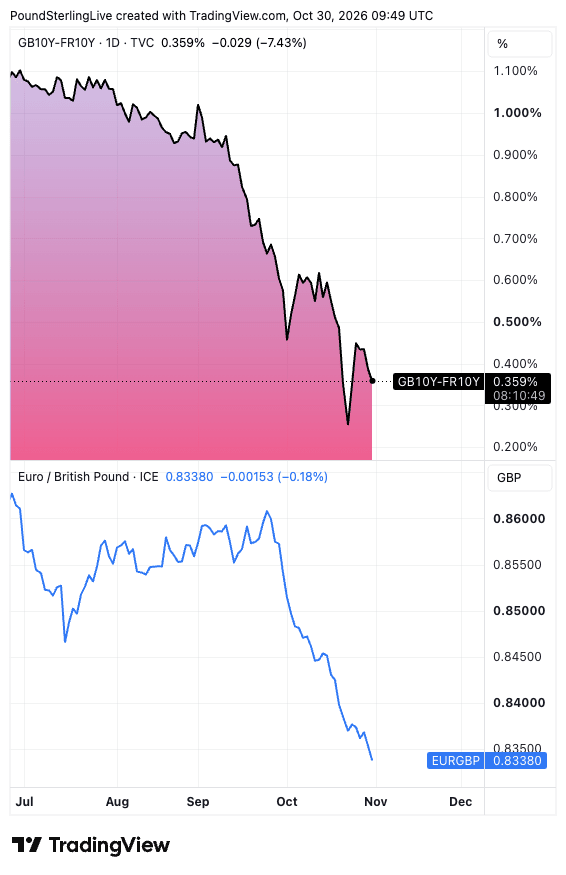
UK-France 10-year yield spread (top) and EUR/GBP (bottom). Image © Pound Sterling Live, chart created with TradingView.
How does the gap between gilt and French yields reach the exchange rate? A shrinking UK premium tells us investors now see French debt as almost as risky as British debt, and they are pricing a risk premium into the euro as a result, which lifts GBP/EUR. More importantly, the direction of travel this year has clearly been against France, and it's that rate of change that expresses itself via the exchange rate channel.
The spread between French and German 10-year bonds stood near 175 basis points in late October, approaching the 2011 high of 190 basis points, according to Corpay, which flags a French parliamentary vote on the budget on 17 November as a further source of investor unease.
A presidential election follows in the spring, with the first round set for 18 April, according to Crédit Agricole CIB, and it is hard to see France's fiscal position improving before then.
Strategists at UBS caution against extrapolating the euro's weakness and say they would "avoid chasing further euro weakness", arguing that "speculative investors are already heavily positioned against the euro and in favor of the US dollar, potentially limiting incremental selling pressure from additional negative European news," in a note dated 26 October.
With the Bank of England set to raise rates and France's fiscal troubles likely to persist into the spring election, Pound Sterling Live see's see GBP/EUR settling into a higher range with pullbacks likely to be shallow.