

Image © Adobe Images
The dollar is losing rate support as disappointing earnings from Alphabet, Amazon and Intel pull US yields lower and price Fed tightening out of the curve.
The dollar fell to a 101.6 low in Asia after a second night of disappointing US technology earnings sent investors into Treasuries, and the Pound to Dollar exchange rate trades at 1.3405 as a result, its best level since 22 October.
Pound Sterling Live judges the tech disappointment supportive of the pair in the near term, because the AI investment cycle is what gives the Federal Reserve its urgency to raise rates, and doubts over that cycle ease the pressure on the Fed to act.
The two-year Treasury yield, the rate that anchors the dollar, fell 10 basis points to 4.60%, its lowest since mid-September, and rates traders have priced 13 basis points of future Fed tightening out of the curve, according to Pepperstone.
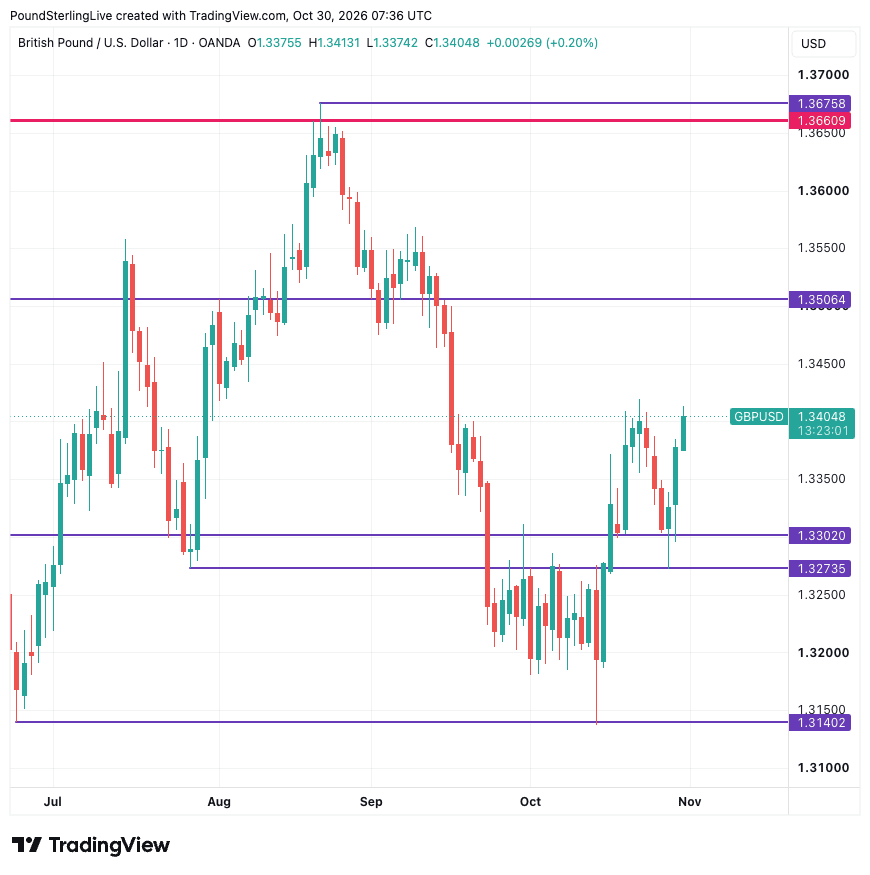
Above: GBP/USD at daily intervals, back above 1.3302 after the dollar's retreat.
The dollar's retreat lifts the pair back above the 1.3302 line that capped it through October, leaving 1.3506 as the next resistance and the 1.3274 base of the October rally as the level that would signal the dollar reasserting itself.
Alphabet closed down 12.6% on Thursday, its worst day on record, after weaker search and advertising revenue, and Amazon fell 7% in extended trading after capital spending of $77bn against the $59bn expected.
Intel plunged more than 20% after hours on weak fourth-quarter guidance, sending Nasdaq futures down a further 2% through the Asian session and the Kospi down 4%.
"The market isn't necessarily questioning whether the AI buildout can be financed. It's increasingly questioning whether shareholders will earn an adequate return on the enormous capital being deployed," says Chris Weston, Head of Research at Pepperstone.
That question matters for the dollar because the Fed has justified its hiking cycle on the demand the AI buildout creates: Chair Kevin Warsh told Wednesday's press conference that capex is high and broadening into sectors beyond technology.
"The tech selloff has supported Treasuries, with 10yr yields falling to their lowest level in 6 weeks," says Jim Reid, Head of Global Fundamental Credit Strategy at Deutsche Bank, noting the decline came despite a strong batch of US data.
Strong Data Is the Counter-case
US GDP grew 3.4% annualised in the third quarter against 3.2% expected, with business investment up 12.7%, the strongest since 2020, and initial jobless claims at their lowest four-week average since 1969.
Core PCE inflation rose 0.3% on the month and 3.1% on the year, in line with expectations, and the dollar has fallen through all of it.
"Taken together, strong private demand increases the risk that demand-driven inflation persists. We continue to expect the Fed to hike in December and March, with a risk of January," says Samara Hammoud, Economist at Commonwealth Bank of Australia.
Hammoud says CBA remains positive on the AI equity story and expects foreign demand for US assets to stay firm, which would support the dollar once the selloff passes.
KBC agrees that expected Fed tightening and elevated real rates provide a solid floor beneath the US yield curve, and that the GDP and PCE data underscore the strength of the economy and the price pressures that go with it.
Microsoft's $25bn bond sale on Thursday drew more than $115bn of orders, which Weston says shows institutional capital is still willing to fund AI infrastructure.
Brent crude above $116 a barrel on reports Trump was briefed on military options against Iran is the other weight the pound carries, since higher oil feeds US inflation and the Fed's case for December.
The Pound Side: BoE Hike Priced for Thursday
Sterling's own support comes from the Bank of England, which is expected to hike to 4.00% on 5 November, and from a Budget that passed without surprise.
Our house view is that the pound recovers in the Budget's wake, and the dollar's loss of rate support brings that recovery forward.
The dollar's near-term direction follows the Nasdaq, and while tech earnings keep yields falling the pair can extend towards 1.3506.
A rebound in the two-year yield above 4.70% would be the first sign the market has put the December hike back in the price.