

Image © Adobe Images
The Bank of Canada raised rates and lifted its 2027 inflation forecast by more than a percentage point, putting a follow-up move in December in play, though analysts say the market has priced too much tightening into the cycle.
The Canadian dollar holds Wednesday's gains because the Bank of Canada paired its quarter-point hike with a set of forecasts that make a second move in December a live prospect.
The Bank raised the policy rate to 2.50%, the first increase since July 2023, and now expects inflation around 3.4% by the end of this year against 2.4% in its July report, with price growth at or above 3% through much of 2027.
Higher Canadian rates narrow the yield gap against the US dollar and raise the cost of being short the Canadian dollar, which is what has pulled the Pound to Canadian Dollar exchange rate down through the support we have been watching since the Alberta referendum.
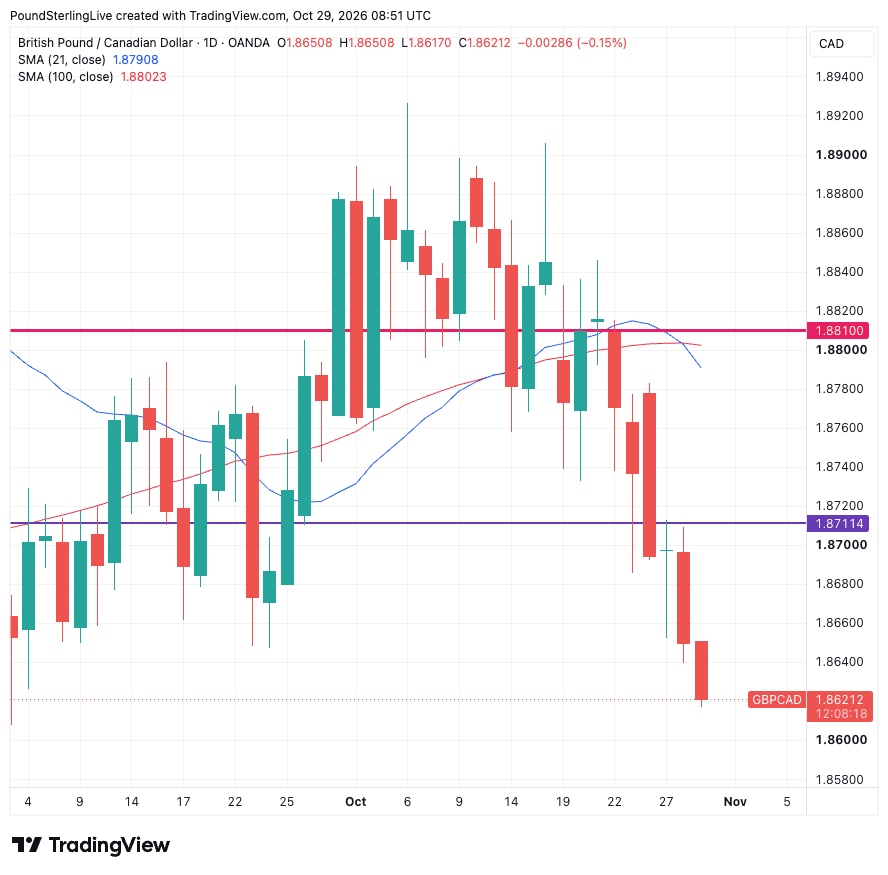
GBP/CAD trades at 1.8623 on Thursday, beneath the 1.87114 shelf that had held every decline this month, with the 21-day moving average at 1.87908 and the 100-day at 1.88023 now overhead as resistance. USD/CAD sits at 1.39927, through the 1.40 handle for the first time since the summer.
What Made the Decision Hawkish
Economists at National Bank of Canada read the decision as a clear opening salvo rather than a reluctant one, "going into the decision, some were speculating the Bank would deliver a 'dovish hike' but it was far from that in our view," say Taylor Schleich and Ethan Currie, who point to a 1.1 percentage point upward revision to the Bank's 2027 CPI projection and lean towards a second hike on 9 December.
The Bank also revised real GDP growth higher for 2026, 2027 and 2028, which removes the weak-economy argument that had anchored the case for standing still.
Desjardins expects the tightening to continue, with Governor Tiff Macklem's own words doing the work: "Looking ahead, Governing Council agreed we would take future decisions one meeting at a time. There could be a need to raise the policy rate further, but given the uncertainties, we will proceed carefully."
Standard Chartered has changed its call on the back of the meeting, having expected a pause, "we now expect another 25bps hike in December, taking the end-2026 rate to 2.75% (2.25% prior)," says Dan Pan, Economist for the Americas at the bank.
The same note draws the line at one more move, with Pan and colleague Steve Englander arguing that "market pricing of over 85bps of hikes for the rest of the cycle remains excessive, in our view, especially given pre-emptive moves likely aimed at avoiding a steep hiking cycle."
Corpay expects that excess to unwind before the year is out, "although we are bullish on the loonie over longer horizons, we remain convinced that markets are overpricing the Bank's tightening trajectory, and expect a bout of weakness before the end of the year as implied rate differentials widen against the currency again," says Karl Schamotta, Chief Market Strategist.
The implication for anyone buying Canadian dollars is that the rate story has already been paid for, which is the conclusion CIBC reaches on the currency itself.
Market-implied pricing now has the Bank reaching roughly 3.5% by the end of 2027, a level CIBC declines to argue with given Brent above $100, and the house sees the consequence falling on the other side of the pair: "there is not much alpha for the CAD leg, and USD/CAD will likely be USD driven for the foreseeable future," says Sarah Ying, Head of FX Strategy at CIBC.
That leaves CIBC looking for USD/CAD to hold a narrow 1.3950 to 1.42 range into the end of the year, with a preference for the upper end on a view that the Federal Reserve delivers a hawkish hold, which it duly did on Wednesday with two of twelve members dissenting in favour of a hike.
The Pound Side of GBP/CAD
Sterling takes its direction from Wednesday's Budget and the 5 November Bank of England decision, with GBP/USD at 1.3327 after a modest recovery, so the pound has little of its own to set against a Canadian dollar carrying a live December hike.
A Canadian inflation print that keeps 9 December alive would press GBP/CAD towards 1.8600 and then the September low, while the repricing Standard Chartered and Corpay expect would send the pair back to test the 1.87114 shelf from below, with the moving averages at 1.87908 and 1.88023 the barrier that decides whether October's decline has further to run.