
Image © Adobe Images
The New Zealand dollar has slumped after the RBNZ unexpectedly held interest rates, with analysts split on whether the central bank has delayed its hiking cycle or cut it short.
The New Zealand dollar has fallen sharply after the Reserve Bank of New Zealand (RBNZ) unexpectedly left interest rates unchanged overnight, sending the pound to its highest level against the kiwi in eleven years.
Markets had priced a hike to 3.00% as close to certain, so the hold - carried on a 4-3 vote - removed the higher returns investors had bought the kiwi to capture, and the currency's next move now turns on whether the RBNZ has delayed its tightening or ended it.
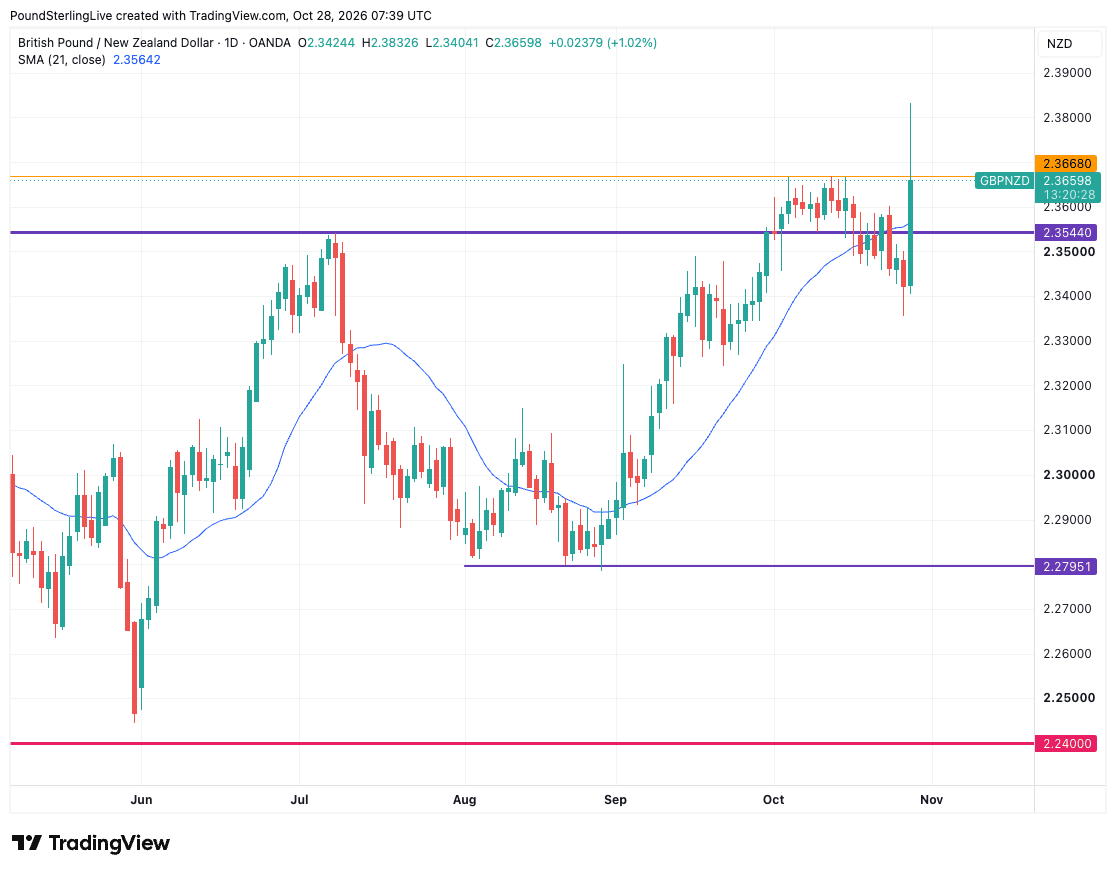
The pound to New Zealand dollar rate rose as high as 2.3833, its strongest level since September 2015, before easing back to 2.3682.
NZD/USD fell around 1.7% to below 0.5590, and AUD/NZD reached 1.2603, its highest since December 2012.
GBP/NZD is now holding above the October high at 2.3668, which turns that level into support after a month in which it capped the pair.
Pound Sterling Live flagged ahead of the decision that the kiwi needed hawkish guidance to hold its pre-meeting gains; the RBNZ delivered neither a hike nor that guidance.
The RBNZ's Monetary Policy Committee voted 4-3 to hold the Official Cash Rate at 2.75%, with Governor Anna Breman among the majority that wants time to assess the 50 basis points of hikes delivered since July.
Economists at ASB call the outcome a shock, "the RBNZ delivered a massive dovish surprise, with a 4-3 vote in favour of holding the OCR at 2.75%," says Mark Smith, Senior Economist at ASB.
"Upside inflation risks were significantly downplayed, with the RBNZ concerned over the state of domestic and external demand while also emphasising that the margin of spare capacity will offset cost increases," he adds.
Kiwibank, which had argued for a pause, expects further weakness in the currency, "we see downside risk to the Kiwi currency from here… wait until London gets "hold" of this news," says Jarrod Kerr, Chief Economist at Kiwibank.
Kerr says market pricing for the OCR to reach 4% "needs to be unwound", noting that even the hawks on the Committee want the cash rate only around the mid-point of the RBNZ's neutral range, near 3.2%.
Analysts See a December Hike Limiting the Damage
Should the data over the next six weeks confirm persistent inflation, the RBNZ is expected to resume hiking in December, with all seven members agreeing that tighter policy is likely to be required.
Standard Chartered reads the vote as less dovish than the headline, "the 4-3 vote implies the decision was less dovish than the headline suggests: three members favoured a hike, while all seven agreed that further policy tightening was likely required, conditional on the outlook," says Nicholas Chia, FX and Macro Strategist at Standard Chartered.
"Overall, we believe that the RBNZ chose to defer policy hikes rather than call an end to the cycle," he adds.
ANZ says the RBNZ presented the choice as hiking now or in December, and continues to expect three hikes, in December, February and March, taking the OCR to 3.50%.
ASB holds the same 3.50% peak, and Westpac expects a December hike to 3%, although Chief Economist Kelly Eckhold says, "we don't think the December hike is a done deal as the data will inform the next move."
The RBNZ raised its forecast for December-quarter inflation to 4.4%, from 3.9%, as fuel costs rise.
The Next Risks for the GBP/NZD: Budget and Fed Ahead
Sterling faces its own test at 12:30 today, when Chancellor John Healey delivers the Budget. Although there are risks associated with the event, sterling is not showing it, continuing to rise against the euro and threaten a new multi-month best on the day.
GBP/NZD's hold above 2.3668 keeps the overnight peak at 2.3833 in view, with the 21-day average at 2.3564 as support should the Budget weigh on sterling.
The Federal Reserve announces its decision at 6:00 pm London time, with markets expecting rates to stay on hold. Readers who regularly follow Pound Sterling Live will know that the NZD has a high 'beta' to the USD, meaning its broader performance tends to rely on what the Greenback is doing: if the dollar is rising, the Kiwi tends to be under pressure.
That means the dollar reaction to the midweek Fed event - anticipated to be a 'hawkish' hold - could have a meaningful impact on NZD.