

Image: Christine Lagarde. Felix Schmitt for ECB. Copyright (c) 2026 European Central Bank.
The euro rebounded against the dollar after softer U.S. inflation data and a tech-led retreat on Wall Street combined to overshadow the ECB decision.
EUR/USD rose from a fresh 2026 low just above 1.11 to 1.1163 on Thursday afternoon, with investment bank analysts tying the gains to a broad retreat in the dollar after the European Central Bank's decision.
The dollar is exposed to US Treasury yields, which fell after the release of US inflation data. "US rates slipped a few bps in the wake of the data, probably because of PCE deflators avoiding an upside surprise. Losses deepened in early US trading with an Alphabet-led tech sell-off prompting haven flows," says a note from KBC's markets desk.
The Pound to Dollar rate rose in step to 1.3367, a parallel move that marks the dollar as the driver. The euro lost ground against sterling over the same hours. EUR/GBP fell to 0.8356, equivalent to 1.1967 in GBP/EUR, after the Pound to Euro rate printed a fresh 17-month high at 1.1978 earlier in the day.
The dollar weakened even as US growth beat forecasts. The economy expanded at an annualised 3.4% in the third quarter, against a consensus of 3.2%, and core PCE inflation, the Federal Reserve's preferred measure, rose 0.3% in September for an annual rate of 3.1%.
The dollar lost support in the decimals of the inflation report, with economists at Barclays saying September's prices were "a touch softer than our translation". By Barclays' count, core PCE rose 0.32% on the month, 3bp below its forecast.
The dollar's exposure to the AI trade came via Alphabet where shares fell more than 10% after third-quarter results showed negative free cash flow of $9.07bn, against $2.70bn expected.
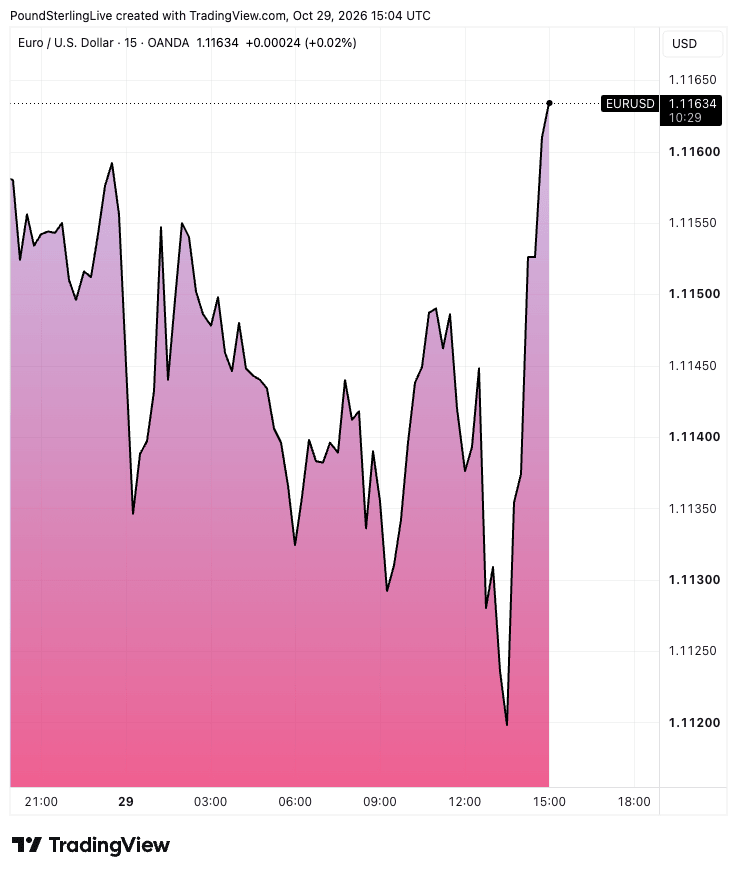
Above: EUR/USD pushes reacts to intial U.S. morning trade.
The dollar has leaned on AI investment for months; "burgeoning AI investment has previously proved largely a bullish US and USD story, via growth dynamics and investment inflows," says Jeremy Stretch, Chief International Strategist at CIBC.
The dollar's tech support was already in question ahead of the earnings round. Commonwealth Bank of Australia said in a recent update that "stronger-than-expected earnings and a more positive outlook, particularly for cloud revenue, would likely revive US tech optimism and could support the USD."
The Alphabet results open "another fissure in the AI trade just as it was gaining momentum," says Kathleen Brooks, research director at XTB.
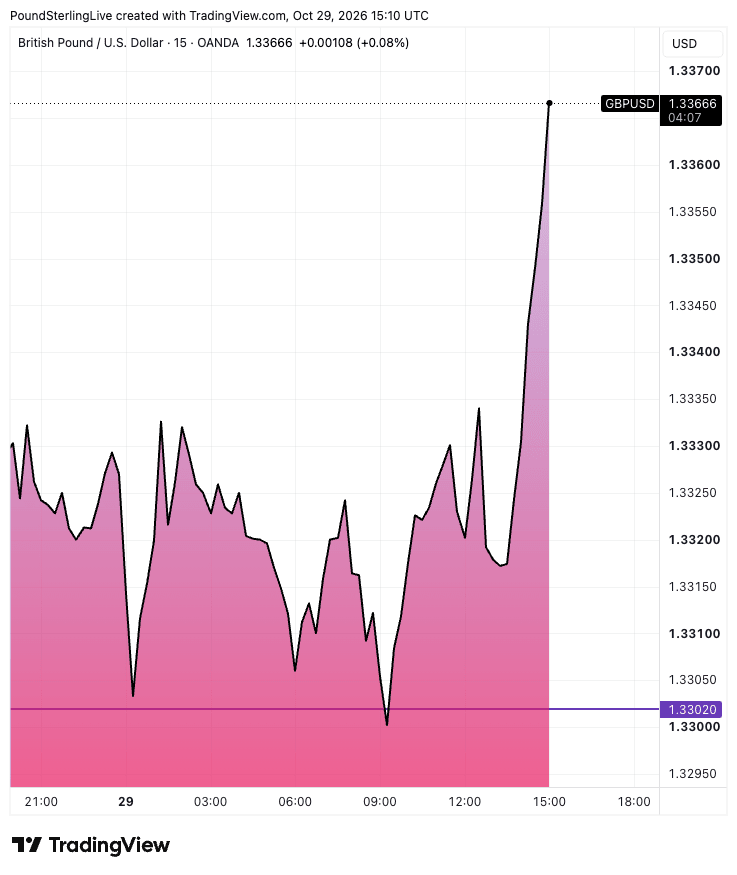
Above: GBP/USD responds to the USD selloff.
ECB Keeps a December Hike Live
The euro drew little lift from the ECB, which held its deposit rate at 2.50% as President Christine Lagarde confirmed she will step down on 7 February 2027.
The euro weakened on the ECB's statement before Lagarde's press conference, with KBC citing the statement's new reference to tighter financing conditions. EUR/USD "recovered from the day's lows just above 1.11 to 1.115 during the press conference," says KBC.
The euro still has a December rate hike in its corner, "with today's comments, another rate hike at the ECB's December meeting is clearly in the offing," says Carsten Brzeski, Global Head of Macro at ING.
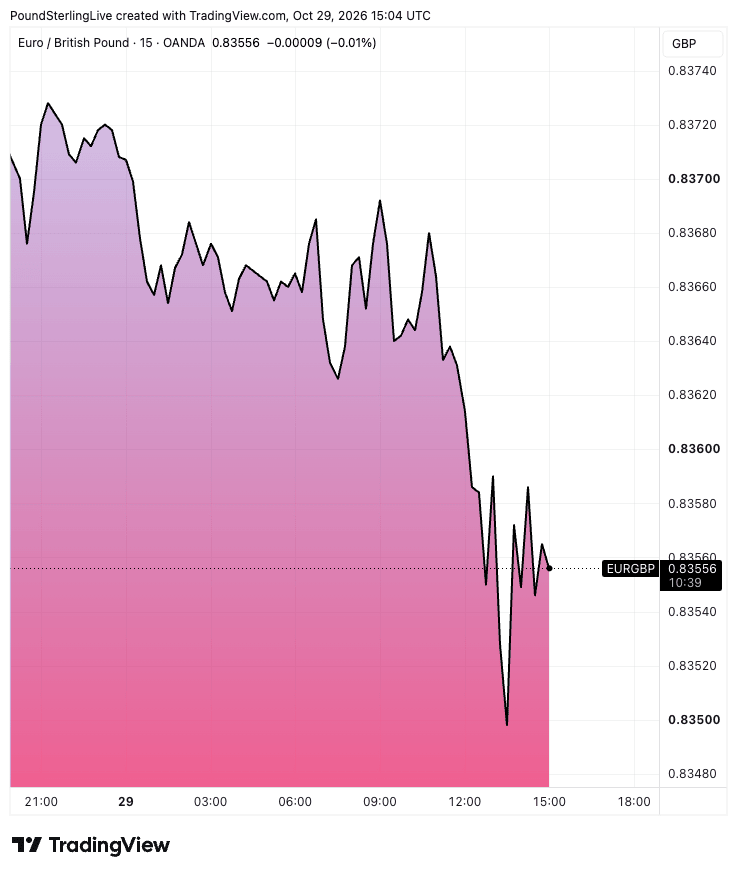
Above: Despite the ECB signalling a December hike, EUR/GBP is softer.
DNB Carnegie expects hikes to 2.75% in December and 3.00% in March. Deutsche Bank's Mark Wall sees December as "probably the end of the hiking cycle".
The euro gains less from that prospect because bond markets have already tightened conditions, "the key point for FX markets is that the ECB no longer needs to do all the tightening itself," says George Vessey, Lead FX and Macro Strategist at Convera.
The euro faces a leadership change that Holger Schmieding, Chief Economist at Berenberg, says "does not change the outlook for ECB policies". CIBC warns that the appointment of Klaas Knot, a known hawk, would bring "a hawkish repricing in the ECB rate strip".
What EUR/USD Needs to Sustain the Rebound
EUR/USD remains a sell on rallies for CIBC, which keeps "an immediate bias to fade EUR rallies" given growth concerns, high gas prices and elections in Spain and France.
EUR/USD would extend losses towards 1.1065, the May 2025 low, and then 1.0882 absent a close above the 16 October high at 1.1269, according to Stretch.
A EUR/USD "rebound... is likely to remain difficult to sustain, even if key support levels continue to hold," says Vessey.
The dollar keeps a hawkish Fed in reserve, with Barclays still expecting 25bp hikes in December and January. KBC says the Fed's outcome "might have been a different one" had it seen Thursday's data before Wednesday's meeting.
EUR/USD has a bullish counter-case in positioning, with the euro "deeply oversold" and able to "find its footing should the 'US exceptionalism' trade that has dominated in recent months begin to fade," says Karl Schamotta, Chief Market Strategist at Corpay.
EUR/USD needs a daily close above 1.1269 to turn the dollar's selloff into a recovery; until then, CIBC's 1.1065 target stays in play.