

Image © Adobe Images
Sterling is closing in on the 1.20 ceiling that has capped it against the euro since 2016, with momentum, French sovereign risk and a diminishing UK risk premium arguing for a break.
The Pound to Euro exchange rate has topped fresh highs on Friday and is heading for the top of the range that has held it since the Brexit referendum, with the case building for the ceiling to give way.
The pair trades at 1.1985, having reached 1.1987 in early trade, its best level for euro buyers since May 2025, and October is on course for a 2.3% monthly gain after a Budget that passed without upsetting gilts.
The monthly chart shows the post-Brexit range running from approximately 1.12 to 1.20: the range incorporates the lion's share of action since the vote to leave. 1.20 has proven to be a level which has supped the strength from sterling bulls:
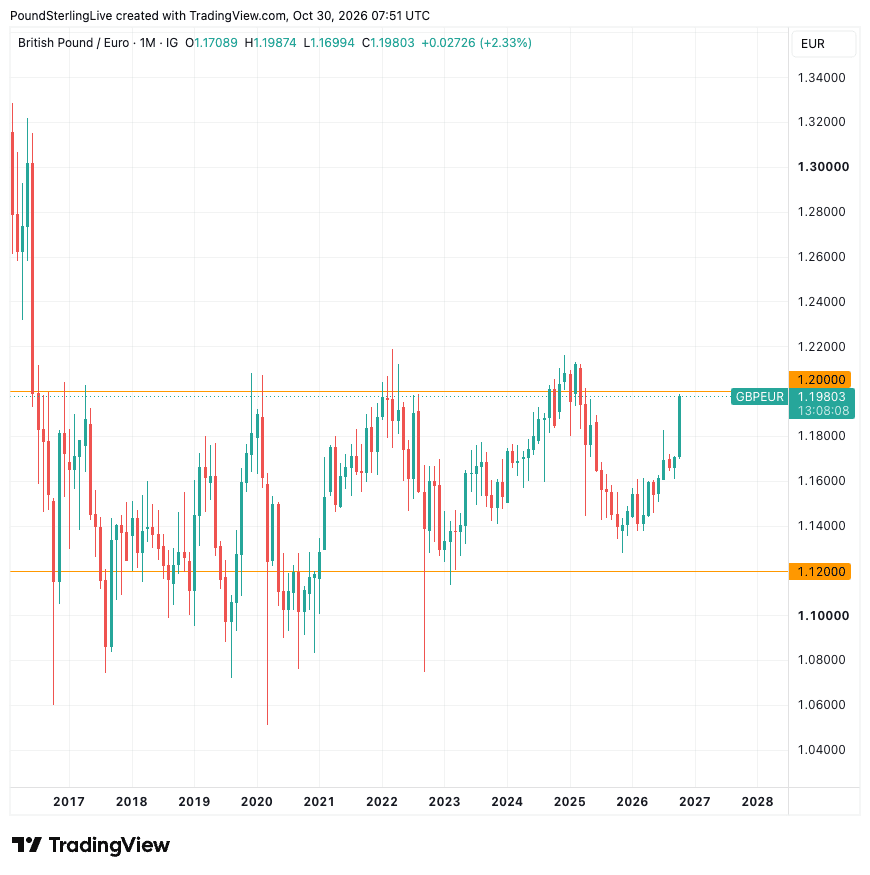
Above: GBP/EUR at monthly intervals. The post-Brexit range runs from 1.12 to 1.20, with 1.20 the ceiling that has held since 2016.
A monthly close above 1.20 would be the fifth time since the referendum, and the question for the coming months is whether pullbacks will be shallow enough to launch the pair into a series of higher monthly closes.
To be sure, Pound Sterling Live predicts a pullback in GBP/EUR in the short term, but is constructive medium term and thinks the pair is close to breaking into a higher post-Brexit plane.
Three Reasons Why A Break to A Higher Plane is Increasingly Likely
Momentum is the first.
October's advance has carried the pair more than three cents above the 1.1650 range ceiling of August and September, with the Relative Strength Index, a momentum gauge where readings above 70 mark an overbought market, holding above that threshold for three weeks and at 82 on the daily chart.
There is scope for the RSI to normalise below 70, but we have to accept the historically elevated RSI reading speaks of a significant 'momentum moment'.
French sovereign risk is the second.
The gap between French and German ten-year borrowing costs, the favoured measure of French stress, sits near 175 basis points and is approaching the 2011 high of 190, with the French budget vote on 17 November the next test.
"Idiosyncratic risks surrounding the euro are unlikely to fade anytime soon, and the Bank of England has sent a clear enough signal that it is prepared to hike," says ING in a recent update that cut its EUR/GBP forecast to a 0.84 to 0.85 range, equivalent to 1.1765 to 1.1905 in GBP/EUR, a range spot has already left behind.
J.P. Morgan's London FX trading desk marks 0.8333 in EUR/GBP, equivalent to 1.20 in GBP/EUR, as the next support for the euro.
A diminishing UK risk premium is the third.
Analysts say the fiscal premium that has weighed on UK assets since the Truss era has steadily drained out, and the Budget's passage removes the event most capable of restoring it.
Crédit Agricole concedes the pound has outrun its expectations and says its forecasts are at risk of upside revision now the Budget and Bank of England have spoken.
OCBC says a Budget that preserves a meaningful fiscal buffer while maintaining a credible tightening path should keep the UK fiscal risk premium contained, which together with continued foreign demand for gilts would remain supportive for the pound.
Our house view adds Prime Minister Burnham's push to rejoin the single market to that list, which gives the rally legs beyond the Budget.
Tactical Pullback Likely, but Shallow
The daily chart shows pullback potential, and Pound Sterling Live strongly believes one will happen before the range breaks.
Spot sits 0.9% above its 21-day moving average at 1.1873, a gap our in-house modelling says closes through a pullback or consolidation.
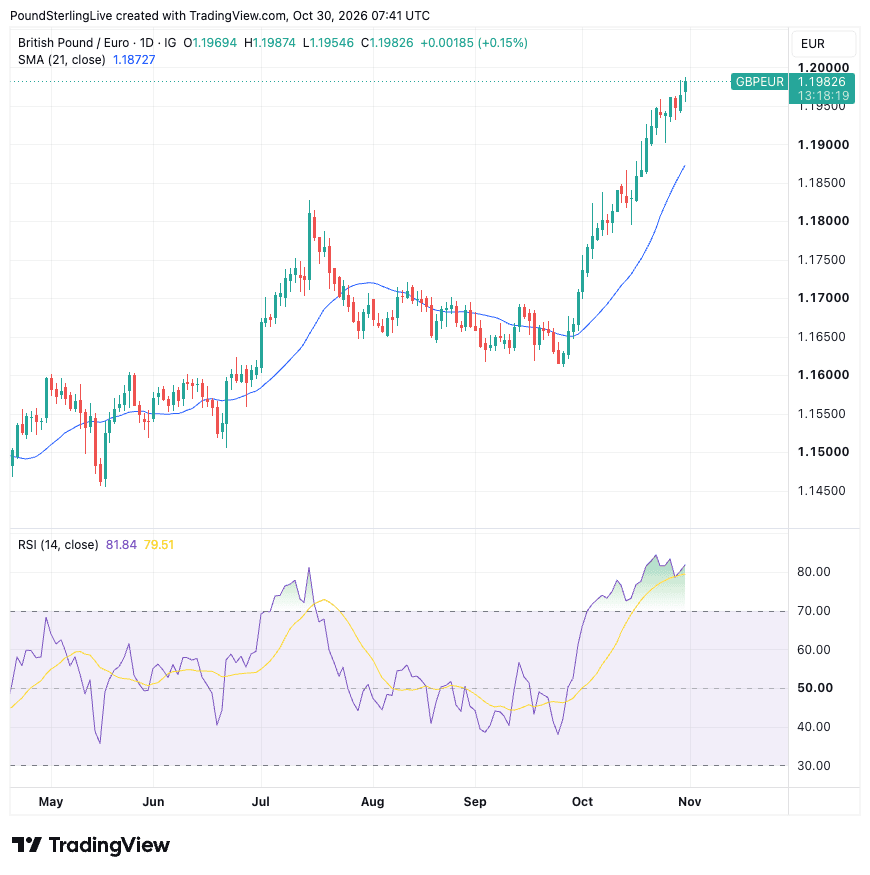
Above: GBP/EUR at daily intervals with the 21-day moving average and the RSI in the lower panel.
Bank of America, a long-time sterling bull, turned neutral last week with its 0.84 EUR/GBP target met, citing one-sided positioning and a run of data surprises unlikely to persist.
We think the dips will be shallow and consistent with the step change in activity, with the rising 21-day average the first area buyers return to and the mid-October consolidation zone at 1.1850 beneath it.
Next week's Bank of England decision on 5 November is the next catalyst, and a hike that keeps a series of increases in play would put a monthly close above 1.20 in reach, while a hike framed as a one-off would supply the pullback.