

Image © Adobe Images
The Australian dollar is under pressure after the Reserve Bank of Australia raised interest rates and signalled it is ready to pause, prompting investment bank analysts to call the peak in the cycle.
The Australian dollar falls against the pound and US dollar on Tuesday after the Reserve Bank of Australia (RBA) raised its cash rate to 4.85% and dropped language committing it to further hikes.
The 25 basis point increase was the RBA's fifth this year and was widely expected after third-quarter inflation data overshot the central bank's forecasts, leaving the Australian dollar to trade on the RBA's guidance for the months ahead.
The Australian to US dollar exchange rate fell about 0.3% to near 0.6980 after the decision, while the Pound to Australian Dollar exchange rate rose to 1.9220 before settling at 1.9208.
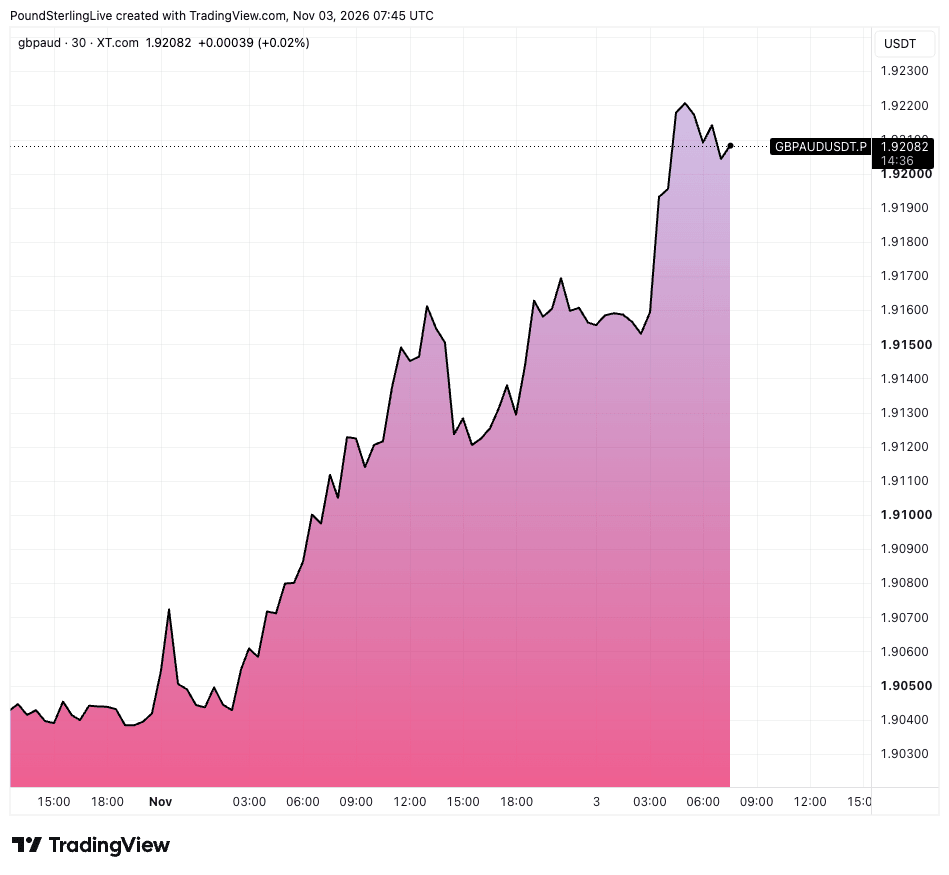
GBP/AUD, 30-minute chart.
The RBA's post-meeting statement removed the phrase "including increasing the cash rate target further if needed" from the Board's commitment to bring inflation sustainably back to target.
Governor Michele Bullock told the post-meeting press conference that after five hikes this is probably a good time to "take stock."
The Board voted six to three for the hike, with the dissenting minority putting more weight on downside risks and seeing less evidence of wages growth picking up than staff forecasts implied, Bullock explained.
Commerzbank reads the split vote as a sign of growing caution on the Board, "the hurdle for another rate hike is therefore likely to be quite high, and we do not expect any further increase in interest rates. In the near term, the Aussie could remain under pressure following the relatively dovish rate hike," says Norman Liebke, FX and Commodity Analyst at Commerzbank.
The RBA cut its growth forecast for end-2027 to 1.3% from 1.6%, sees unemployment reaching 5.1% by end-2028 and raised its fourth-quarter Brent crude assumption to almost $110 a barrel from just over $81, an external price pressure Liebke says higher interest rates can do little to alleviate.
Westpac takes the Governor's comments and the dissents as confirmation of a December hold, "while risks are still skewed up, we stick with our existing base case that this is likely the peak of the cycle," says Luci Ellis, Chief Economist at Westpac.
"In our view we are at, or close to, the cash rate peak and we are not forecasting another increase," says a review note from ANZ.
Commonwealth Bank of Australia's economists expect this to be the last hike of the cycle, though they see the risks skewed to further tightening next year.
Société Générale judged the changes to the statement and press conference "net more dovish than the market expected," with strategist Stephen Spratt saying: "RBA thinks and hopes they are done; we tend to agree."
The Australian dollar loses support from a dovish hike because currencies trade on where interest rates are expected to go, and an RBA signalling an end to its cycle removes the prospect of further gains in the returns offered on Australian dollar deposits and bonds.
Investors had already priced Tuesday's move, leaving the RBA's guidance to set the direction, and Commerzbank notes that "even after today's rate hike, financial markets are not pricing in any further increase."
The Australian dollar has been one of 2026's stronger performers on the back of that cycle, rising from 0.6670 against the US dollar at the start of the year to a peak near 0.7258 in May, before settling around 0.70.
Tuesday's increase was the RBA's fifth this year, taking the cash rate to its highest level since late 2008 and completing 125 basis points of tightening, a marked turnaround from an August outlook in which Westpac notes further hikes looked unlikely.
The Australian dollar was the standout performer among major currencies in October, according to Commonwealth Bank of Australia, as hawkish comments from three RBA officials and a strong third-quarter inflation print cemented expectations for Tuesday's move.
With that hike now delivered, Corpay's Dragicevich argues that the positive repricing of RBA expectations that supported the Australian dollar earlier in 2026 is spent.
Corpay Sees the Australian Dollar Weakening Against the Pound
Corpay expects the Australian dollar to weaken against the pound, euro, New Zealand dollar and yen over the coming months, "we believe it might be a far more reluctant rate hiker from here," says Peter Dragicevich, strategist at Corpay.
"Perceptions the RBA may be closer to the end than the beginning of its rate hiking phase may generate more short-run headwinds," he adds.
Dragicevich expects the Australian to US dollar exchange rate to hold a range of roughly 0.69 to 0.71 over the next three months.
Commonwealth Bank of Australia has cut its forecast for Australian growth to 1.0% by mid-2027 from 1.8%, and raised its forecast for peak unemployment to 5.1% from 4.8%.
Oil and Wages Must Revive Inflation Fears for the RBA to Hike Again
Michael Tang, a rates strategist at Commonwealth Bank of Australia, suspects markets are reading too much into the split vote, "we wonder whether there is some overweighting of the 3 dissents, particularly given the staff view is still quite alert to upside risks to inflation even against a slowing economy," he says.
The Australian interest rate curve inverted after the decision, with money markets pricing rate cuts from August 2027.
"We suggest oil should be a key watchpoint, as well as how wages respond as the labour market softens as a glimpse into whether inflation expectations fears are materialising," says Tang.
Corpay sees "still some chance another rate rise could be needed" over the next six months, while Westpac sees February as the most likely date for a further hike, should one come.
Commerzbank expects the Australian dollar's longer-term path to depend on interest rate expectations in the US and euro area, "current market expectations for further monetary tightening are likely overdone, which could ultimately benefit the Aussie," says Liebke.
US midterm elections today give the Australian to US dollar rate a further driver, with Commonwealth Bank of Australia warning that "a big electoral defeat could be the trigger for President Trump to restart a bombing campaign in Iran. History shows the Iranian military will strike back and the oil price and the USD will lift."
GBP/AUD Extends Gains Into Thursday's Bank of England Decision
GBP/AUD has risen from around 1.9040 on Friday, extending the near-term gains Pound Sterling Live anticipated in its week-ahead forecast.
The Bank of England announces its interest rate decision on Thursday, shifting the pound-to-Australian dollar exchange rate's focus to the sterling side of the pair.
A break above the post-RBA high at 1.9220 would extend GBP/AUD's advance into Thursday's Bank of England decision.