

Image © Adobe Images
The euro's bounce against the dollar can extend short-term, but medium-term headwinds will limit gains as France's worsening public finances will remain a concern.
The euro's rally against the dollar has room to run in the short term as the Democrats sweep both chambers of Congress meets supportive market positioning dynamics, although investment bank analysts expect France's worsening public finances to cap gains over the medium term.
The dollar fell overnight on concern that a Democrat Congress will slow the AI investment boom behind US growth. Analysts at Danske Bank say the selloff was driven "less by a higher political risk premium and more by renewed concerns around the AI and data centre investment buildout".
The Euro to Dollar exchange rate rose to 1.1265 and trades at 1.1246, putting it back above its 21-day moving average at 1.1195:
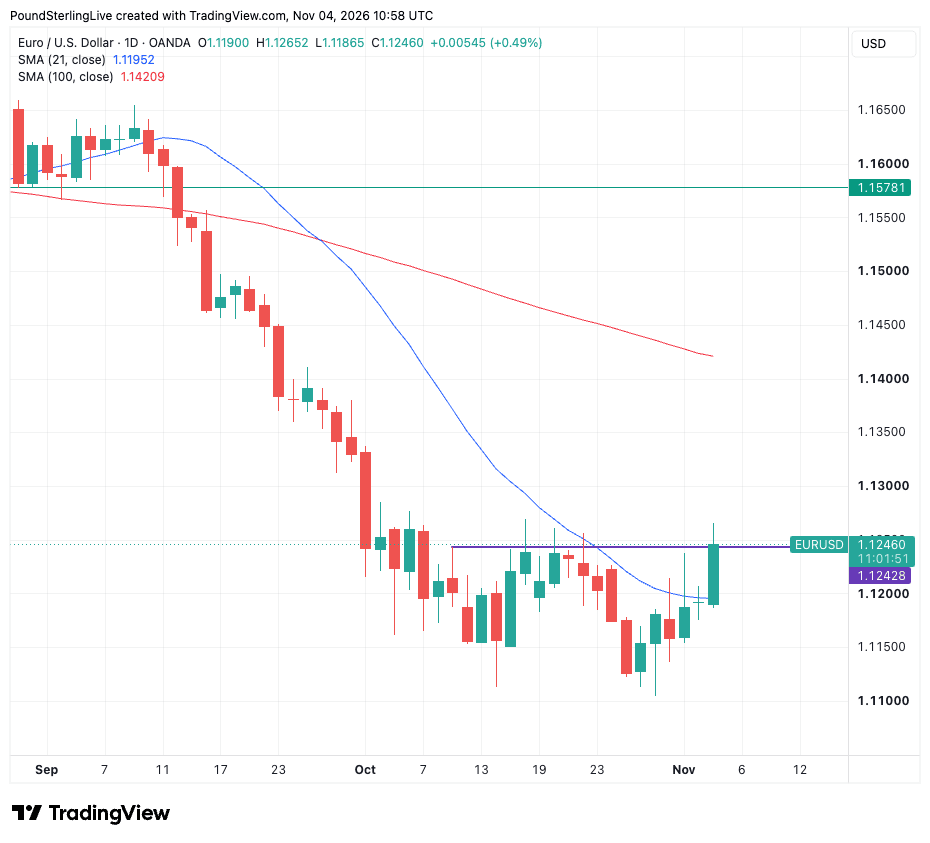
Above: EUR/USD at daily intervals with the 21-day and 100-day moving averages, and graphical resistance at 1.1241.
The pound is holding near the top of its post-Brexit range against the euro, with the Pound to Euro rate at 1.1984 and the 1.2016 high of 30 October within reach ahead of Thursday's Bank of England decision.
The euro has made no headway against sterling, a sign that its gains against the dollar rest on dollar weakness.
Analysts covering the election results say it it is too soon to write off the dollar rally, with little empirical evidence existing to suggest a gridlocked U.S. political system is bad for U.S. assets.
"In our view, the equity market and USD losses will be short-lived. Despite controlling Congress, Democrats would still need President Trump to sign legislation into law. Trump can veto legislation, while overriding a presidential veto requires a two-thirds majority in both chambers," says a response note from Commonwealth Bank.
The dollar still retains the backing of a strong US economy and a Federal Reserve ready to tighten further, "the dollar looks likely to be traded through the macro/monetary lens, which remains supportive," says Chris Turner, Global Head of Markets at ING.
U.S. job openings rose to 7.523 million in September, against a consensus of 7.100 million, in figures released on Tuesday. ING's Turner says US labour data has "come in on the strong side so far this week".
The euro is among the currencies enjoying "relief rallies" against the dollar that "could soften slightly as investors rebalance," says Karl Schamotta, Chief Market Strategist at Corpay.
Record Euro Shorts Offer Tactical Support Short-term
The midterm results could trigger a rebalancing in the market, allowing the euro to extend a technical bounce; after all, CFTC data show speculators' net short positions in the euro at their highest since 2016.
Speculators who have sold the euro must buy it back to close their positions, so a dollar selloff that moves against them can trigger a burst of buying that lifts the euro quickly, a short-term force that fades once those positions are cleared.
The euro is exposed to that squeeze after a decade-high build-up of bets against it, "we're wary of further momentum-driven softness, but also alert to the risk of a short squeeze that drives the common currency higher," says Corpay's Schamotta.
EUR/USD also has the calendar on its side this month, "CFTC short covering and seasonals (avg monthly gain 0.4%) are possible tailwinds in November," says Societe Generale, the French investment bank, in a recent update.
The euro also has domestic support from October's purchasing manager surveys, which show "the best Eurozone manufacturing spell in four years," according to Geoff Yu, Senior EMEA Macro Strategist at BNY. Yu says resilient data and an alert ECB "should put a floor under EUR for now".
CIBC sees room for the selling to run further once any squeeze has passed, noting that net shorts "remain well below 2015 extremes", which in its view "underline the scope for an extension, maintaining an immediate bias to fade EUR rallies".
But, French Public Finances Point to Ongoing Stresses
Looking ahead, the euro is set to remain weighed by France's deteriorating public finances, which prompted Fitch Ratings on Friday to cut the outlook on the country's A+ rating to negative from stable, citing weaker growth, higher borrowing costs and a wider budget deficit.
France's economy contracted by 0.1% in the third quarter, a further strain on a government that is struggling to narrow its deficit.
Fitch acted "outside the usual rating calendar, so it was a surprise and we expect OATs will come under pressure," says Danske Bank, referring to French government bonds.
Fitch took a harder line than Moody's, which held France's rating in October, "unlike Moodys the ratings agency did not give politicians the benefit of the doubt," says CIBC, the Canadian investment bank.
France is in focus because weak growth, a large primary deficit and political gridlock make a credible fiscal consolidation difficult, according to Rabobank.
EUR/USD faces sellers in the 1.1200 to 1.1250 area after the Fitch decision, "we would think that the news limits the potential for EUR/USD to rebound on softer energy prices," says ING in a recent update.
The euro drew no lift from eurozone inflation data released on Wednesday. Headline inflation rose to 4.0%, the highest in three years, and core inflation held steady at 2.5%, so the upside surprise in core that ING said "should be euro bullish" did not come.
The euro can meanwhile expect limited support from the European Central Bank, "muted underlying inflationary pressure, at the same time, confirms our view that the December hike could also be the last one," says Carsten Brzeski, Global Head of Macro at ING.
EUR/USD is expected to hold around 1.12 over the coming month before dipping to 1.10 in three months, according to Rabobank, which sees pressure building on the euro ahead of the French presidential election.
The pound stands to benefit from the same French strain, with CIBC continuing to like EUR/GBP downside "amid good carry, a resolution of UK budget uncertainty, and continued France fiscal risks". That view favours further gains in GBP/EUR from 1.1984.