

Image © Adobe Images
The euro's losses against the dollar should stay limited into year-end if the European Central Bank pairs a December rate hike with a message that it will not soften policy in response to French fiscal stress.
The euro's downside against the dollar should be limited into year-end as the European Central Bank looks set to raise interest rates in December and hold a hawkish line on inflation.
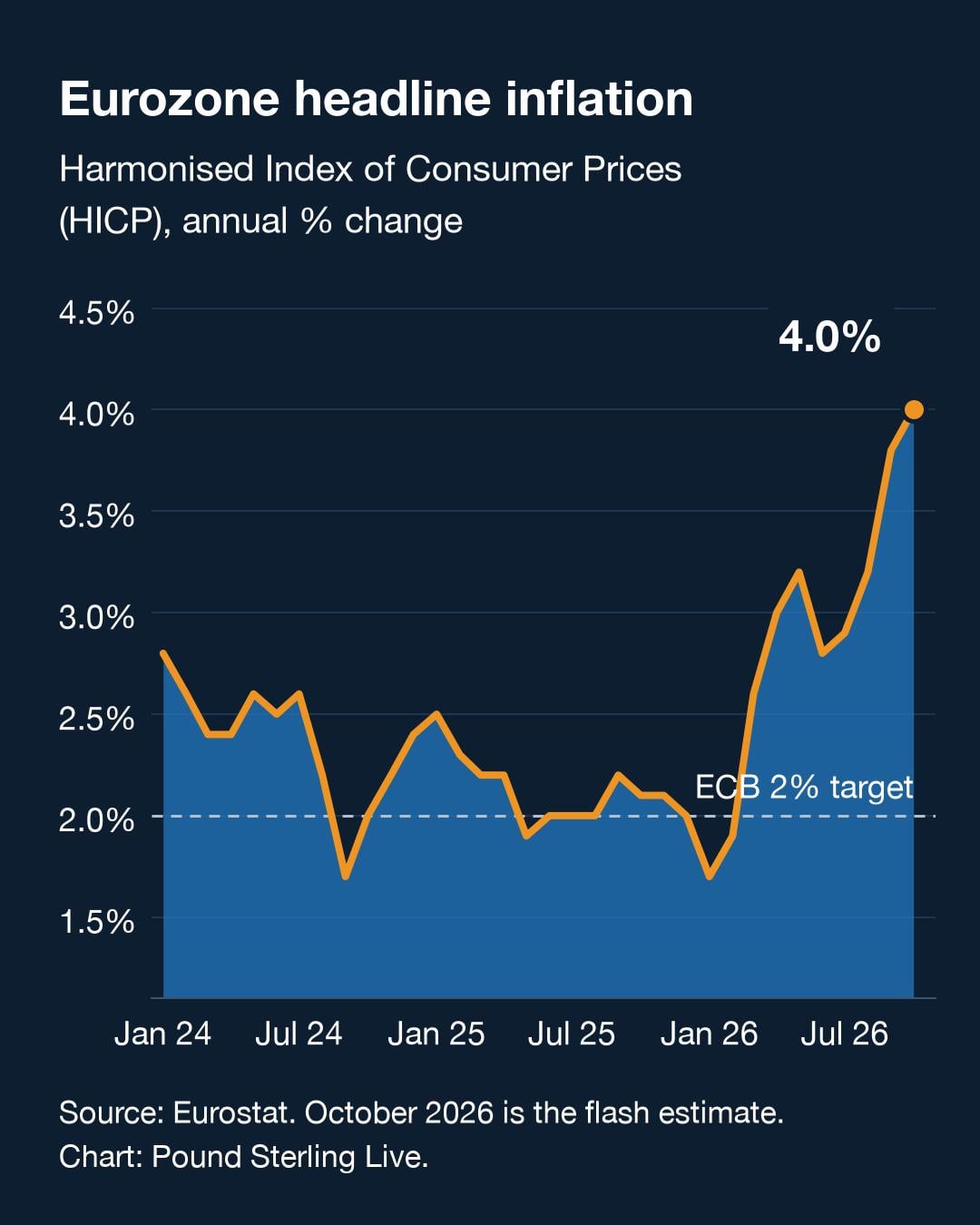
Eurozone inflation rose to 4.0% in October from 3.8% in September, the highest in three years, according to flash figures released by Eurostat on Wednesday.
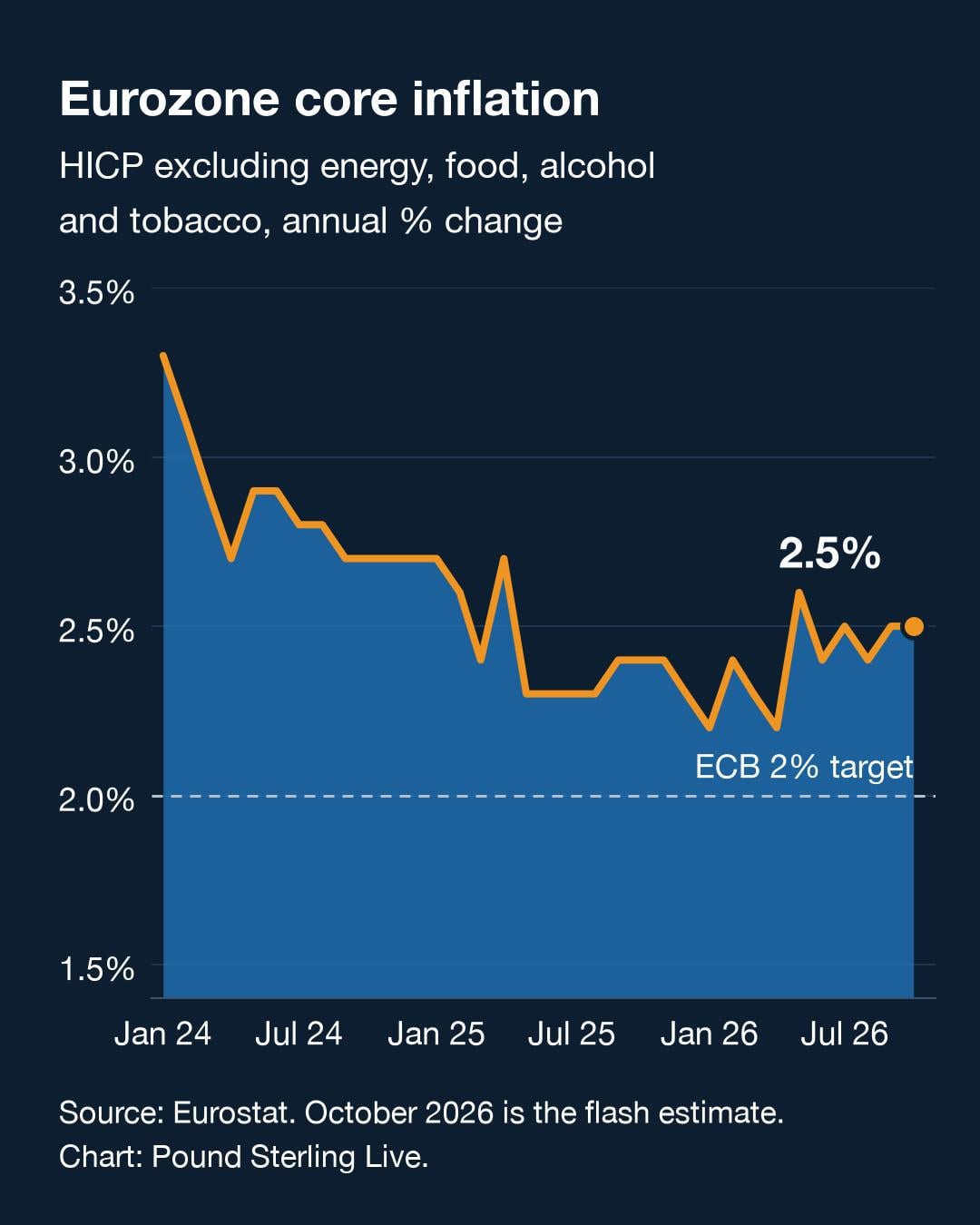
Core inflation, which excludes energy, food, alcohol and tobacco, held at 2.5%, but food inflation rose to 1.6% from 1.3% and services inflation to 3.3% from 3.2%.
Lloyds Bank expects food prices to gain momentum in the coming months on rising input costs, "it would not be an entire surprise to see the core measure rounded up to 2.6% once the final calculations are in," says a note from Lloyds Bank.
Services inflation is the measure the ECB's Governing Council is "most focused on when trying to calculate second round risks," Lloyds adds.
Money markets price a roughly 90% chance of a quarter-point ECB hike at the 17 December meeting.
Investment bank analysts agree with the market pricing, "...inflation numbers have brought the central bank one step closer to a December rate hike," says Carsten Brzeski, Global Head of Macro at ING.
ECB President Christine Lagarde said at the October press conference that a rate hike was discussed by the Governing Council.
The euro will take its lead from the ECB's guidance on further hikes, as December's move is already in the price.
The ECB needs to hold a hawkish stance to keep the market's confidence.
A cautious ECB would show it is willing to lean against inflation as a priority, and is not here to relieve the pressure on French government bonds.
"The two main drivers behind the weaker EUR have been the worsening energy price shock and intensifying concerns over fiscal and political risks in France," says MUFG, the Japanese investment bank, in a recent update.
MUFG says the euro would weaken further if the ECB signals that higher bond yields reduce the need for more rate hikes, or that market intervention may be required.
The euro is meanwhile extending a recovery against the dollar that began after the Democrats swept both chambers of Congress in Tuesday's midterm elections: the euro-to-dollar exchange rate trades at 1.1244, back above its 21-day moving average at 1.1196.
The pound-to-euro exchange rate is 0.13% lower at 1.1982 ahead of the Bank of England's interest rate decision later today.
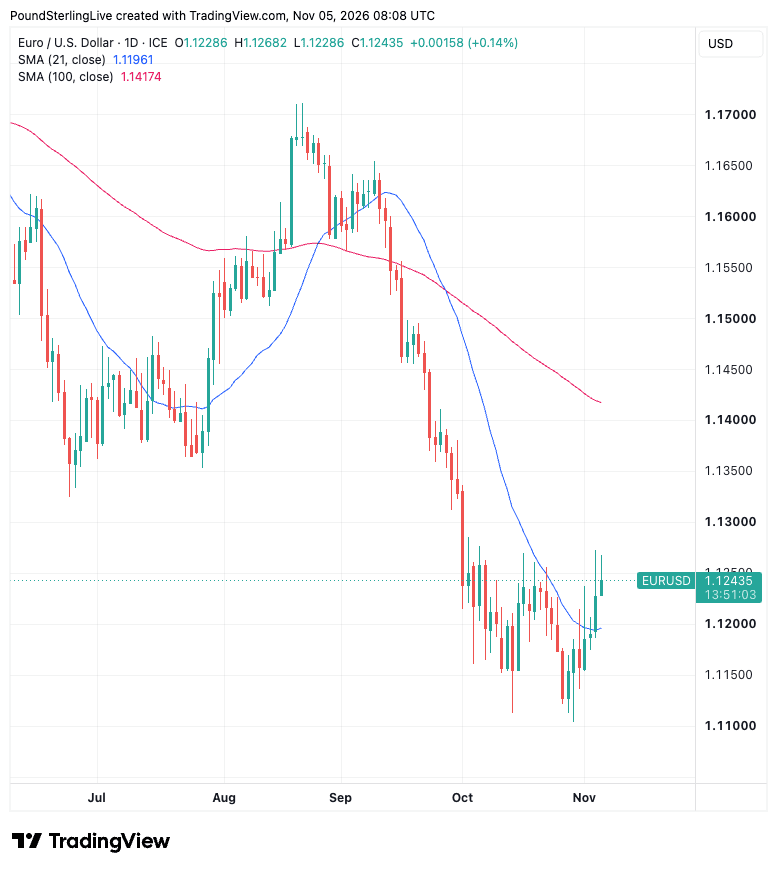
Above: EUR/USD at daily intervals with the 21-day and 100-day moving averages.
"On balance, we see political developments overnight as supportive of a continued bottoming out in EUR/USD," says Deutsche Bank in a note on Wednesday.
Commonwealth Bank of Australia expects attention to return to US fundamentals ahead of Friday's payrolls report, "we expect solid data to support the USD," says CBA.
Analysts Expect the ECB to Withhold Support From France
France's National Assembly this week rejected the revenue side of the 2027 budget, adding to the strain on the country's public finances.
The gap between French and German ten-year borrowing costs, the favoured measure of French stress, stands above 155 basis points, against around 70 at the end of 2025.
Berenberg, the German private bank, sees ECB support for France as conditional on Paris adopting more sustainable policies, "the ECB has no mandate and no appetite to fund French fiscal follies," it says in a recent update.
Commerzbank says only a disorderly spike in French bond yields would stop the ECB raising rates in December.
Pound Sterling Live holds that any ECB support mechanism for French government bonds would be a headwind for the euro.
An ECB rescue would signal that the central bank ranks French borrowing costs above its inflation mandate.
Analysts Split on Whether December Is the ECB's Last Hike
Money markets price around 60 basis points of ECB tightening by September 2027, down from 70 a week earlier.
For the euro to hold its ground, the ECB must validate that pricing with guidance for more hikes beyond December.
UOB expects a December hike followed by an extended period of steady rates, "the ECB continues to benefit from substantial tightening in financial conditions through higher bond yields and wider sovereign spreads, particularly in France," says UOB, the Singapore-based bank.
"The more the economy slows, the stronger is likely to be the evidence of inflation persistence required by the Governing Council to justify continued tightening," says Christopher Graham, Chief Economist for Europe and UK at Standard Chartered.
Lloyds Bank says the October data are not concerning enough to call for more aggressive ECB action.
However, Crédit Agricole expects a second ECB hike in March and sees headline inflation "probably not far from 4.5% YoY in Q1 2027 and core around 3% on average next year."
Danske Bank flags upside risk to its own call for one more hike, with the euro area's winter gas bill set to rise by around €140bn on current futures pricing.
KBC says core inflation's "brisk monthly 0.3% pace is something to keep a close eye on."
Pound Sterling Live Expects EUR/USD Downside to Stay Contained
Investment bank three-month forecasts for EUR/USD run from 1.10 at Nordea and OCBC, around 2.2% below spot, to 1.14 at Goldman Sachs and Standard Chartered, around 1.4% above.
A firmer ECB would also slow the pound's advance against the euro, with GBP/EUR unable to hold above 1.20 since its 1.2016 high on 30 October.
EUR/USD faces its first meaningful resistance at 1.13, according to KBC.
Should the ECB pair its December hike with guidance for further tightening, EUR/USD would be expected to hold above the 2026 low of 1.1105 into year-end.