Image © Adobe Stock
The Canadian dollar no longer trades as a bet on oil prices, which leaves it exposed to the US yield gap in the near term, although it should strengthen if Canada's investment and trade reforms deliver a more competitive economy.
The Canadian dollar has shed its old status as a proxy for oil prices and global risk appetite, says Corpay, the payments and currency risk firm.
"After years of being derided as the "petroloonie", it doesn't respond to changes in the price of oil in the way it once did, and shifts in interest rate differentials move it only modestly," says Karl Schamotta, Chief Market Strategist at Corpay.
Schamotta says the shale revolution loosened the link between the exchange rate and crude by damping the energy sector's capital spending cycles and turning the US into a net exporter of oil.
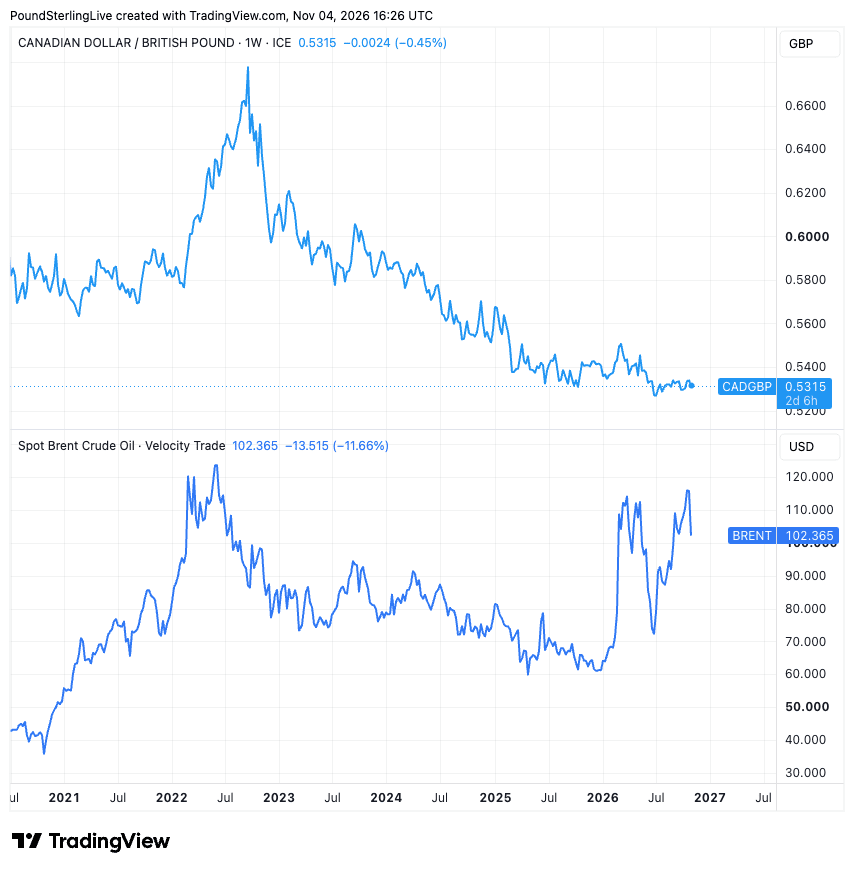
Above: CAD/GBP (top) and brent crude. Empirical evidence dispels any notion that oil benefits CAD in the current climate.
The loonie has held within a narrow range for most of the past decade despite a run of shocks that included the collapse of the shale boom and a trade war with Canada's largest trading partner, he adds.
Implied and realised volatility in the currency sit close to multi-decade lows, Corpay notes.
CIBC applies the same reading to the US-Canada trade talks, "we think that CAD is not as sensitive to a trade deal at this point, as there does not appear to be a material tariff premium in the currency, and instead trade is impacting CAD through rate spreads," says Noah Buffam at CIBC Capital Markets.
That reading matters for the loonie this week: President Donald Trump said on Sunday a trade deal with Canada is "very close" following talks with Prime Minister Mark Carney.
Carney said on Tuesday the US is "asking less" and "offering more", although 50% tariffs on Canadian steel and autos remain threatened from 1 January.
The short-term implications of the research findings are that developments in the Middle East following the midterm vote might have limited impact on CAD given the breakdown in the currency's correlation with oil.
However, several investment banks still count oil prices as supportive of the Canadian dollar.
"For FX, the read-through remains clearest for CAD and NOK, where higher energy prices provide a terms-of-trade tailwind," says Sim Moh Siong at OCBC in a recent update.
Commonwealth Bank of Australia finds the US dollar-to-Canadian dollar rate holds a strong negative short-term correlation with WTI crude, so a higher oil price tends to pull the pair lower.
Société Générale disputes the second half of Corpay's argument, "the two-year rate differential plotted against USD/CAD is a useful gauge of where the Canadian dollar may be heading," says Kit Juckes at Société Générale.
Juckes points to the IMF's October forecasts, which put Canadian growth at 1.1% in 2026 against 2.5% for the US.
He adds that a sustained Canadian dollar recovery depends on both that growth gap and the two-year rate differential narrowing.
Corpay Expects Loonie Weakness Into Year-End
The yield gap Société Générale watches is the reason Corpay's near-term view on the loonie is bearish, despite its structural case.
The Bank of Canada raised interest rates to 2.50% on 28 October, its first increase since July 2023, as Pound Sterling Live reported.
Money markets price 15 basis points of tightening for the Bank's 9 December meeting and 40 basis points by March 2027.
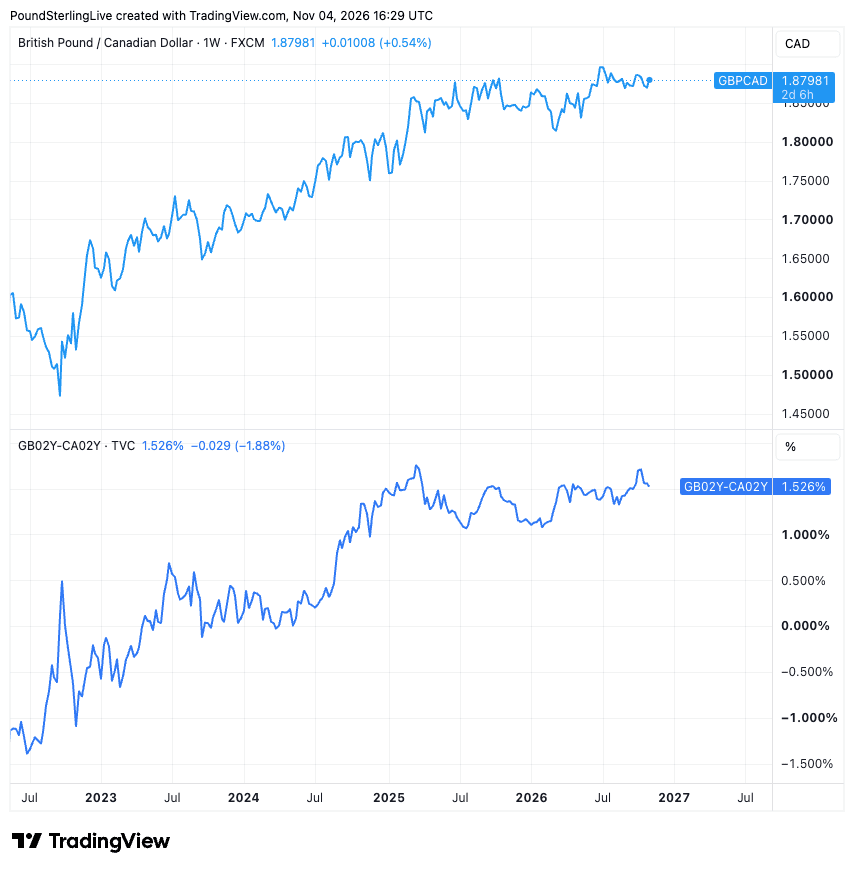
Above: GBP/CAD (top) and the difference between UK and Canadian two-year bond yields.
"Canada will struggle to narrow the yield gap with the US, given a larger household debt overhang, higher unemployment, weaker investment, and slower growth, and we think the three Bank of Canada rate hikes now priced in over the next year could be pared back before December," says Corpay's Schamotta.
BCA Research also says housing and labour market weakness argue against the hikes priced into the Canadian curve.
Friday's labour force survey is the next test of that pricing, with economists expecting 18,000 jobs and unemployment to hold at 6.5% after a 68,000 fall in September.
CIBC forecasts 35,000 jobs on temporary hiring for the Alberta referendum, "an upside surprise could see USD/CAD lower by 20-30 pips, although the temporary nature of the jobs should temper CAD outperformance," says CIBC's Buffam.
Investment Banks Expect CAD Recovery in 2027
The Canadian dollar is firmer on Wednesday as Democrats head for a sweep of both chambers of Congress: USD/CAD is down 0.32% at 1.3966, having touched a one-month low at 1.3930.
The pound-to-Canadian dollar exchange rate is at 1.8803, little changed on the day.
Corpay expects the loonie's relief rally to "soften slightly as investors rebalance."
The firm looks for USD/CAD to end the year closer to 1.41 than 1.38, about 1% above spot, with an options-derived trading band of 1.36 to 1.42.
CIBC expects the pair to trade between 1.3900 and 1.4050 into the December Federal Reserve and Bank of Canada meetings, with downside risks after them.
Further out, Corpay sees the loonie breaking through 1.35 by the end of 2027 as infrastructure spending, a pipeline buildout and trade diversification lift Canada's competitiveness.
OCBC targets USD/CAD at 1.35 in twelve months, MUFG at 1.36 and Standard Chartered at 1.37.
Société Générale says a move below 1.35 will likely require improved geopolitical conditions or stronger Canadian economic data.