
Image © Adobe Images
The New Zealand dollar can recover some ground as markets steady their bets on an RBNZ rate hike, although high inflation and a weakening economy leave the central bank in a bind that keeps the currency vulnerable.
The New Zealand dollar is recovering some of the ground it lost after Tuesday's jobs data as markets steady their bets on a December interest rate hike at the Reserve Bank of New Zealand (RBNZ).
Markets cut the odds of a December hike to around 50% from 80% after the data, although they have since rebuilt them to around 60%.
Pound Sterling Live thinks much of the market's response to the employment report is now in the price.
"We believe a lot of negatives already look to be factored in to the NZD given it is tracking ~4 cents below our 'fair value' estimate," says Peter Dragicevich at Corpay, the payments firm.
The New Zealand dollar has firmed accordingly: NZD/USD is 0.38% higher at 0.5643, and the pound-to-New Zealand dollar exchange rate is down 0.30% at 2.3888, a second day of losses after Wednesday's push above 2.40 took it to its highest since 2015.
GBP/NZD is easing out of overbought conditions, with the Relative Strength Index, a measure of momentum, turning lower after rising above 70 earlier this week.
This week's rally also took GBP/NZD unusually far above its 21-day moving average, which sits at 2.3650.
Pound Sterling Live's mean-reversion modelling holds that such a gap closes through a pullback or a consolidation. A pullback would find support at the 21-day average and at 2.3544, the level that capped the pair in July and October:
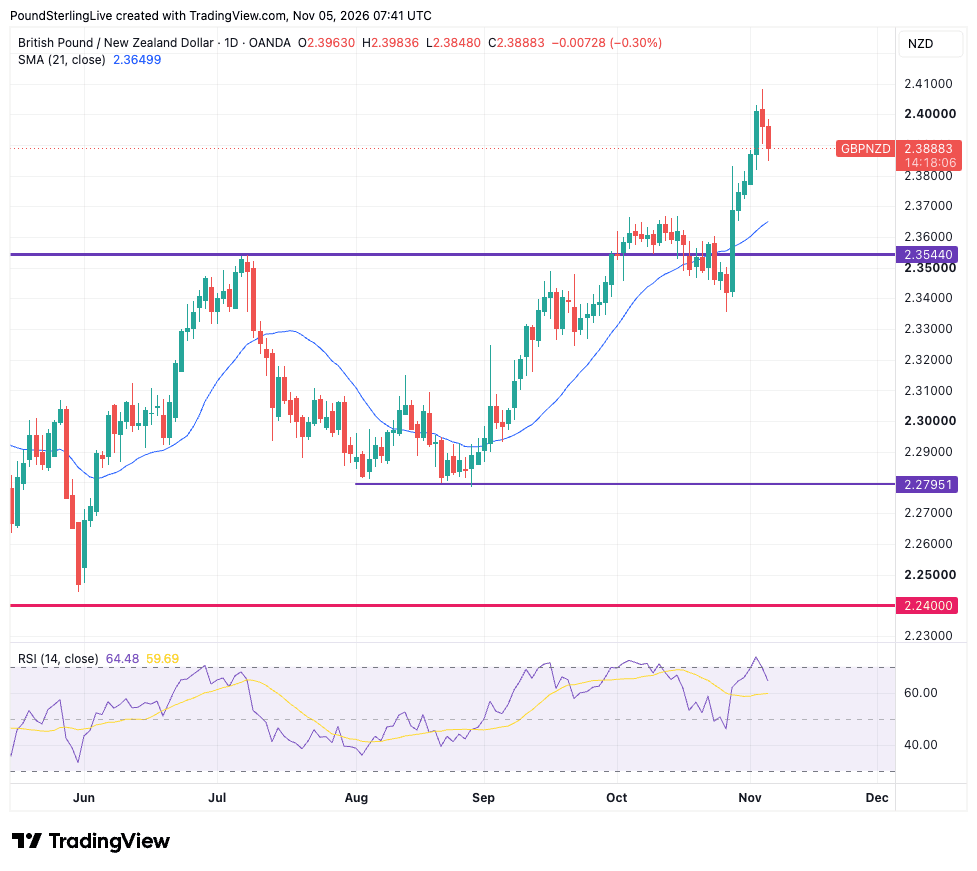
Above: GBP/NZD daily chart, with the RSI turning lower from overbought territory.
However, GBP/NZD remains in a medium-term uptrend as New Zealand's domestic economic cycle is yet to turn.
Unemployment rose to 5.7% in the third quarter, its highest since September 2015, against expectations of 5.5%, Stats NZ figures show.
Full-time employment fell 0.8% in the quarter and hours worked dropped 1.6%.
ASB, the New Zealand bank, says elevated Middle East energy costs may be weighing on activity, pointing to softness in third-quarter GDP.
New Zealand's inflation rate was 3.7% in the third quarter, above the RBNZ's 1-3% target band.
"More than 85% of the CPI basket recorded price increases over the past year, while only about 13% of items posted price declines, indicating that inflation pressures remain broad-based," says UOB, the Singapore-headquartered bank, in a recent update.
The RBNZ faces uncomfortably high inflation and subdued growth.
Pound Sterling Live is bearish on the New Zealand dollar over the medium term as a result.
Westpac, the Australian-headquartered bank, judges the jobs figures weaker than the RBNZ expected, "this data supports the views of those on the policy committee who were less convinced in October about the potential for second-round inflation pressures in the economy," says Westpac.
Barclays judges market pricing for further RBNZ tightening to be too aggressive, "we expect the NZD to continue to underperform versus the AUD," says Barclays in a recent update.
GBP/NZD would outperform GBP/AUD in that scenario.
ANZ still forecasts 25 basis point hikes at each of the next three RBNZ meetings.
ASB pencils in a 3.5% peak in the Official Cash Rate by March 2027, although it says "the environment is fickle and the OCR forward path is highly uncertain."
The New Zealand dollar faces a further near-term risk in Saturday's general election, although Credit Agricole says "NZD movements post-elections have been mostly tame."
Bank of England Could Add Fuel to Near-term Pullback
Turning to the pound, markets expect the Bank of England to raise Bank Rate by 25 basis points to 4.0% at midday, however, the most important market driver will be the tone of future guidance.
The pound would lose part of its rate support should the Bank push back on the further hikes markets price beyond today, "we continue to disagree with current market pricing that the BoE needs to deliver a series of hikes," says Carol Kong at Commonwealth Bank of Australia.
Pound Sterling Live looks for the Bank to trigger a near-term setback in GBP but continues to hold a constructive medium-term view on the currency's prospects as the UK economy outperforms expectations.
Any setback in GBP/NZD should hold above the 21-day moving average at 2.3650, provided the Bank of England leaves expectations for further UK rate hikes intact.