Image © Adobe Stock
The Bank of England can use falling oil prices to argue against the further rate hikes markets expect, as the same oil move lowers rate expectations at the Federal Reserve and the European Central Bank.
The Bank of England is expected to raise interest rates to 4.00% on Thursday, although a two-day slump in oil prices gives Governor Andrew Bailey grounds to push back against the further hikes markets expect.
"Cheaper oil gives Governor Bailey the opportunity to lean against market pricing of two additional hikes next year," says Kenneth Broux at Société Générale.
Brent crude fell around 8% on Wednesday as the Democrats' sweep of the US midterm elections raised hopes of a quicker end to the war with Iran.
Analysts say the Bank is raising rates to guard against high energy prices spreading into wages and prices.
"Any positive news on Iran would quickly dial back tightening bets," says Matthew Ryan, Head of Market Strategy at Ebury.
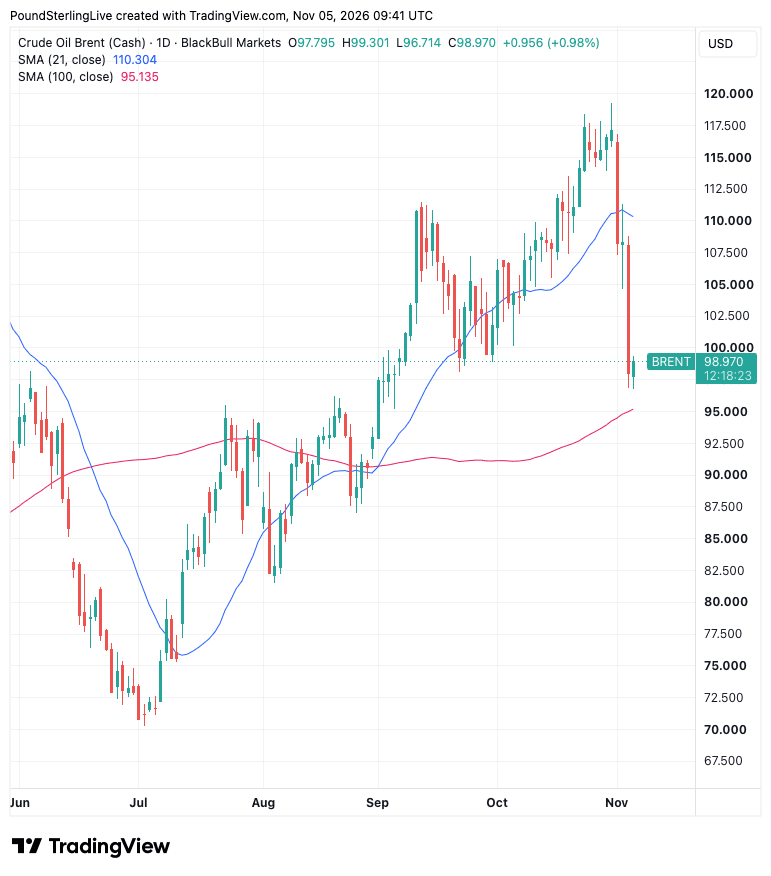
Above: Brent crude has fallen back below its 21-day moving average and towards its 100-day average.
Money markets price close to 100 basis points of further Bank of England tightening through late 2027, as Pound Sterling Live has reported.
"We see today's hike as an insurance move rather than the start of a new tightening cycle," says a note from SEB, the Swedish bank, which considers market pricing of around four further hikes "excessive".
"If energy prices recede, we think that the BoE will hike just once," says a note from Berenberg, the German investment bank.
Société Générale notes the cut-off for the Bank's updated growth and inflation forecasts was October, before the fall in oil.
ING expects a split decision, "we expect a 7-2 vote for a hike, and don't see the BoE committing to further tightening at this stage," says Francesco Pesole, FX Strategist at ING.
"The BoE is starting from a far more restrictive position than either the ECB or Fed, and the labour market is struggling to maintain jobs even if productivity is improving and GDP remains resilient," says Neil Wilson, UK Investor Strategist at Saxo.
However, Pantheon Macroeconomics backs a longer cycle, "we expect inflation to peak at 5.0% in February and the MPC to hike three times by next April," says the research consultancy.
The Bank is not alone in facing a repricing, because falling oil prices are lowering rate expectations at other central banks too.
Falling oil "could see central banks hold off on more hikes," adds Saxo's Wilson.
Two-year swap rates, a market gauge of expected central bank policy, fell by around 8-10 basis points in sterling and the euro on Wednesday as crude dropped 8%, against 5 basis points in the US dollar.
Money markets also cut the amount of Federal Reserve tightening priced by June 2027 to 55 basis points.
The European Central Bank is still expected to hike in December after eurozone inflation rose to 4.0% in October, although core inflation held at 2.5%.
Further Bank of England hikes depend on energy costs feeding into wages and prices, a risk the fall in oil now reduces.