Inflation is rising to 5% says the Bank. It could hardly have sat on its hands on the day it delivers such news.
Image © Adobe Images
British pound's weakness against euro to be shallow, but against the dollar, the tech selloff matters more.
The pound gave back the gains it made on the Bank of England's rate hike as investors judged the Bank's hawkish message was already in the price, although the prospect of further hikes keeps its losses against the euro limited.
"Despite this rather hawkish decision, the pound only benefited briefly and had to give up its gains as the day progressed," says Michael Pfister, FX Analyst at Commerzbank.
The Bank of England raised Bank Rate to 4.0% on Thursday by an 8-1 vote, with the sole dissenter, Catherine Mann, voting for a larger 50 basis point hike.
The pound fell despite the hawkish vote because markets had already priced much of the Bank's message, "expectations ahead of the meeting were quite ambitious, with almost three further rate rises priced in by the middle of next year," adds Pfister.
"Without news which softens the risks to inflationary pressures, I can see the argument for a further increase in rates and thereafter taking a more conditional approach, dependent on the evidence on energy prices and inflation dynamics," says Governor Andrew Bailey.
The pound's fall matches the sell-the-fact move Pound Sterling Live flagged in its preview of the Bank of England decision, although the Bank's message proved more hawkish than the 'dovish hike' the preview anticipated.
Sterling has given back the move against both currencies: the pound-to-euro exchange rate rose from 1.1988 to 1.2010 in the minutes after Thursday's noon announcement and trades at 1.1991 on Friday.
The pound-to-dollar exchange rate reached 1.3501 on Thursday and is down 0.30% at 1.3410 on Friday.
The Bank's Readiness to Hike Again Keeps GBP/EUR Supported
The pound's downside against the euro is limited by the Bank of England's signal of further hikes, which keeps the UK's interest rate advantage over the Eurozone in place.
Markets price around a 50% chance of a second hike in December, up from around 30% before Thursday's decision.
Danske Bank and Commonwealth Bank of Australia now both expect two further hikes, in February and April, taking Bank Rate to 4.50%.
The European Central Bank is expected to hike in December, although Bank Rate at 4.0% sits well above the ECB's 2.50% deposit rate.
"The backing by the BoE serves as a strong GBP-floor going forward," says a note from KBC, the Belgian bank.
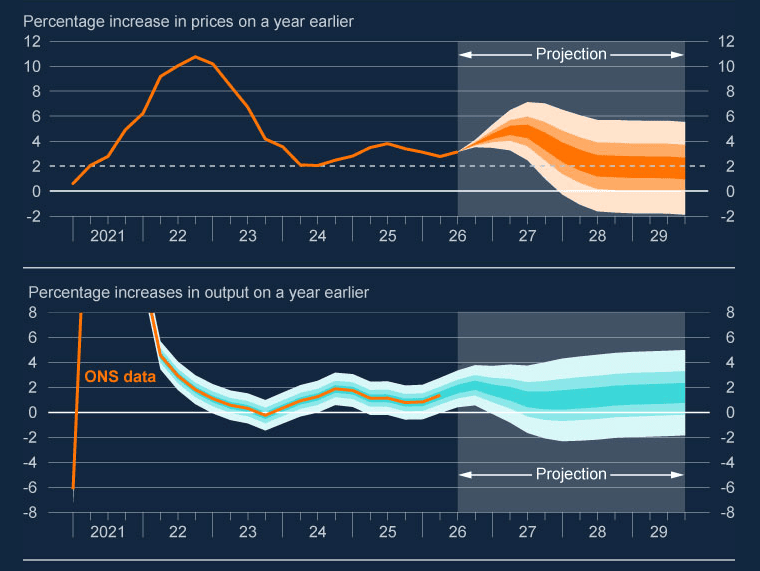
Above: Inflation is rising to 5% says the Bank. It could hardly have sat on its hands on the day it delivers such news.
The euro remains exposed to France's struggle to pass its 2027 budget, with Thursday's nationwide strike over wages and the cost of living adding to the pressure on the government.
The gap between French and German ten-year borrowing costs, the favoured measure of French stress, stood above 155 basis points on Wednesday, against around 70 basis points at the end of 2025.
"The contrast between the UK's fiscal discipline and the political & fiscal upheaval in France remains a key support for the GBP vs EUR," says Crédit Agricole, which does not expect market uncertainty over the French budget to abate before mid-December.
GBP/EUR Needs a Close Above 1.20 to Extend the Rally
The pound-to-euro rate has tested 1.20 repeatedly since late October without a daily close above it, a barrier Pound Sterling Live flagged ahead of the decision.
The pound risks a pullback against the euro after failing to clear that level, with GBP/EUR trading around 0.6% above its 21-day moving average at 1.1922.
Pound Sterling Live's modelling treats an unusually large gap between spot and the 21-day average as a deviation that must close through a pullback or a period of consolidation.
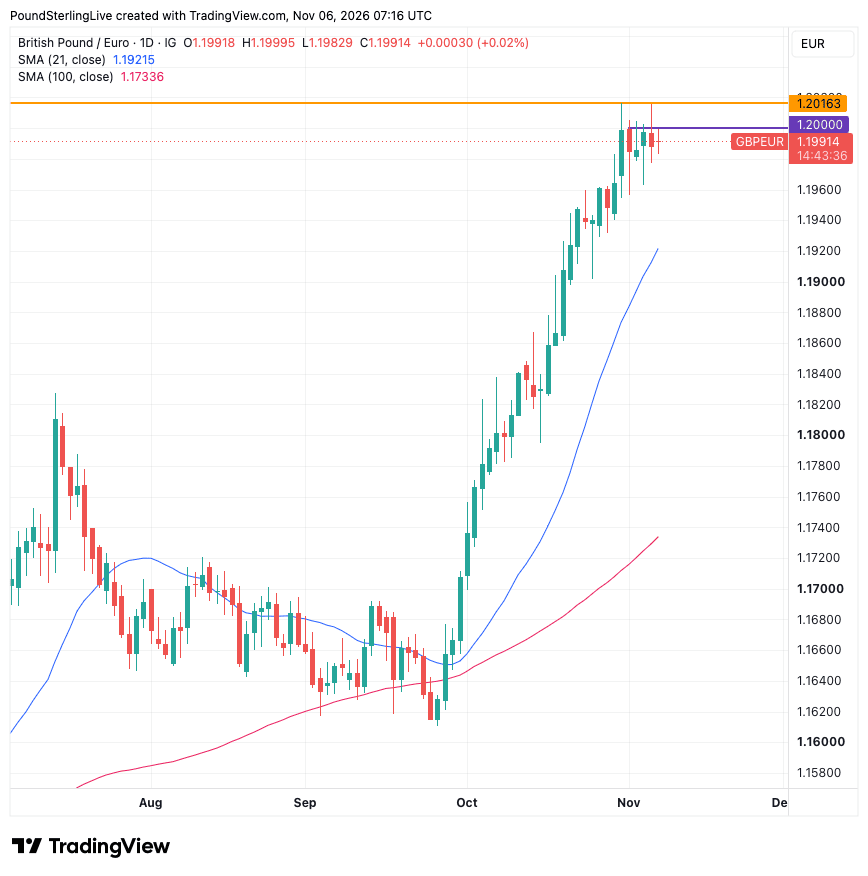
Above: GBP/EUR at daily intervals, showing repeated failure to close above 1.20 and the gap to the 21-day moving average.
Crédit Agricole's short-term measure of currency valuations, its FAST FX model, shows the euro is undervalued against the pound by more than 1.5 standard deviations, with fair value for EUR/GBP at 0.8469 (GBP/EUR 1.1808).
GBP/USD Needs Calmer Stock Markets to Recover
The pound's outlook against the dollar depends more on global stock markets than on the Bank of England, after a selloff in technology shares deepened on Thursday on fears that a Democrat-controlled Congress will rein in AI investment.
Should the selloff deepen, the pound is likely to weaken against the dollar as investors seek safer waters.
The Nasdaq 100 fell 6.4% on Thursday, its worst session since March 2020, and the Philadelphia Semiconductor Index fell 12.3%.
"The deepening sell-off in AI-related tech stocks could dampen upside for UK rates and the GBP," says MUFG, the Japanese investment bank.
The yen, the Swiss franc and the dollar all gained on Thursday as investors sought safety, says Danske Bank.
However, analysts at Crédit Agricole doubt the dollar can profit as a safe haven in this selloff, "the overreliance on foreign buying of tech stocks to fund the vast US current account deficit has made the USD a less attractive safe-haven currency during bouts of risk aversion centred on market AI fears," says Valentin Marinov, Head of G10 FX Strategy at Crédit Agricole.
The view here is that stock selloffs born in the U.S. will tend to weigh on the USD, but our question is simply, "aren't all selloffs born in America?!" History says acute selloffs tend to benefit the dollar.
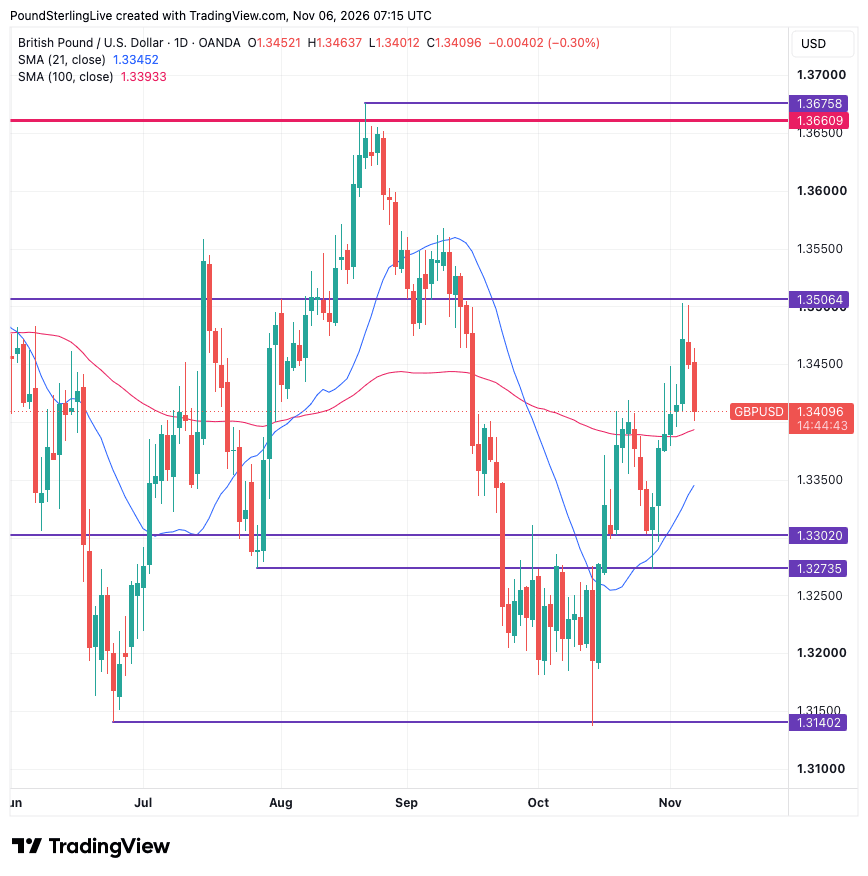
Above: GBP/USD at daily intervals, showing the rejection below 1.3506 and the test of the 100-day moving average.
CIBC sees dips towards the 200-day moving average at 1.3423 as an opportunity to buy, as it expects investors to keep reducing a "sizeable short skew" in sterling; investors closing bets against the pound must buy it back, which adds demand on any dip.
GBP/USD trades just below that level and above its 100-day average at 1.3393 ahead of Friday's US payrolls report, where the consensus looks for 65,000 jobs in October.
Pound Sterling Live Expects Any Setback Against the Euro to Be Shallow
Pound Sterling Live continues to hold a constructive medium-term view on the pound's prospects; the economy is outperforming, the Bank is prepared to tighten further and the euro is undermined by French fiscal stress.
Investment bank targets for GBP/EUR are split either side of spot:
KBC sees EUR/GBP falling towards the 2024 low at 0.8222 (GBP/EUR 1.2162), around 1.4% above spot.
CIBC looks for a break of 0.8316 (GBP/EUR 1.2025) that opens a move towards 0.8241 (GBP/EUR 1.2134).
ING expects EUR/GBP to stabilise around 0.84 (GBP/EUR 1.1905).
Crédit Agricole forecasts EUR/GBP at 0.86 by the end of the year (GBP/EUR 1.1628), around 3% below spot.
ING sees GBP/USD capped at 1.35 in the near term.
Crédit Agricole forecasts GBP/USD at 1.31 by the end of the year, around 2.3% below spot.
UOB's technical analysts expect GBP/USD to rise to 1.3530 over the coming weeks provided it holds strong support at 1.3410, the level at which it trades on Friday.
"It would thus take positive UK data surprises from here that could encourage rate investors to frontload their rate hike bets to give the GBP a boost in the near term," says David Forrester, Senior FX Strategist at Crédit Agricole.
Sterling needs a daily close above the 30 October high at 1.2016 against the euro to extend its rally, with UK GDP figures for September, due next week, the next test of the rate expectations that support it.