
Image © Adobe Images
The Canadian dollar is cheap on long-run valuation measures, and it should start to close that discount if a revival in Canadian investment and narrower US rate differentials take hold.
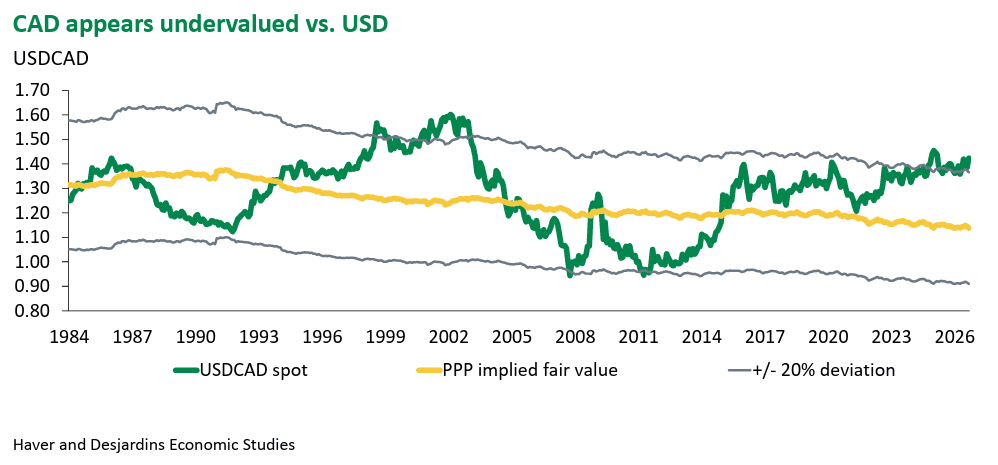
The Canadian dollar is deeply undervalued against the US dollar on long-run measures, says Desjardins, the Quebec-based financial cooperative.
"But cheap currencies can stay cheap for a long time. As any value investor will tell you, the multiple is usually low for a reason," say Jimmy Jean, Vice-President, Chief Economist and Strategist, and Mirza Shaheryar Baig, Foreign Exchange Strategist, at Desjardins.
Investors call that risk a value trap: an asset that looks cheap but stays cheap because the forces behind its discount persist.
Desjardins estimates the loonie is around 22% undervalued against the US dollar on purchasing power parity, a model that assumes exchange rates eventually adjust to differences in price levels between countries.
Past overshoots in the US dollar-to-Canadian dollar exchange rate peaked at 20% to 25% and took roughly three years to unwind once they passed 20%, the analysis shows.
The current overshoot is 20 months old.
Desjardins names three reasons the discount has persisted: productivity growth that has trailed the US by about 1.1% a year over the past decade, a decade-long slump in business investment and Canadian savings flowing into US AI stocks.
Productivity alone explains more than half of the deviation from fair value, Desjardins estimates.
Desjardins traces the loonie's weaker link with oil to the same investment slump, as resource companies have prioritised returning cash to shareholders, "we believe this helps explain why the relationship between energy prices and CAD has weakened in recent years," says Jean.
The Canadian dollar no longer trades as an oil currency, as Pound Sterling Live reported on Wednesday.
The loonie retains a "residual sensitivity to oil", says Karl Schamotta, Chief Market Strategist at Corpay, after Brent crude fell from above $115 a barrel on Monday to below $95 on Wednesday.
The Canadian dollar is steady against the US dollar: USD/CAD is at 1.3982, little changed from Monday's close of 1.3987.
The pound-to-Canadian dollar rate is at 1.8828.
Desjardins Expects the Loonie's Discount to Start Closing
Desjardins sees Canada's investment cycle turning in the currency's favour, "we remain optimistic on the loonie over the medium-term," says Jean.
The Bank of Canada expects business investment to strengthen modestly next year.
Desjardins adds that investor doubts over the revenues of AI hyperscalers could slow the flow of Canadian savings into US stocks.
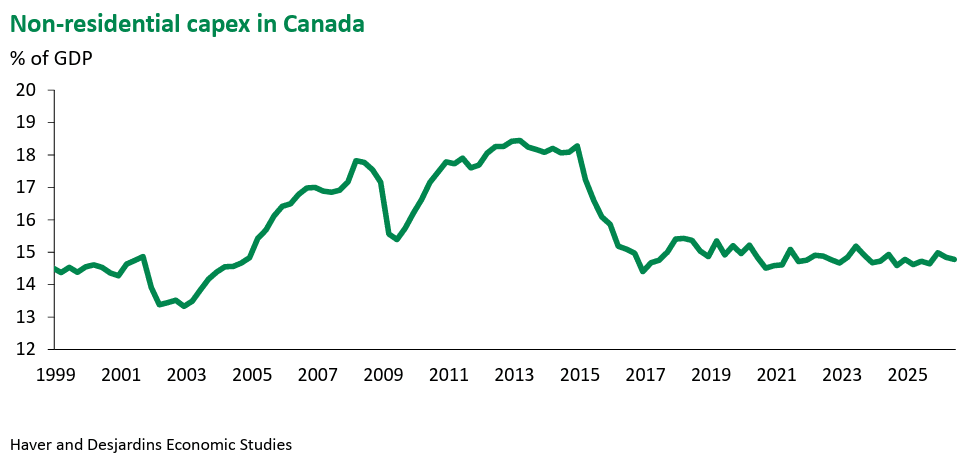
Above: "Canada’s Capex Slump May Be Ending" - Desjardins.
USD/CAD has tracked the two-year US-Canada swap spread closely as it narrowed to about 125 basis points from a high near 155, Desjardins finds.
The spread narrowed after the Bank of Canada raised rates to 2.50% on 28 October while the Federal Reserve held.
Desjardins expects the spread to narrow further if the Federal Reserve cuts rates next year.
Desjardins expects the productivity gap to keep weighing on the loonie, "we would be cautious about assuming a meaningful narrowing in the productivity gap between the US and Canada on a tradable horizon," says Jean.
US tariffs of 50% on Canadian autos are threatened from 1 January 2027, although Prime Minister Mark Carney describes a "slight intensification" of trade talks.
Desjardins forecasts USD/CAD at 1.41 by the end of this year, just under 1% above spot, before a gradual decline to 1.38 by the end of 2027.
For sterling, Desjardins forecasts GBP/CAD at 1.83 by year-end, about 3% below spot, and 1.86 by the end of 2027.
The Canadian dollar should start to escape its value trap once the US-Canada rate spread narrows further, a move Desjardins ties to Federal Reserve rate cuts in 2027.