
Image © Adobe Images
The British economy could keep interest rates higher for longer if it continues to grow faster than the Bank of England expects, because strong investment demand raises the risk that the energy shock feeds into wages and prices, although the Bank sees growth slowing next year.
The British economy is growing faster than the Bank of England expected, according to its November Monetary Policy Report, which upgrades this year's growth forecast by a full percentage point.
Bank staff now expect annual GDP growth of around 2.2% in the final quarter of 2026, up from the 1.2% projected in the July Report.
"UK GDP growth has so far been resilient in 2026 and much stronger than anticipated at the start of the conflict," says the Bank in the Report.
Faster growth leaves the economy with less spare capacity to absorb higher energy costs, which raises the risk that the energy shock feeds into wages and prices and keeps interest rates higher for longer.
The Bank's Monetary Policy Committee raised Bank Rate to 4.0% on Thursday, and the minutes show some members now see the economy's strength as a reason to tighten in its own right.
"For some members, the news on domestic activity and underlying inflation was a signal that monetary policy had not been as restrictive as previously judged," say the minutes.
"I believe the output gap is smaller than we think and has likely peaked," says Megan Greene, an external member of the Committee.
The economy grew 0.5% in the second quarter, against the July Report's projection of 0.3%, and Bank staff expect third-quarter growth of 0.7%, against July's 0.1%.
The Bank has now fallen short on 2026 growth in both its April and July forecast rounds.
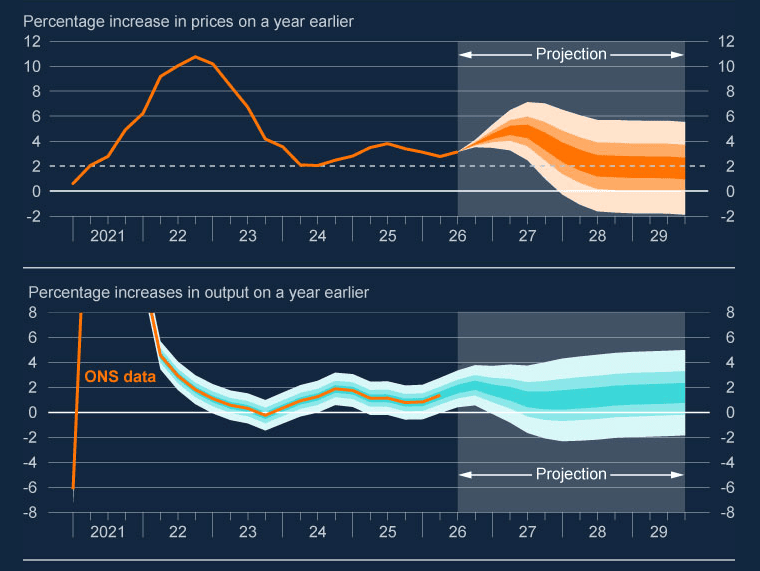
Above: Bank of England projections for CPI inflation and GDP growth. Image courtesy of the Bank of England.
AI Investment Leads the Upswing
The private sector is driving the expansion, "resilience this year has been primarily driven by the private sector, and in particular private sector services," says the Bank.
Business investment grew by nearly 5% in the first half of 2026, the fastest two-quarter pace since 2022.
"Growth continues to benefit from strong business investment, particularly around AI-related infrastructure," says April LaRusse, Co-Head of Client Portfolio Management at BNY Investments.
The Bank estimates that "novel AI-related activity accounts for just under a fifth of GDP growth since the start of 2026."
Pound Sterling Live's House View, published mid-year, said the pound would outperform expectations because economists and markets are underestimating British economic growth in 2026, with the AI investment cycle being underappreciated.
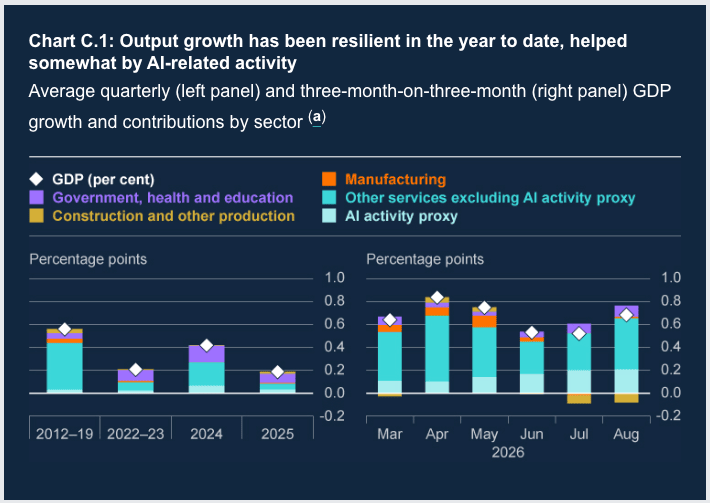
The Bank says the AI contribution so far comes from developing and implementing the technology rather than from wider adoption across the economy.
That leaves room for a second phase of gains, and the Bank flags "material upside risks if the benefits from AI adoption increase."
The labour market is also beating forecasts: the Bank projects unemployment at 4.8% at the end of 2026, below the 5.1% it forecast in July.
The UK composite PMI rose to 52.9 in October, and Pantheon Macroeconomics says the survey is consistent with fourth-quarter growth of around 0.3%.
"Resilient growth and sticky inflation mean the MPC can hike multiple times over the coming months," says a note from the research consultancy.
Sterling has tracked the growth story through higher rate expectations: the pound-to-euro exchange rate trades at 1.1998, up 4.7% this year and close to the 1.2016 high of 30 October.
The pound-to-dollar exchange rate trades at 1.3460, little changed on the year.
The Bank Expects Growth to Slow in 2027
The Bank has cut its growth forecast for 2027 to 1.0% from 1.4%, as higher inflation, tighter financial conditions and fiscal consolidation weigh on activity.
Households are expected to feel the squeeze first, with the Bank projecting consumption growth to ease to 0.2% in the fourth quarter as real incomes fall.
The GfK consumer confidence index fell sharply in October, reversing the improvement of recent months, the Report notes.
The Bank's weaker demand scenario has growth slowing to 0.3% in 2027 and unemployment rising to 5.5% in 2028.
In that scenario, "demand is assumed to be weak enough to prevent any second-round effects from emerging," says the Bank, which would remove the case for further hikes.
The 2027 forecast assumes the support from AI-related activity fades, the same assumption that has left the Bank's growth estimates short twice this year.
For the economy to slow as the Bank expects, business investment and AI-related services must start to lose momentum.