Image © Adobe Images
Pound sterling looks set to grind lower against the euro in the coming week as Budget nerves build, and a hot eurozone inflation print on Friday would speed the descent.
The Pound to Euro exchange rate has slipped beneath its 21-day and 100-day moving averages, the two lines our Week Ahead model watches most closely, and we read that as a bearish signal for the days ahead as fiscal risk builds into the 28 October Budget.
Losses have come in small steps, though: buyers have stepped in on every dip through September, the bottom is not falling out of the market, and a steady grind lower looks likelier than a sharp break.
From a technical perspective, sellers must keep the market beneath the falling 21-day moving average - the blue line in the below chart - if that grind is to continue:
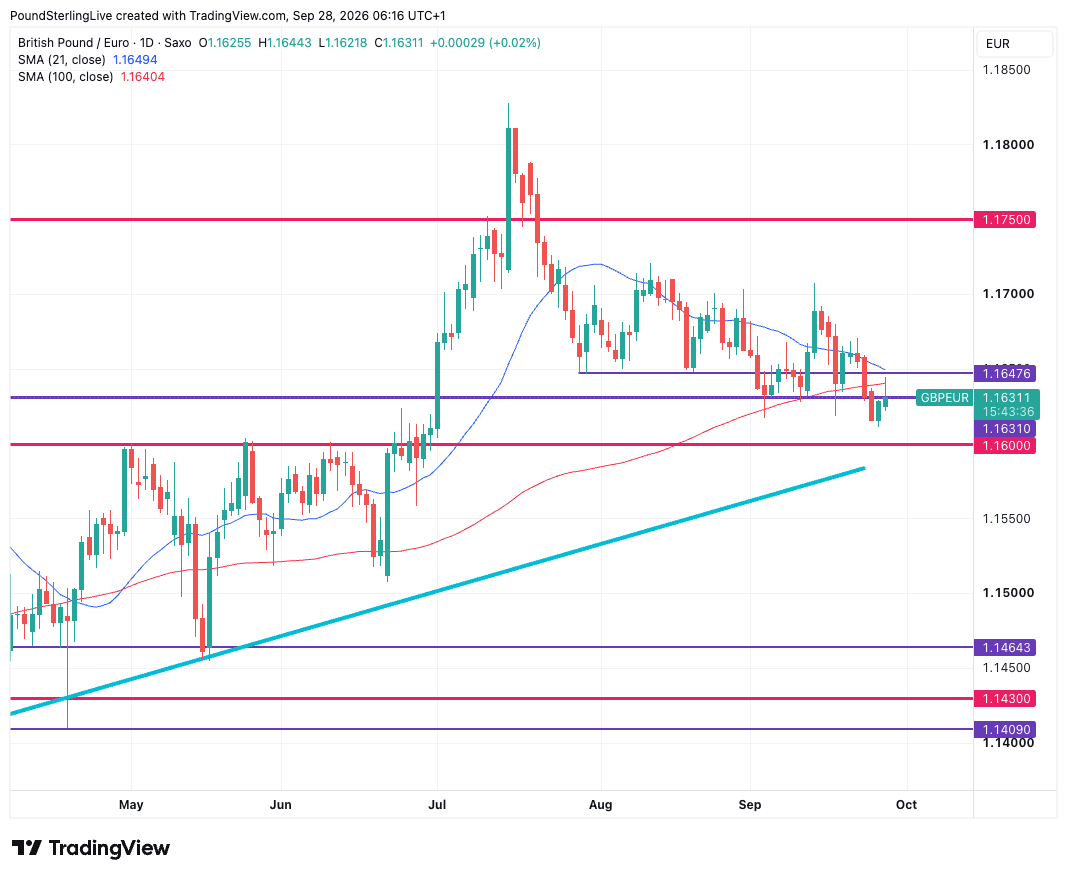
GBP/EUR daily chart. Image © Pound Sterling Live, chart created with TradingView.
GBP/EUR trades at 1.1631 at the start of the new week, putting it on a graphical horizontal support zone at 1.1631 that the market has traded either side of since Thursday.
The 100-day moving average - the red line - has pointed higher since the spring and caught the pullbacks of August and early September, so Thursday's close beneath it marks a change in behaviour. The 21-day has fallen since the middle of July and is closing in on the 100-day from above.
What does trading beneath both averages denote? The 21-day tracks the short-term trend and the 100-day the broader one, so a market below the pair of them has lost momentum on both horizons. The 100-day is still rising, which suggests the uptrend that began last November is damaged but intact.
The first obvious target is 1.1600, the graphical horizontal level that capped the market from March through June before the July breakout turned it into support. It sits close enough for a steady grind to reach it this week.
Further out, the rising trendline from February's low - the light blue line - is heading towards 1.1580, and a break of it would turn this pullback into something larger.
We look for a steady grind lower towards 1.1600 in the days ahead, and a daily close back above 1.1648, the graphical horizontal line the market lost last week, would change our Pound to Euro forecast.
A week ago we expected the 100-day to act as a pivot that drew the pound back towards it. The market duly returned to the line, but Thursday's close beneath it shows the average did not hold as a pivot, and our read has moved from a range to a pullback.
Budget Risk Builds as Burnham Weighs New Levies

Picture by Simon Dawson / No 10 Downing Street
Prime Minister Andy Burnham said he would set out proposals for new levies to fund social care that is free at the point of use as Labour's annual conference opened in Liverpool at the weekend, and when pressed on the cost said "nothing is off the table at this moment in time."
He rejected The Health Foundation's estimate that universally free social care in England would cost an extra £18 billion a year, and said the cost should be shared by all.
The proposals land as economists expect the Chancellor's buffer against his fiscal rules to shrink, with MUFG pencilling in a deterioration in headroom of roughly £15 billion ahead of the 28 October Budget. Henry Cook, writing in MUFG's European Macro Weekly of 25 September, calls the Budget "a huge test of communication for the new Chancellor."

Daniella Arcadipane, Senior Currency Specialist at Indigo
Moving a life-changing sum abroad? You won’t be doing it alone.
One specialist explains every step in plain English and stays with it until the money lands. FCA authorised, FRN 594433.
Talk to a specialistBurnham has made social spending the centre of gravity in his fiscal policy, and with UK bond yields elevated the market has little tolerance for spending plans that lack a funding source. That is consistent with our medium-term view that sterling underperforms into the Budget.
Oil offers the pound some support at the start of the week: Brent rose on Monday after President Donald Trump rejected Iran's latest proposal to reopen the Strait of Hormuz. Higher energy prices have tended to lift UK bond yields by more than German ones, which has worked in sterling's favour against the euro, so falling oil is the bigger risk to GBP/EUR.
Wednesday's final second-quarter GDP estimate, carrying the annual Blue Book revisions, is second tier: an upward revision would lift sterling and a downgrade would weigh on it.
Eurozone Inflation Is the Week's Calendar Highlight
Friday's flash eurozone inflation reading for September is the week's calendar highlight for GBP/EUR, with the market looking for headline inflation to rise to 3.7% year-on-year from 3.2% in August on higher energy costs, which would be the highest reading in three years.
A reading above consensus would tell the market the European Central Bank has more hiking to do, lifting eurozone bond yields and the euro with them and pushing GBP/EUR lower. An undershoot would do the reverse.
MUFG will be looking for a broadening of domestic price pressures, which would support its out-of-consensus call for a second consecutive ECB hike in October.
With a sharp jump already expected, the bar for an upside surprise on the headline is high, but firmer core inflation would put an October hike into play and hand the euro fresh support. On balance, that risk favours the euro and fits our Pound to Euro forecast of a grind lower this week.
Daniella Arcadipane, Senior Currency Specialist at Indigo
Moving a life-changing sum abroad? You won’t be doing it alone.
One specialist explains every step in plain English and stays with it until the money lands. FCA authorised, FRN 594433.
Talk to a specialist