
Image © Adobe Images
The British pound looks due a pause in its slide against the dollar in the days ahead, but a strong U.S. jobs report on Friday could cut any rebound short.
The Pound to Dollar exchange rate has fallen hard through the second half of September, and the decline has carried it so far from its short-term trend that we expect a pause in dollar strength this week.
The dollar's advance still has deep roots, with U.S. growth outpacing its peers and the ten-year Treasury yield above 5%, so any recovery in the pound should be shallow and short-lived.
The technical chart is doing a lot of lifting in our short-term considerations: the gap between spot and the falling 21-day moving average - the blue line in the below chart - is now wide enough to invite a mean-reverting bounce or a spell of consolidation:
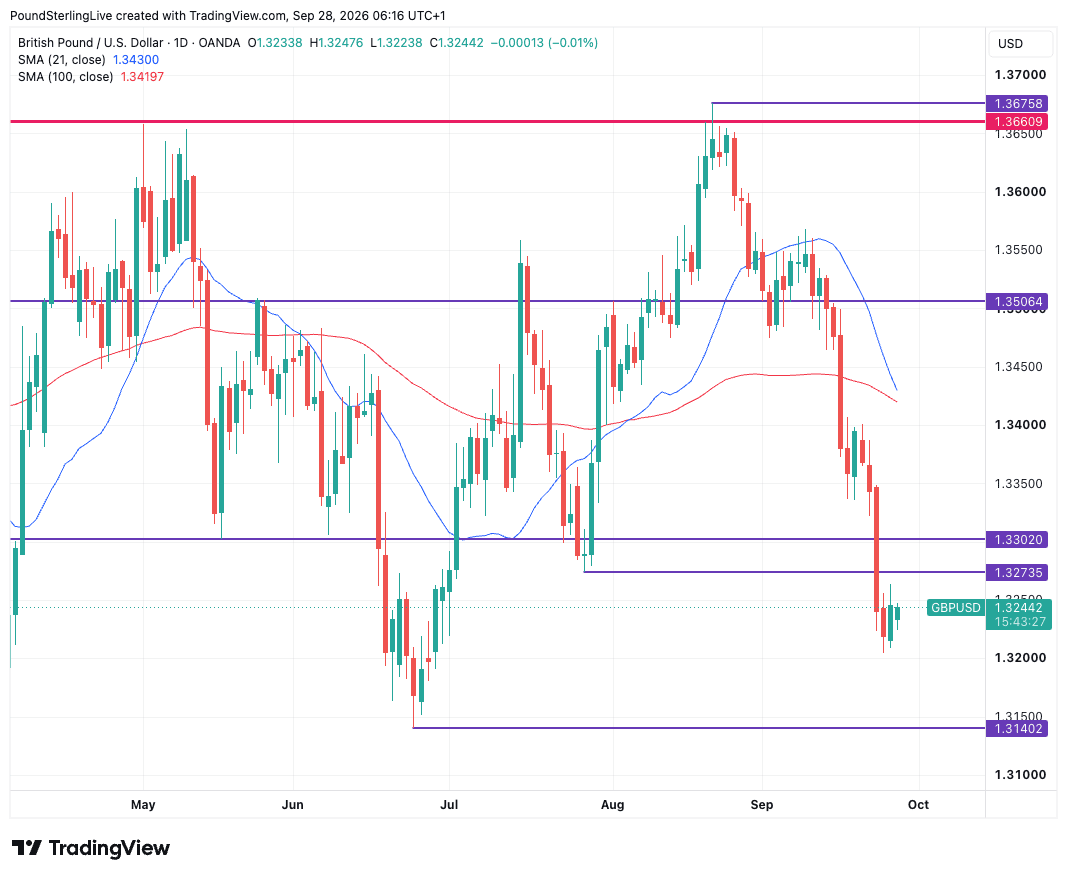
GBP/USD daily chart. Image © Pound Sterling Live, chart created with TradingView.
GBP/USD trades at 1.3244 at the start of the new week, almost one and a half percent beneath its 21-day moving average, a gap wide enough to suggest the selling has run ahead of itself.
Exchange rates tend to mean-revert to the 21-day when they run this far from it. The average is falling steeply, however, so the gap can close as effectively through a few days of sideways trade as through a rally.
A rebound would first meet graphical horizontal resistance at 1.3274, the late-July low, and then at 1.3302, the floor that held through May and June. Both gave way during last week's decline and now sit overhead as old support turned resistance.
This is a call for a pause in the pound's decline, and the decline itself has further to run.
The red line, the 100-day moving average, has rolled over after flattening through August, and the 21-day is set to cross beneath it within days. Price trades below the pair of them, which keeps the medium-term bias pointed lower, with June's low at 1.3140 the next graphical horizontal support.
We expect the pound to steady this week, either through a bounce towards 1.3274-1.3302 or through a sideways drift that lets the falling 21-day catch up, before the decline resumes. A daily close above 1.3302 would suggest the selloff has run its course, and until then our Pound to Dollar forecast stays bearish beyond the near term.
A week ago we said the stretched selloff was due a brief reprieve before post-August weakness reasserted itself. The reprieve lasted barely two sessions before Wednesday's U.S. PMI beat triggered a fresh leg lower to just above 1.3200, so the pause was shorter than we expected while the direction held.
Strong U.S. Data Keeps the Dollar's Yield Advantage Intact
Friday's U.S. non-farm payrolls report is the calendar highlight for Pound-Dollar, with the market looking for 90K jobs in September after 162K in August and for unemployment to hold at 4.1%.
A print above expectations would tell the market the U.S. economy can carry higher interest rates, lifting Treasury yields and the dollar with them and pushing GBP/USD lower. A miss would do the reverse and give the pound room to close its gap with the 21-day.

Daniella Arcadipane, Senior Currency Specialist at Indigo
Moving a life-changing sum abroad? You won’t be doing it alone.
One specialist explains every step in plain English and stays with it until the money lands. FCA authorised, FRN 594433.
Talk to a specialistWednesday's PCE inflation report comes first, with the core measure expected to rise 0.3% on the month. This edition carries annual revisions and methodology changes that could muddy the signal, and Elias Haddad, Global Head of Markets Strategy at Brown Brothers Harriman, expects the week's data to "reinforce the Fed's hawkish bias," he writes in his Drivers for the Week Ahead note of 27 September.
The Federal Reserve raised rates on 16 September, and firm data would keep further tightening in play in the months ahead. The bond market is already carrying that view: two-year Treasury yields rose 72 basis points between Jackson Hole and last Thursday, the largest 21-day jump since just before the U.S. regional banking crisis of 2023, according to MUFG's G10 FX Weekly of 25 September.
Barclays' FX strategists add in their weekly note of 27 September that the dollar's move higher is not excessive and that positioning is not yet stretched, leaving scope for a further dollar premium and a pickup in currency volatility.
Market-implied odds of a Bank of England hike in November sit above 90% after Monetary Policy Committee speakers backed the case last week, so hawkish talk is largely in the price and the pound has little left to gain from it.
Higher debt servicing costs alone will knock around £10 billion off the Chancellor's £23.6 billion of headroom ahead of the 28 October Budget, says Andrew Goodwin, Chief UK Economist at Oxford Economics, in his weekly UK briefing of 25 September. Deutsche Bank has turned bearish on the pound for similar reasons.
A soft payrolls number would give the pound the breathing space its stretched chart is asking for, while a strong one would end the pause before it has begun. On balance, our Pound to Dollar forecast looks for a brief consolidation inside a falling market.
Daniella Arcadipane, Senior Currency Specialist at Indigo
Moving a life-changing sum abroad? You won’t be doing it alone.
One specialist explains every step in plain English and stays with it until the money lands. FCA authorised, FRN 594433.
Talk to a specialist