Image © Adobe Images
The British pound endures a soft short-term tone, but the broader setup remains relatively constructive.
The currency has endured three days of successive losses against both the euro and dollar with cross-currency movements proving dominant in a week that's devoid of domestic UK data releases.
The dollar is therefore in command and we saw a decent recovery in the midweek session that forced a slide of 0.38% in the pound-to-dollar conversion.
Compare that to a lesser 0.18% fall in the euro-dollar conversion and we can immediately see the euro withstood the dollar's advance better than pound sterling did.
The obvious cross-currency implication of that euro resilience was a softer pound-to-euro cross (GBP/EUR), which fell by nearly a quarter of a percent to 1.1661.
The fall is consistent with a near-term run of weakness for GBP/EUR that could extend to 1.1647 ahead of the weekend, which is the location of the near-term floor.
Driving dollar resilience was a firmer U.S. PCE data docket, which reinforced Federal Reserve rate hike expectations.
Headline PCE inflation - which the Fed officially targets with interest rate policy - rose by 0.2% m/m and 3.7% y/y, above estimates of 0.1% and 3.6%, respectively.
Core PCE inflation rose by 0.2% m/m and 3.3 y/y, in line with expectations, placing it well above the Fed's target of 2.0%.
"We continue to expect the first 25bp Fed interest rate hike in December which is currently fully priced. We expect two or possible three more follow‑up hikes in 2027," says Carol Kong, FX strategist at Commonwealth Bank. "By contrast, markets are pricing about a 70% chance of an additional hike."
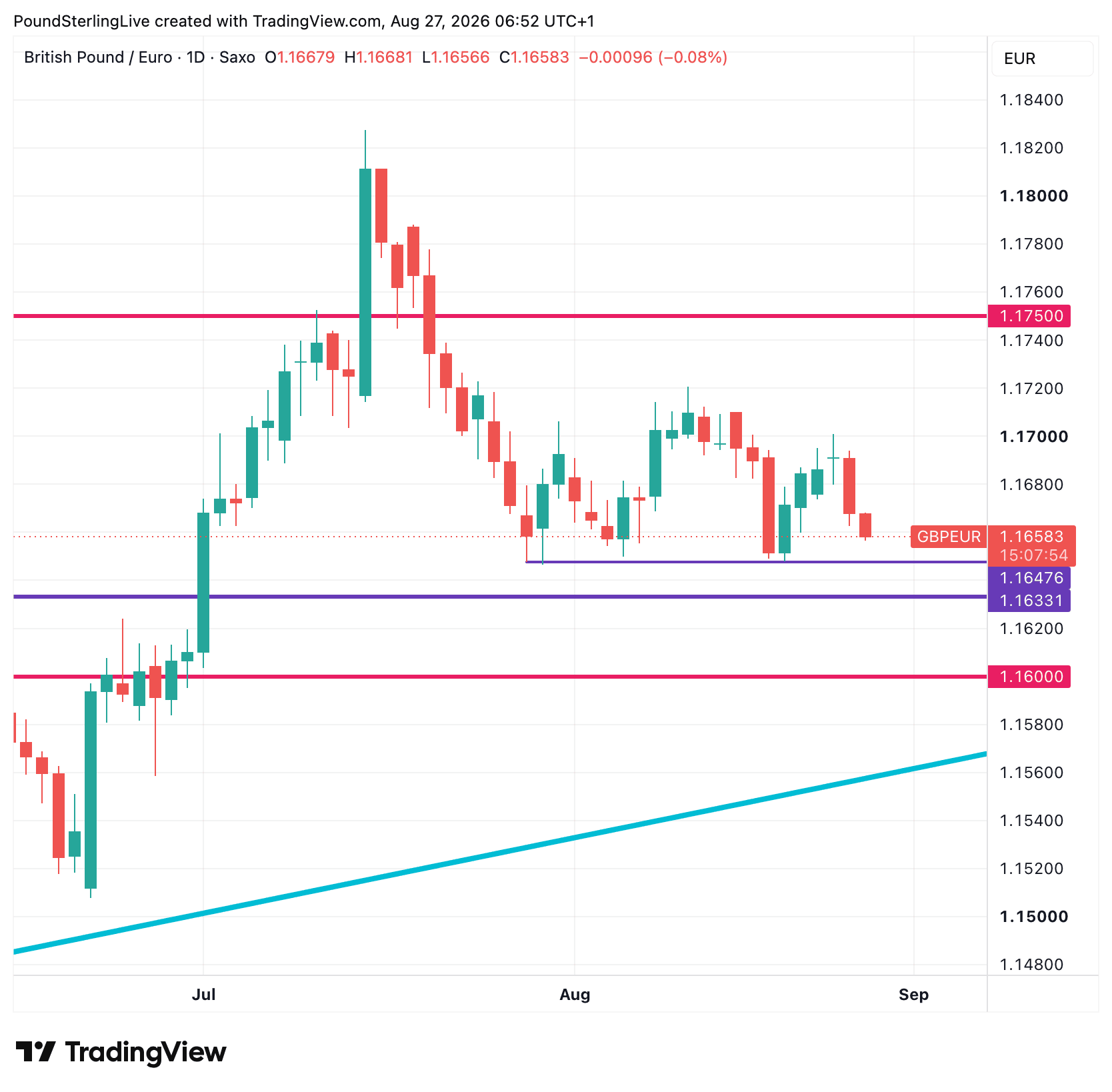
Above: GBP/EUR aiming for the immediate support line at 1.1647.
The data contributes to the firm global fixed income backdrop, helping to prop up both short- and long-dated tenors of U.S. bonds.
UK bond yields are understandably supported as a result, given the global picture is currently holding sway over sterling assets.
And although the near-term looks to be a case of expecting some more GBP weakness, there's reason to expect dips to be shallow.
British bonds continue to yield above most developed market peers, and in a world where 'carry' remains popular amongst global investors, that counts in the pound's favour.
That's because investors like to invest in low interest rates (or where bond yields are low) and invest where the return is higher.
That's providing a consistent theme of support for GBP on longer-term considerations.
Near-term, the next test is Friday's Jackson Hole appearance of the Federal Reserve's Governor Kevin Warsh.
Any comments that reinforce bets for future rate hikes would likely play into the dollar's hand, and given the cross-currency action we've seen so far this week, that would pose a damp end to the week for the pound.

The Bank Consensus, Without the Terminal
The median, mean, highest and lowest from the October survey update, plus named point forecasts out to 2027.
Free information pack, issued by World Wide Currencies.
Bullish Euro Setup Could Fade on Energy Worries
We tend to focus on the GBP leg of the GBP/EUR equation, and today's fare in the research inbox offers a reminder that the EUR shouldn't be forgotten.
MUGF, the international investment bank, says ongoing developments in the energy market and a resilient Eurozone economy make the case for a rate hike at the ECB in September, and again in subsequent months.
According to a standard FX reading, that's a bullish combination that would, all else equal, frustrate GBP/EUR upside via EUR/USD outperformance.
But, medium-term, the implications of the Middle East crisis could yet prove a significant negative.
MUFG analyst Derek Halpenny says gas market dynamics are less responsive to moments of good news concerning energy flows normalising through the Strait of Hormuz:
"Ship-to-ship transfers are not straight forward and are more complicated with specialised tankers required that come from dedicated terminals. Natural gas storage in Europe is at 63% as of 24th August, way off the 81% 5-year average."
This is particularly troublesome for the Eurozone's largest economy, Germany, where grid operators warned last week that winter storage target was "virtually unattainable".
"The risk continues to grow of higher inflation and weaker growth in Europe that could well open up some downside scope for EUR/USD over the coming weeks," says Halpenny.
The UK is less industrialised than Germany, and the MUFG view aligns with this article's lean that near-term weakness in GBP/EUR can give way to further upside in the medium-term.