
Image © Adobe Images
The pound sits stretched below its short-term average against the Aussie, a mechanical rebound could follow without turning the trend.
The pound-to-Australian dollar exchange rate's selloff cut through the 1.90 shelf last week as the Australian Dollar ran to a three-month high, the best-performing currency in the G10.
From a technical perspective, the market now sits an unusual distance below its 21-day moving average, a potential argument for near-term upside:
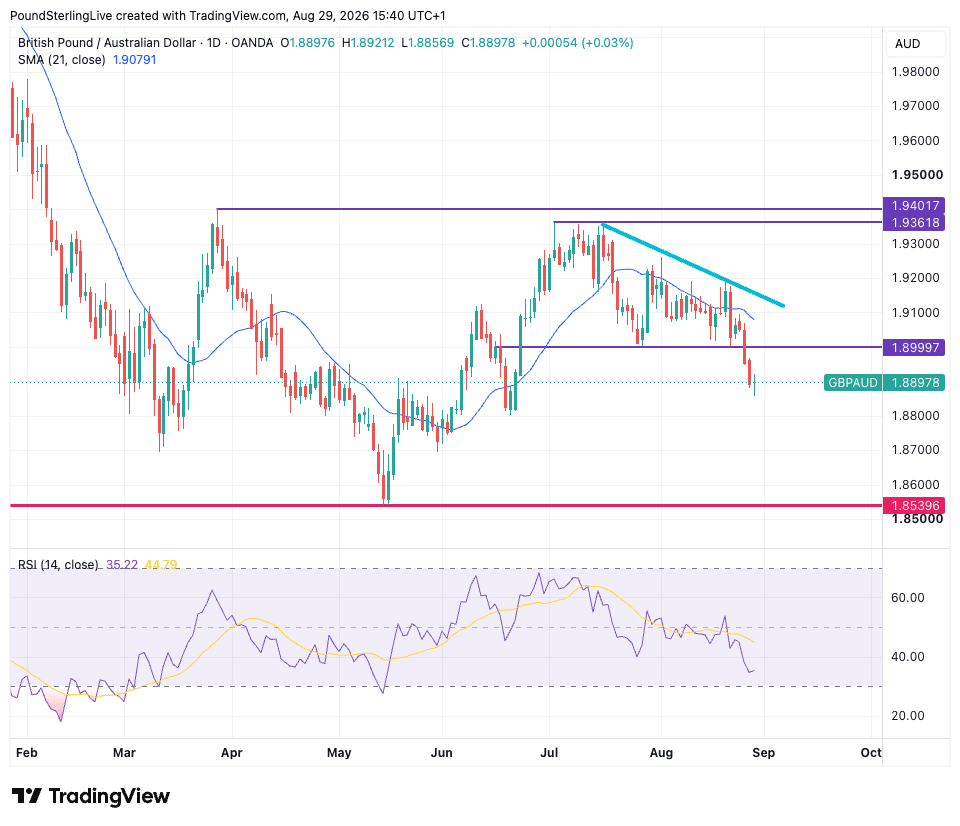
Above: GBP/AUD daily chart. Image © Pound Sterling Live, chart created with TradingView.
Spot sits 1.81 cents beneath the 21-day moving average at 1.9079, a gap of just under 1%. Deviations of that size tend not to persist, because the way we like to think about exchange rates is that they mean-revert to the 21-day, and the wider the gap grows the stronger the pull back towards it becomes.
The RSI at 35.22 against its signal line at 44.79 fits that reading, low enough to say the selling has been heavy without reaching the 30 mark that would mark it as exhausted.
From a directional perspective, we look for that pull to deliver a mechanical rebound over the coming week.
It should not be read as a turn in the trend: the 21-day is still falling, the descending trendline from the early-July peak still caps the market near 1.9100, and nothing on this chart has broken the sequence of lower highs running since July.
Last week's selloff ran from roughly 1.9110 down to Friday's low at 1.8857, and a 50% retracement of it sits near 1.8985. That lands immediately beneath the 1.89997 shelf the market broke on the way down, which now works as resistance, and the two together form the band we would expect a recovery to stall in.
A week ago we called for a downside break of 1.9000 that would open 1.8850, with a daily close above the trendline near 1.9110 as the level that would end the sequence of lower highs.

The Bank Consensus, Without the Terminal
The median, mean, highest and lowest from the October survey update, plus named point forecasts out to 2027.
Free information pack, issued by World Wide Currencies.
The break came and Friday's low stopped seven pips short of that first objective. The momentum reading we flagged at 42.75 has since fallen to 35.22, which is the continuation we said it pointed to, and the trendline was never threatened.
For now we look for a retracement into the 1.8985 to 1.9000 band and expect it to fail there. A daily close above the trendline near 1.9100 would change that, and beneath Friday's low the chart offers nothing until the June low at 1.85396.
The Aussie has outperformed of late as RBA rate hike odds have drifted higher again.
Last week's July CPI data offered fresh impetus to a hawkish reappraisal, with an increasing number of investors now expecting the RBA to hike the cash rate 25bp in November.
Aussie Economic Growth in Focus
That pricing is tested again this week with the release of GDP numbers on Wednesday.
On paper, a print above expectations lends support to the case for higher interest rates, which lifts Australian bond yields and makes the Aussie more attractive to hold, pushing the GBP/AUD pair lower.
A print below expectations does the reverse.
Consensus looks for 0.4% on the quarter and 1.9% on the year, in a range running from flat to 0.6%.
Westpac sit beneath it at 0.2% and 1.7%, and their partials carry the reasoning: net exports detracting 0.3 percentage points, private capital expenditure down 3.6% on an 8.9% fall in machinery and equipment as data centre spending cools, and construction down 2.1%.
China's PMIs Land While UK Markets Are Shut
China's purchasing managers' indices arrive on Monday, when the UK is closed for the bank holiday and the Australian Dollar has the field to itself.
The GBP/AUD pair trades as a proxy for broad risk appetite, because the Aussie is the highest-beta currency in the G10 to Chinese financial conditions and to dollar-priced commodities. A weak Chinese manufacturing reading pulls the Australian Dollar lower and lifts this exchange rate, with no reference to anything happening in Britain.
The manufacturing index is forecast at 49.6 after an unexpected contraction to 49.2 in July, and the non-manufacturing measure at 49.8 after its weakest reading since 2022. Both sit beneath the 50 mark that separates expansion from contraction.
That makes Monday the likeliest source of the mechanical rebound our Pound to Australian Dollar forecast expects, with a soft Chinese print doing the work while the domestic calendar is still empty.
The Bank Consensus, Without the Terminal
The median, mean, highest and lowest from the October survey update, plus named point forecasts out to 2027.
Free information pack, issued by World Wide Currencies.