
Image © Adobe Images
Pound pinned on the floor of a six-week compression against Australian dollar, Wednesday's Australian inflation print eyed.
The Pound-to-Australian Dollar exchange rate was turned back last week at the descending line that has capped every rally since the first week of July, and Friday's decline took it straight down to the average that has floored the market for the same period, closing at the bottom of the day's range:
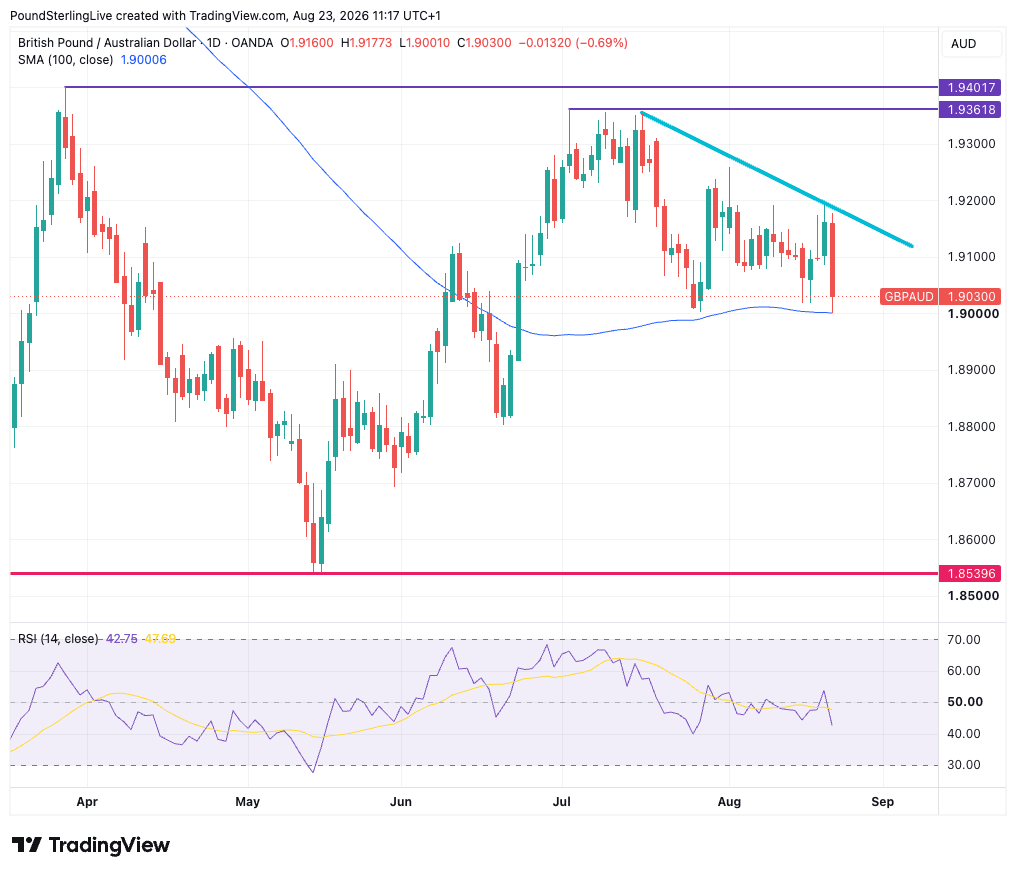
Above: GBP/AUD daily chart. Image © Pound Sterling Live, chart created with TradingView.
Six weeks of lower highs against a horizontal floor represents a compression, and the risk for AUD buyers is a downside resolution to this coiling market.
From a tactical perspective, this is a market days away from a break, and the Australian calendar is dense enough to deliver one: monthly inflation and quarterly construction on Wednesday, private capital expenditure and household spending on Thursday, with the August Reserve Bank of Australia minutes opening the week on Tuesday.
The pair started the new week at 1.9038, which puts it close to the previous week's close and the floor of the August range.
That level sits just above the 100-day moving average at 1.9000, which the session's low of 1.9001 tested to the pip without breaking.
The 100-day has been flat since June with only a marginal upward tilt, and it has caught every decline over that period, which makes 1.90006 a floor with four weeks of defence behind it rather than a line on a chart.
The RSI reads 42.75 against a signal line at 47.69, with the faster line below the slower and falling, so momentum points lower and sits nowhere near the oversold territory that would argue for a bounce.
A market closing on its low, at a floor, with momentum falling and room to fall further is a market more inclined to break lower.
Our Pound to Australian Dollar forecast for the coming five days is a downside break of 1.9000 during the coming week, opening 1.8850 and eventually the June low at 1.85396, with a daily close above the trendline near 1.9110 the development that would end the sequence of lower highs and put 1.93618 back in reach.
The falling ceiling does mean this market could break higher by standing still, and that is the case for the other side of the trade, but it requires the Pound to hold a floor it is currently leaning on while the calendar hands the Australian Dollar four chances to push it off.

The Bank Consensus, Without the Terminal
The median, mean, highest and lowest from the October survey update, plus named point forecasts out to 2027.
Free information pack, issued by World Wide Currencies.
July Inflation and Q2 Capex Decide Whether the RBA Can Stay Patient
Australia carries the fullest data load of any region next week with the minutes of the August Monetary Policy Board meeting being released on Tuesday at 02:30, followed by a speech from Reserve Bank Head of Domestic Markets David Jacobs on the liquidity regime.
Given the volume of Reserve Bank communication since the August meeting, the minutes are unlikely to contain surprises, says research from ANZ.
The July monthly inflation report arrives on Wednesday at 02:30, with consensus at 3.3% year-on-year after 3.8%.
Westpac expects the headline to rise 0.8% in the month for an annual pace of 3.3%, with the trimmed mean up 0.4% and its annual rate at 3.5%, while ANZ looks for a trimmed mean gain of 0.3%.
That gap between the two Australian houses on the core measure is the most useful number in next week's calendar, because it is wide enough that either side of consensus is a live outcome and neither would be a shock.
Q2 construction work done follows the same morning, where Westpac forecasts a fall of 1.0% against a market consensus of 0.5% and ANZ looks for a gain of 0.4%, and Q2 private capital expenditure lands on Thursday with the Sydney-based lender at flat against ANZ at -3.3%.
The houses are split on all three releases, which is unusual and makes the week genuinely two-sided on the data even where the chart is not.
Deputy Governor Andrew Hauser flagged three inflation risks in a fireside chat this week: renewed Middle East tensions, a global technology investment boom proving more inflationary than expected, and weak local supply growth.
Wages and the labour market are unlikely to be a source of upside inflation risk, according to ANZ, which points to private sector wage growth at its slowest since 2021.
Why Is the Aussie the Strongest Conviction Call in the G10?
The Australian Dollar enters this data with the only outright bullish rating in Morgan Stanley's latest currency scorecard, and a bullish skew alongside it.
The US bank stays bullish after Governor Michele Bullock's hawkish August tone, citing high carry, unusually low implied volatility and firm risk appetite, and looks for AUD/USD at 0.75 in coming quarters.
That reading leans on the hawkish policy document rather than the dovish market reaction that followed the unanimous August hold.
Sterling is marked neutral with a bearish skew on the same scorecard, its rating resting on a dovish Bank of England pivot that Morgan Stanley expects to take time to arrive, with reasonably high carry supporting the currency in the interim.
The scorecard therefore has this cross falling on both legs, which is what a chart making lower highs for six weeks has been saying independently.
A soft trimmed mean print on Wednesday is the one route to unwinding that call, because carry is the first pillar of the bullish case and a downside inflation surprise is what takes the Reserve Bank's next hike out of the price.
Watch the U.S. Dollar for GBP/AUD Guidance
A second channel matters as much as the data: this pair trades as a proxy for broad Dollar direction, because the Aussie is the highest-beta currency in the G10 to risk appetite, to dollar-priced commodities and to Chinese financial conditions.
That makes Wednesday's US inflation report and Friday's Jackson Hole speech from Federal Reserve Chair Kevin Warsh live events for this cross even though neither mentions Australia, with a falling Dollar typically lifting the Aussie by more than it lifts the Pound.
The beta and the domestic calendar therefore pull in the same direction, which is unusual and which removes most of the two-way risk a compression would ordinarily carry. That is why our Pound to Australian Dollar forecast commits to the downside break rather than waiting to be told, with 1.90006 the only thing standing in the way.
The Bank Consensus, Without the Terminal
The median, mean, highest and lowest from the October survey update, plus named point forecasts out to 2027.
Free information pack, issued by World Wide Currencies.