
Image © Adobe Images
AI-related borrowing has become big enough to reprice long-dated bond markets, say analysts.
For years, the U.S. technology sector has financed its AI buildout with cash, but the AI arms race means more money is needed today to build tomorrow's machines.
That marks the entry of a powerful new entrant into the long-dated bond sector.
U.S. Treasury yields at the long end, that's tenors of 10 to 30 years, have surged, and a rising yield reflects either demand falling out of the market or additional supply meeting static demand.
The source of the new supply matters: increased government issuance is meeting tech giants' borrowing to fund the AI rollout.
Nine major tech companies have already spent roughly $600 billion on capital projects over the past year, and the funding mix is shifting from cash flow to the bond market.
"We estimate $489 billion of AI-related supply so far this year - already well above our full-year 2025 estimate of $322 billion. Across many markets, AI-related issuance represents a significant share of overall supply," says Amanda Lynam, Chief Credit Strategist at Goldman Sachs.
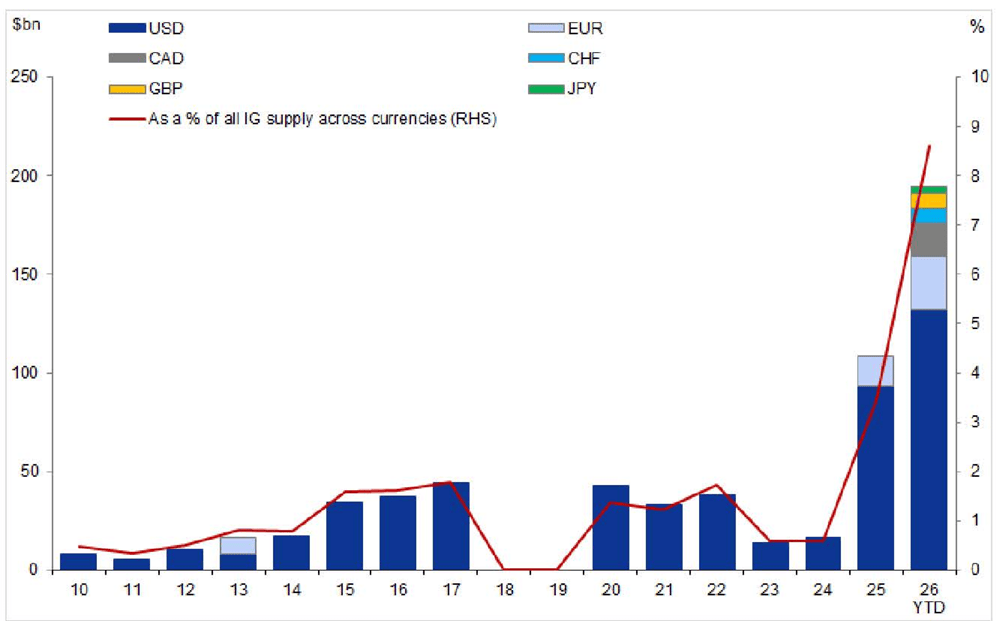
Image courtesy of Goldman Sachs.
USD investment-grade issuance has already exceeded $1.5 trillion this year, leaving 2026 on pace to surpass the pandemic-era record, and Lynam sees the risks to her $2.1 trillion full-year supply forecast as skewed to the upside.
Bond sales by the "hyperscalers" building AI infrastructure are on pace to roughly double in 2026.
Nvidia is working with BlackRock, Goldman Sachs, KKR and other Wall Street giants on plans to raise more than $500BN for AI infrastructure.
A Wall Street Journal analysis found they have another $3.0TRN in future commitments, mostly tied to AI, that aren't yet reflected on their balance sheets.
The New Marginal Price-Setter
The corporate borrowing is now transmitting into government bond pricing.
"Further analysis suggests that, over longer time horizons (20+ days), hyperscaler term risk spread likely leads real 5y5y pricing, particularly around key inflections. This reinforces the view that AI-led capital demand is increasingly influencing longer-dated rates, as pricing signals from hyperscaler credit markets diffuse into swaps and Treasuries," says a note from Lloyds Bank released Friday.
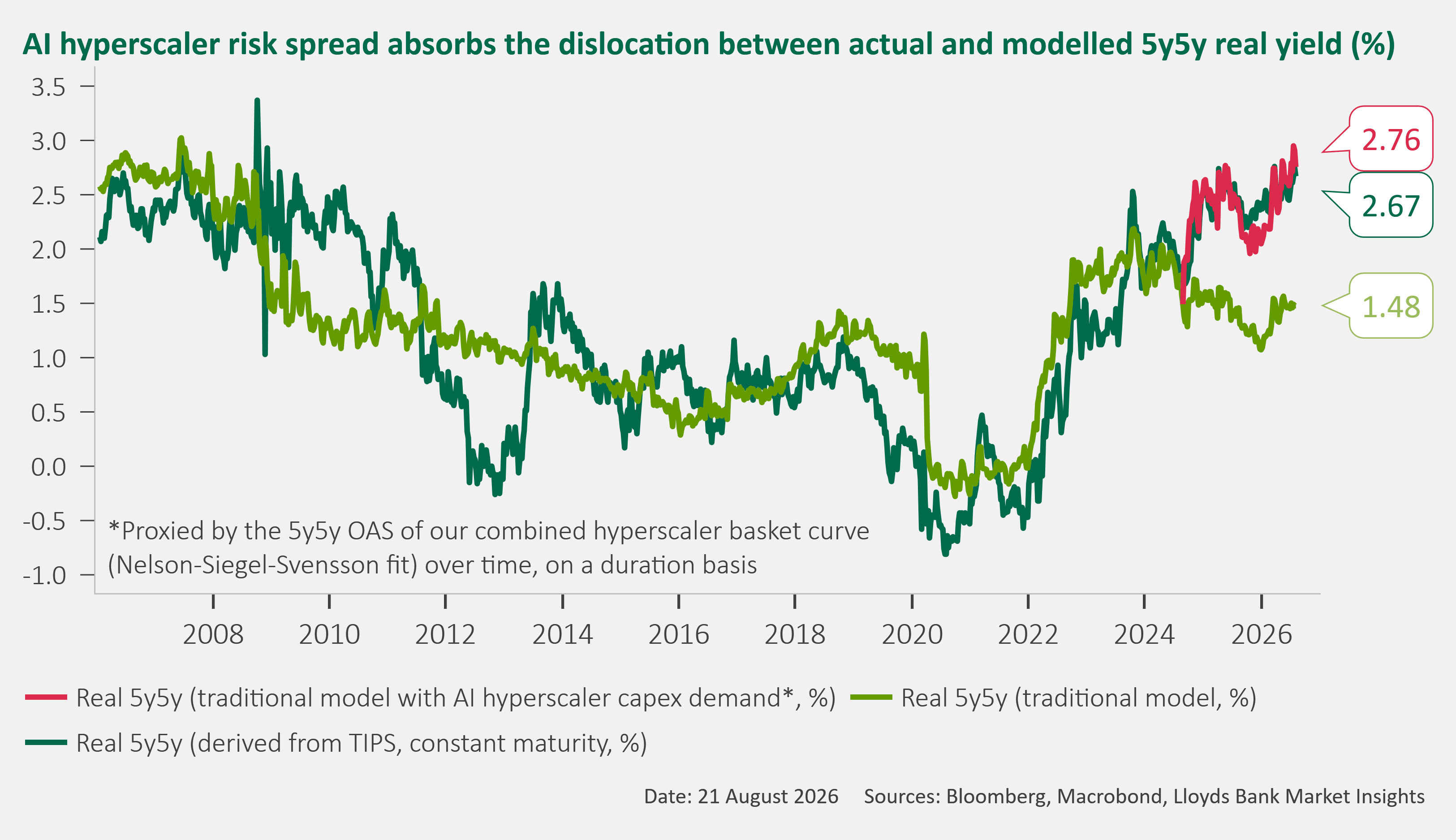
In plain terms, the market where Microsoft and Meta price their bonds now moves the market where governments have traditionally dominated pricing dynamics.
"With hyperscaler capex intensity continuing to rise and the investment cycle still in its early stages, we see scope for further long-end repricing," adds Lloyds.
Padhraic Garvey at ING agrees the pipeline is relentless: "Issuance pressure continues to churn, especially when the wider credit market duration weighted issuance from the hyper-scalers is lumped in."
ING has previously calculated that the hyperscalers could issue $250-280BN in 2026 alone, a flow it identified as a driver of elevated long-term yields.
A Supply Problem, Not a Discipline Problem
Julius Baer's research finds Treasury auctions still clearing without indigestion, evidence that demand, while more price-sensitive, has not necessarily gone missing.
A note from Goldman Sachs' trading desk frames the consequence for the wider market.
"Rates are increasingly a supply problem, not necessarily a central bank discipline problem. Short term data has been softer and the front end has outperformed, but you cannot escape the hard facts... massive sovereign deficits alongside potentially >$1tn of annual AI capex, increasingly funded through debt markets. That is a lot of paper. Real rates need to clear it," says the note.
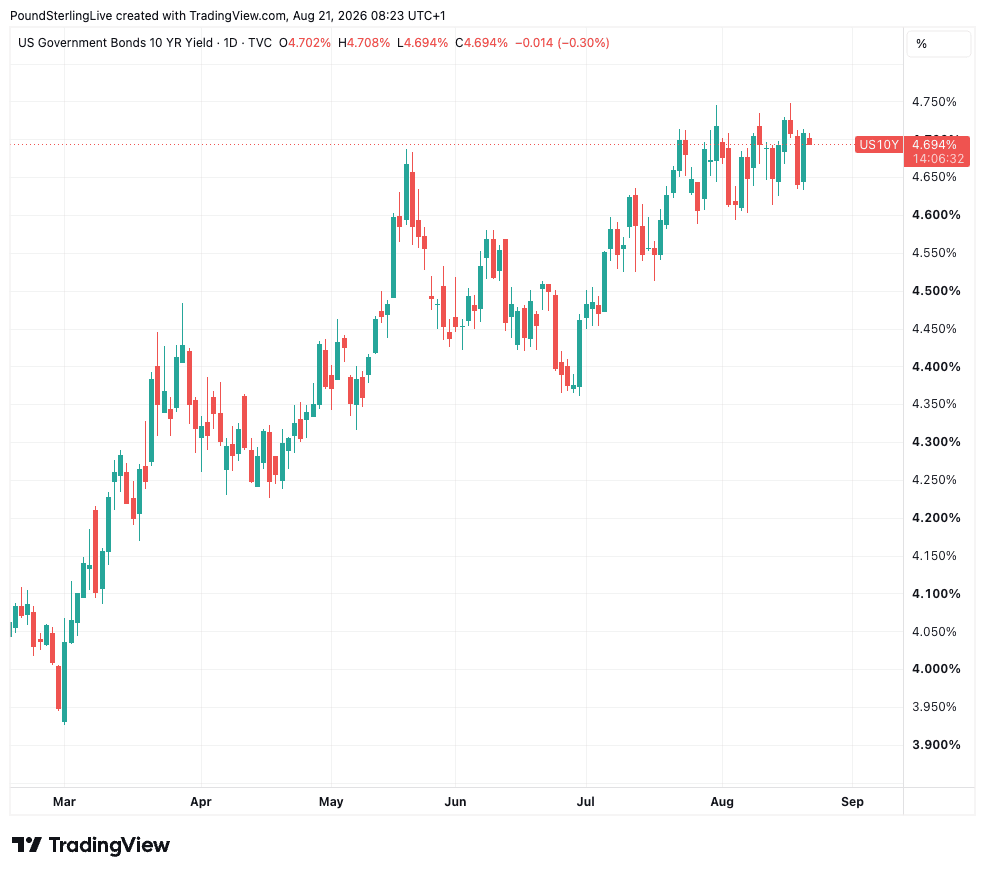
The relentless rise in U.S. ten-year bond yields.
The desk goes further on the policy implication: "At some point the Fed may even be forced to hike into weaker data to flatten the curve/re-anchor the back end."
The endpoint is crowding out:
"If the market is trying to force either the public or private sector to spend less, realistically the adjustment falls more heavily on the private sector. Governments rarely volunteer austerity. So higher real rates + huge public/AI capital demands = some degree of crowding out elsewhere. That feels like part of the de-rating we are already seeing in the broader market," the note adds.
No Let Up in Government Issuance
And Austerity almost won't be in the government's remit, current or future.
Democratic socialism led by the younger demographic is on the rise, driving demand for economic populism, characterised by promises of cheaper housing, health care and child care.
The Republicans are meanwhile keen to protect Social Security and Medicare while pursuing tax cuts and higher defence spending, including Trump's push for a $1.5TRN Pentagon budget.
This week's efforts by the Treasury to cap long-term debt yields are an acknowledgement of the pain building in the market.
However, rising yields are a symptom of significant supply increases that won't fade for some time, suggesting the Treasury can at best manage the pace of bond yield increases, not stop them.