Image © Adobe Images
Why the Dollar Fell on U.S. Bond Buyback Announcement.
The dollar dropped against all its peers after the U.S. Treasury said it will increase its purchases of long-dated bonds in order to try and prop up the market following a losing run that saw them fall in value to multi-decade lows.
Of course, the effect of falling bond prices is a surge in the yield they offer; in short the government is facing surging borrowing costs as a result, no wonder it lools as though the authorities are rattled.
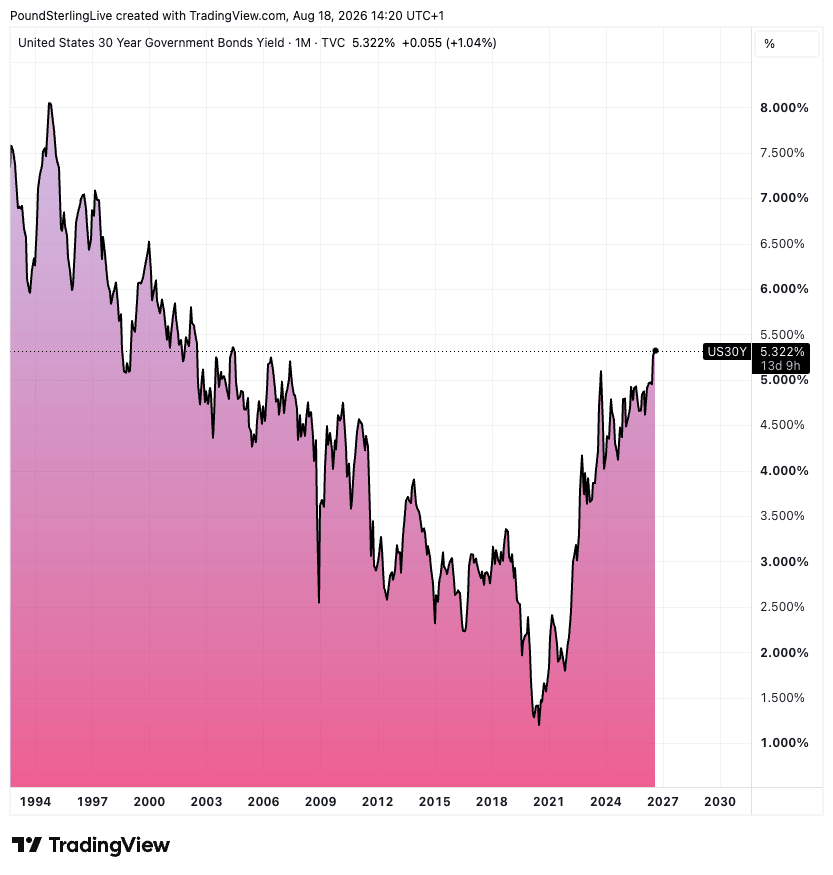
Back to the 90s: The yield on U.S. 30-year bonds.
In a surprise move, the US Treasury announced that it is increasing, by at least double, the size of liquidity support buyback operations for longer-dated nominal coupon securities (10y to 20y and 20y to 30y).
The current maximum size of $2BN per operation will be at least $4BN per operation, effective September 9 and in effect for the remainder of the current refunding quarter.
That did the trick - as bond prices found support their yield slumped - with the 10y dropping from 4.71% to 4.65%.
The fall in U.S. yields was mirrored elsewhere and it takes the pressure off borrowing costs here in the UK and globally.
However, it's on the currency market where we're seeing some interesting moves: the dollar is feeling the heat.
The pound-to-dollar pair rises 0.70% on the day to hit 1.3624, the euro-to-dollar rises 0.80% to hit 1.1667.
The dollar looks to be a release valve.
George Saravelos, Deutsche Bank's lead currency strategist explains why:
1) This is another sign of increasing administration unease on the ongoing rise in long-end U.S. yields.
2) Saravelos sees both the buyback and encouragement to use the FIMA facility for FX reserves as soft-form financial repression policies aimed at containing the long-end of the US yield curve.
3) Both developments are "negative for the dollar."
Why is the buying of U.S. bonds by the Treasury a negative?
Because "if the market price of USTs is not allowed to adjust down, the foreign exchange price of UST owned by foreign investors has to adjust via a weakening in the dollar," explains Saravelos.
The analyst adds that the buyback operation is effectively very similar to the Fed’s operation twist, where the Treasury would have to issue more treasury bills to finance the removal of duration from the market.
i.e. the Treasury has to issue short-term debt to buy out the longer-term more expensive debt.
There is a catch: "to the extent that this eases financial conditions, it would arguably necessitate an offsetting tightening from the Federal Reserve. If Chair Warsh does not recognize the buyback as a factor driving an easing of financial conditions, we would take it as an additional dollar negative driver," warns Saravelos.
In all, the market is likely to be increasingly attentive to further measures intended to support the US Treasury market going forward. The more these are perceived as distortionary to market pricing, the more the dollar is likely to weaken.
It's all looking increasingly negative for the dollar from here.