
Image © Adobe Images
Sterling's rebound against the Australian dollar looks set to stall this week as the Aussie stays well bid.
The Pound to Australian Dollar exchange rate has recovered the ground it gave up through September and now sits on its 100-day moving average, where the advance looks likely to run out of road.
Buyers have a rising short-term average behind them and September's floor has held every test it has been given, so a second attempt at last week's high cannot be ruled out.
From a technical perspective, the question is whether the flat 100-day average, the red line in the below chart, turns into support or anchors the move and reopens the downside:
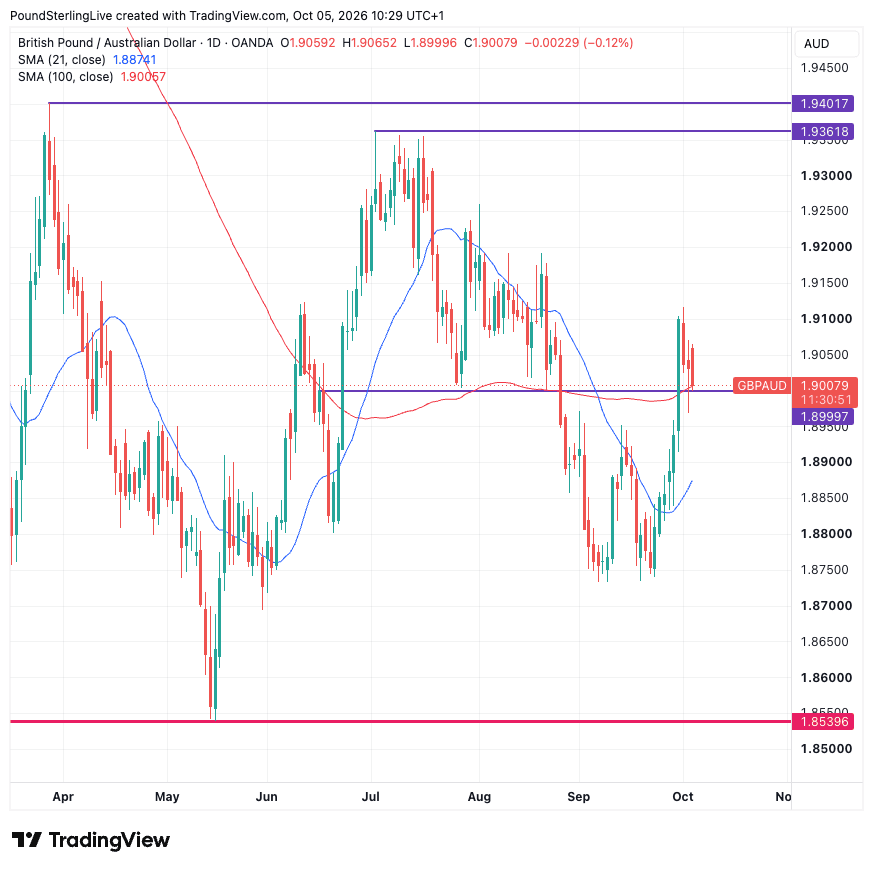
Above: GBP/AUD daily chart. Image © Pound Sterling Live, chart created with TradingView.
GBP/AUD trades at 1.9008 at the start of the new week, with the 100-day at 1.9006 and graphical horizontal support at 1.9000, a level the market touched in early trade on Monday and bounced from.
The rebound started at September's floor near 1.8730 and ran as far as just above 1.9100 late last week before sellers appeared, and the pair has given back around half a percent since.
The 21-day average has turned higher and sits at 1.8874, which gives the rebound something to fall back on and is the first level we would expect to see tested should 1.9000 give way.
Above, the next graphical horizontal resistance is a long way off at 1.9362, with 1.9402 beyond it, and neither comes into play without a daily close above last week's high.
Our base case is that the 100-day anchors the move rather than turning into support, leaving GBP/AUD to drift back towards the 21-day as the week develops. A daily close above 1.9100 would change that, and our Pound to Australian Dollar forecast would then look towards 1.9362.
Our call a week ago was for the recovery to extend towards 1.8990 to 1.9000 with the 1.8730 floor intact. The pair reached just above 1.9100 and the floor was never threatened, so the call worked, and the target has become the obstacle.
The Aussie Gains From Europe's Debt Problem
The Australian dollar is holding its ground while the Dollar is bid, which is not how a high-beta currency usually behaves and points to a shift in what is driving the majors.
We think the market's focus on French and European debt is behind it. Where the question is which sovereign balance sheets can carry the load, Australia's bears comparison with anything in Europe, and the Aussie becomes the obvious home for money leaving the region. For now, that is capping GBP/AUD.
"We remain bullish the AUD, even against the backdrop of a resilient USD," say strategists at Barclays in a weekly strategy note. "Australia remains a key beneficiary of the AI commodity supercycle, which is generating a terms-of-trade boost to the economy. Housing measures introduced in the last budget are a modest headwind, but commodity tailwinds dominate those by a considerable margin."

Daniella Arcadipane, Senior Currency Specialist at Indigo
Moving a life-changing sum abroad? You won’t be doing it alone.
One specialist explains every step in plain English and stays with it until the money lands. FCA authorised, FRN 594433.
Talk to a specialistHigher export prices lift the terms of trade - what Australia earns for what it sells against what it pays for what it buys - and with them the national income that stands behind the currency. That is a medium-term argument rather than a weekly one, but it tells you which way the Aussie leans when nothing more pressing is in front of it.
Speculators were short the Aussie to the tune of 63,239 contracts in the week to 29 September, having added 16,425 to the position, according to CFTC figures compiled by RaboResearch. That leaves fuel for a squeeze should the European story keep running.
A Hawkish RBA Hike Leaves November Open
The Reserve Bank of Australia raised the cash rate by 25 basis points to 4.60% on 29 September in a unanimous vote and kept its tightening bias, pointing to stronger-than-expected inflation, higher energy prices and ongoing capacity pressures.
"We still think a rate hike at the November meeting, taking the cash rate to 4.85%, is more likely than not," say Adam Boyton and colleagues at ANZ in the bank's Australian Macro Weekly of 2 October.
That being said, Governor Michele Bullock's September press conference struck a softer note than many had been expecting, which raises some uncertainty about whether November is a go.
If those doubts build further, AUD could come under pressure.
Short-term, there are no tier-one data releases to watch out for in Australia and the UK.
Australia's calendar runs to the ANZ-Roy Morgan consumer confidence reading and job ads on Tuesday, alongside the Melbourne Institute inflation gauge and the Westpac-Melbourne Institute consumer sentiment survey, all second-tier releases. The rule holds all the same: a print above expectations says the economy can carry higher interest rates, which supports the Aussie and pushes GBP/AUD lower, and a miss does the reverse.
Sterling's calendar carries the final reading of September's services PMI on Monday at 09:30, where the flash estimate was 51.7, the construction PMI on Tuesday at 09:30 after a previous reading of 44.3, and Bank of England Chief Economist Huw Pill speaking in London on Thursday at 11:30.
With the 28 October Budget still ahead of it and nothing on the calendar to force a rethink, the Pound has little to work with this week. That leaves our Pound to Australian Dollar forecast where the chart puts it, capped at the 100-day.
Daniella Arcadipane, Senior Currency Specialist at Indigo
Moving a life-changing sum abroad? You won’t be doing it alone.
One specialist explains every step in plain English and stays with it until the money lands. FCA authorised, FRN 594433.
Talk to a specialist