
Image © Adobe Images
Key Takeaways
- The U.S. Dollar index fell to 99.29 on Monday 17 August 2026, its lowest since June, as 30-year Treasury yields hit 5.337%, their highest since 2004, according to Pound Sterling Live.
- Analysts at Convera, Nomura and Lloyds Bank attribute the Dollar's weakness to a rising Treasury term premium, with investors demanding extra compensation for energy-driven inflation risk and rising government debt.
- Bank of America disputes the debasement explanation, telling Pound Sterling Live readers the Dollar sell-off "can almost entirely be attributed to front-end rate differentials", making September's Federal Reserve meeting the decisive event.
The U.S. Dollar is being weighed down by debt debasement concerns according to market analysts.
The Dollar is among the poorest performing major currencies of the past month, with losses arriving alongside increasing focus on an unusual suspect: the long end of the U.S. bond market.
"Bond yields across the world are displaying increasing unease, with the US 30 yr treasury bond among them," says Jane Foley, Senior FX Strategist at Rabobank.
The rising long-term bond yields aren't translating into dollar strength, and, if anything, are consistent with underperformance.
The dollar index, the broad measure of USD performance, fell to its lowest level since June on Monday, hitting 99.29.
That softness was reflected in a pick-up in dollar pairs: the Pound-to-Dollar exchange rate reclaimed 1.35 last week and set a high at 1.3571 on Monday, the Euro-to-Dollar rate traded a multi-week high at 1.16 alongside.
The rise in the long-dated portion of the bond market is often associated with fears that inflation in the coming years will prove difficult to contain, eroding the value of the underlying bond. i.e., there's a premium on those bonds with a long term or duration.
"The term premium on 10-year Treasury yields – the extra return demanded by investors to compensate for perceived risk – has risen sharply since July," says a note from payments firm Convera.
The ten-year U.S. bond yield rises to its highest level since January 2025 on Tuesday at 4.748%, the ultra-long 30-year yield traded at its highest since 2004 at 5.337%:
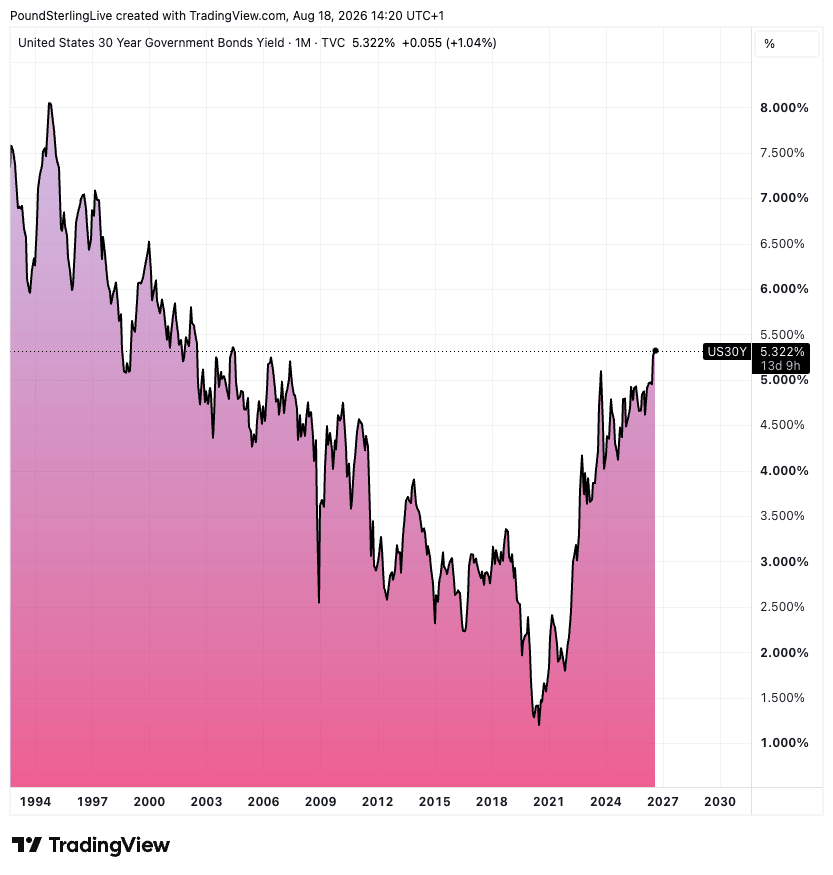
"The rise reflects growing consensus that the energy shock is beginning to feed into longer-term inflation uncertainty, alongside some scepticism about Warsh's less-than-clear hawkish credentials. We continue to view a further bear-steepening move as dollar-negative," explains Convera.
The debasement argument runs as follows: when long-term yields rise because investors demand extra compensation for inflation and debt risks, higher yields stop being a source of currency support and start signalling eroding confidence in the assets behind the currency.
"We are starting to see a bit more momentum into the softer USD trade," says Dominic Bunning, FX strategist at Nomura.
Lloyds Bank analyst concurs that the rise in longer-term debt "may reflect a rise in term premia, with investors demanding greater compensation for inflation risks associated with persistently higher energy prices and concerns over rising government debt levels."
Hyperscalers Add to Supply
The supply side looks to be supporting the trade thanks to the increase issuance of debt by private sector firms.
Investors are being asked to absorb a significant increase in bond issuance from the U.S., France, UK, Japan et al at exactly the same time the Gulf conflict keeps the energy-price inflation channel open.
And there is a further twist for Dollar watchers: the same AI investment boom that has offered the currency structural support through record equity inflows is now adding to the bond market's burden, as the hyperscalers fund their data centre buildout in the debt markets.
ING's rates strategy team point out that 30-year US Treasury swap spreads have not widened, which suggests it isn't fiscal concerns driving the move.
"More compelling is the heavy investment-grade issuance from the US hyper-scalers," says ING.
On that reading, the long-end lift reflects corporate bond supply competing for investor cash, a technical pressure that says nothing about confidence in the U.S. government's finances.
The outcome remains consistent: increased supply against stable demand lowers the value of underlying bonds and pushes their yield higher.
Not So Fast, Says BofA
A counterpoint comes from Bank of America, where analysts see less evidence of risk premium being the primary driver of USD.
"The recent USD sell-off can almost entirely be attributed to front-end rate differentials," say the analysts in a weekly FX briefing.
Notably, BofA finds no evidence of a risk premium "gap" opening up, as was observed last year when the market worried about a credibility deficit in Fed policy under a new Trump-aligned Fed Chairman.
The exact driver matters for what comes next for USD.
If the debasement camp is right, Dollar rallies stay capped and further bear-steepening acts as a standing sell signal for the currency regardless of what the Fed does.
But if the Dollar's fate remains a front-end story, September's Federal Reserve meeting, where markets still price a live chance of a hike, decides whether the slide extends or reverses.