Image © Adobe Images
Recent dollar weakness is not another rerun of the dollar debasement trade, shows new research.
There's an argument doing the rounds that the U.S. Dollar's recent slide is evidence of a rising risk premium following the "awkward" 30 July Federal Reserve policy meeting.
"Fed credibility risk is USD negative," says Bank of America in a weekly foreign exchange research report. The research comes as investors question whether we're seeing a rerun of 2025's debasement trade.
"The rally in gold prices is consistent with the risk premium narrative, especially with the latest data showing central banks resumed gold purchases in 2Q after stepping away in 1Q," adds the report.
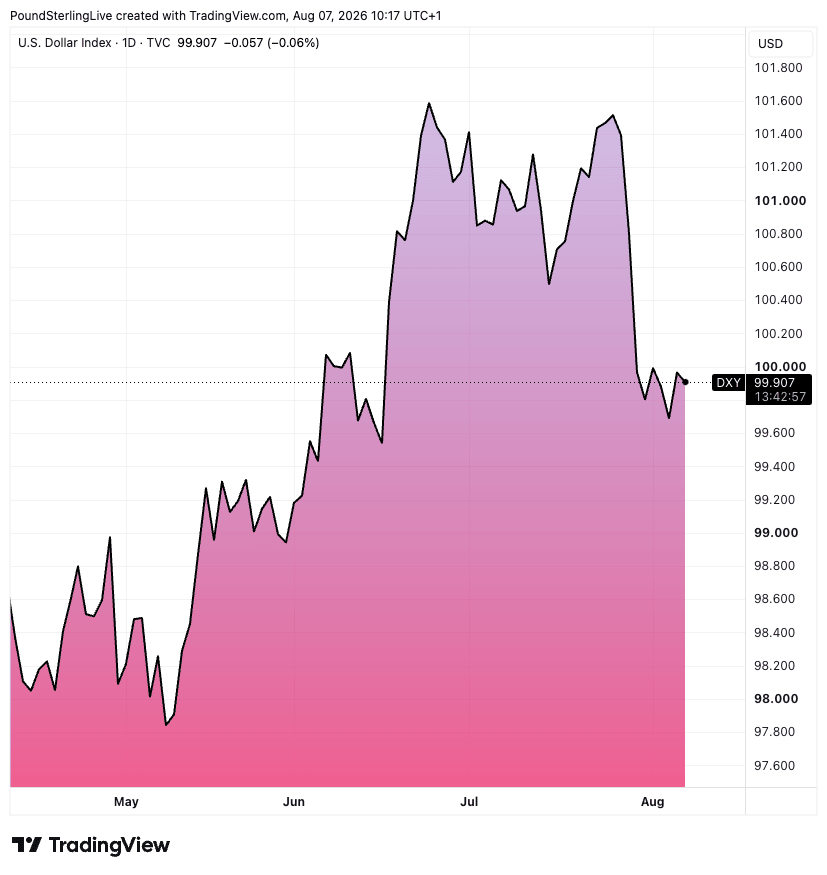
Above: USD weakness catches attention.
The dollar index, which is a measure of broader dollar performance, has fallen from 101.40 to 99.90 since the July Fed decision.
Euro-dollar has jumped from 1.1368 to 1.1540, pound-dollar from 1.3289 to 1.34480.
The Debasement Trade
The dollar debasement trade was the umbrella narrative that dominated 2025 markets: a bet that persistent deficits, political pressure on the Fed and chronically above-target inflation would erode the dollar's purchasing power.
Here, capital should rotate out of dollar cash and Treasuries into assets whose supply cannot be expanded.
Gold was identified as a prime benefactor. "The surge in gold and silver over the past three years is essentially a devaluation of the world's fiat currencies," economists at Standard Chartered wrote in a note released last October.
No 2025 Redux Says BofA
However, Bank of America's analysts say in their latest FX Weekly that they see less evidence of risk premium being the primary driver of USD.
Instead:
"The recent USD sell-off can almost entirely be attributed to front-end rate differentials," say the analysts.
Notably, there is no evidence of a risk premium "gap" opening up, as was observed last year when the market worried about a credibility deficit in Fed policy under a new Trump-aligned Fed Chairman.

The Bank Consensus, Without the Terminal
The median, mean, highest and lowest from the October survey update, plus named point forecasts out to 2027.
Free information pack, issued by World Wide Currencies.
"There is little evidence of risk premium in dollar option skew," says BofA. "This is again a notable contrast to 2025, when USD debasement concern led to a richening of USD puts vs. calls."
Further evidence against a debasement argument is that the USD has weakened alongside flat-to-lower US real rates and higher U.S. equities over the past week.
According to Bank of America, this "normal" relationship has been evident through most of 2026, in contrast to the concurrent sell-offs in USD, USTs and US equities observed last year.
What Next for the Dollar?
If front-end rate differentials are indeed doing the heavy lifting, the dollar's near-term path rests on U.S. data rather than on institutional credibility.
Watch the incoming inflation and labour market releases and the repricing they force into the September FOMC meeting: a dollar that keeps sliding while front-end spreads narrow in step confirms Bank of America's reading, whereas a dollar that falls without that support would point to something less benign.
The tells for a genuine debasement rerun are specific.
The first is a richening of dollar puts versus calls in option skew, which would mark the return of the risk premium gap that is currently absent.
The second is a breakdown in the "normal" relationship, with the dollar, Treasuries and U.S. equities selling off in concert rather than trading to the rate-driven script that has held through most of 2026.
The third is gold extending gains against a backdrop of rising real yields, which would sever the metal from its rate anchor and leave devaluation as the residual explanation.