
Image © Adobe Images
The British pound's recovery against the Canadian dollar looks fragile, but softer oil could hand it momentum.
The Pound to Canadian Dollar exchange rate has put together steady gains through September, but those gains sit inside a trend that has pointed lower since July, and we would imagine near-term pressures stay soft this week.
Oil is the wildcard, because the Canadian dollar has leaned on firm crude prices for support and Brent has just touched a ten-day low, which could give September's recovery the push it needs.
The 21-day and 100-day moving averages are converging and about to cross, and how the market trades around them will shape the rest of the month:
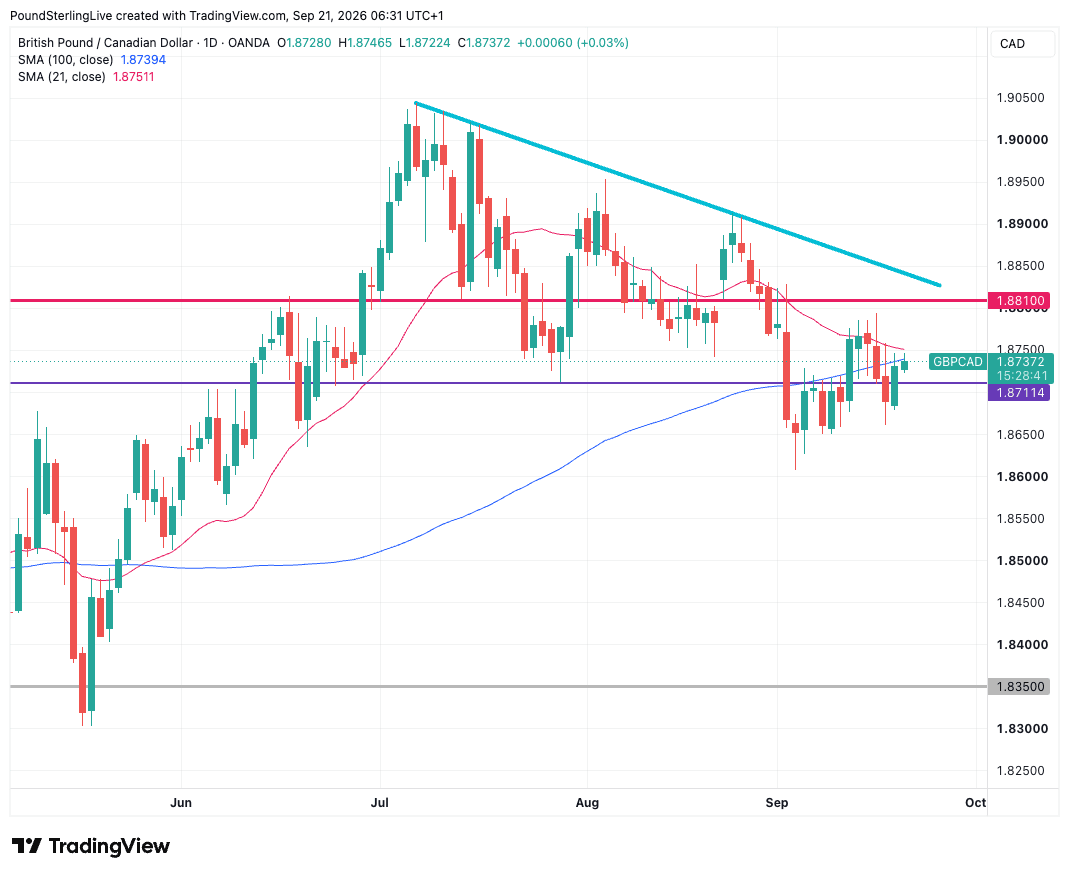
Above: GBP/CAD daily chart. Image © Pound Sterling Live, chart created with TradingView.
GBP/CAD trades at 1.8737 on Monday, having closed Friday at 1.8732.
What does the convergence denote? A short-term average meeting a medium-term one tells us the past month's price action has caught up with the trend of the past five months, and the crossover shows which of the two is gaining the upper hand. Here, the read is not yet clear, and we would not lean on the crossover for direction this week.
September's gains have come inside a decline that has run since July, and a recovery against the grain of the trend tends to lose energy before it can overturn it.
For now, we think near-term pressures stay soft and the Pound struggles to establish itself above the converging averages, while a sustained move above them would suggest September's attempted recovery can build some momentum. That keeps the Pound to Canadian Dollar forecast cautious for the days ahead.
Falling Oil Leaves the Loonie Exposed
The oil market could supply the verdict the chart has not, since the Canadian dollar fell 0.81% against the U.S. dollar last week with higher crude prices limiting its losses.
Brent trades near $102.70 on Monday, and a break beneath $100 would remove part of the Loonie's support.
Oil and liquefied natural gas shipments through the Strait of Hormuz over the past fortnight reached their highest level in six months, according to U.S. Central Command, even as Iran maintains it has closed the strait.
"Clearly, momentum is building," said Admiral Brad Cooper, head of U.S. Central Command, in a video message on Saturday.
Bank of Canada Governor Tiff Macklem speaks in Halifax on Monday, and National Bank of Canada expects him to offer insight into how tariffs and rising energy prices bear on the policy path. A hawkish tone would support the Loonie, while concern for growth would weigh on it.
Canadian inflation held at 3.0% in August, with the preferred core measures, CPI-median and CPI-trim, at 2.0% and 1.9%, which leaves the Bank of Canada under little pressure to act.
July's retail sales figures, a second-tier release, may show headline sales falling 0.8% month-on-month as consumers cut discretionary spending to cope with rising energy costs, according to National Bank of Canada. Under the FX rule of thumb, a weaker print than expected would weigh on the Loonie and a stronger one would support it.
A Canadian dollar stripped of oil support, with soft domestic spending and core inflation near 2%, would give the Pound the opening it needs to push above the converging averages, a reversal of the headwind oil has posed. Until Brent makes that break, our Pound to Canadian Dollar forecast leans towards the soft conditions of the post-July trend.