
Image © Adobe Images
The British pound looks set for further losses against the Australian dollar, and Thursday's jobs data could speed them.
The Pound to Australian Dollar exchange rate looks set to extend its downtrend this week, now that the rebound of early September has run its course and sellers have regained the upper hand.
Any decline should be a gradual one, since the more significant support lies some distance beneath the market and a softer oil price takes a little of the shine off the Aussie.
The 21-day moving average is pointing lower and is capping the Pound's attempts at strength, which keeps the path of least resistance pointed down:
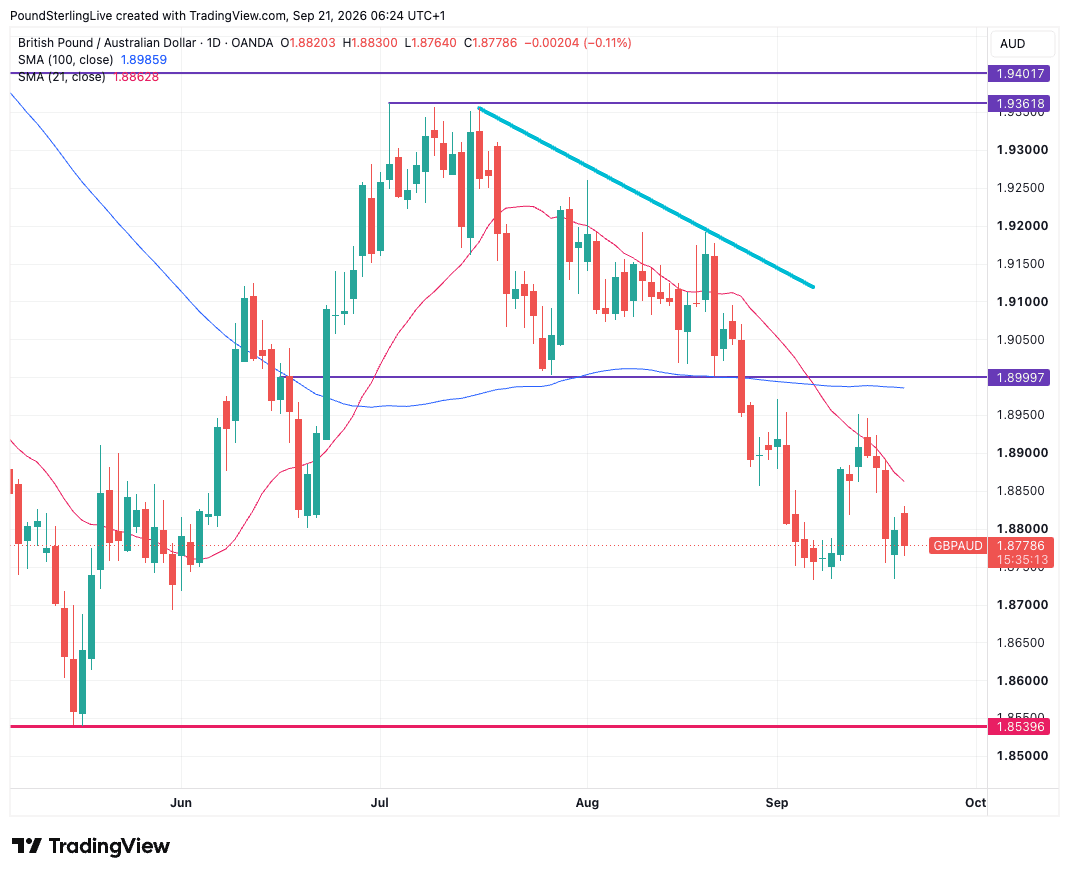
Above: GBP/AUD daily chart. Image © Pound Sterling Live, chart created with TradingView.
GBP/AUD trades at 1.8778 at the start of the new week, having closed Friday at 1.8800, beneath a 21-day that has turned lower.
The rebound in the first half of September looks to have been a technical mean-reversion: the Pound had fallen a full percent beneath its 21-day by the start of the month, and a deviation of that size tends to close as the market errs back towards the average.
Earlier this month we said the Pound looked due a corrective bounce, and that beyond it the decline had further to run. The bounce has come and gone, and with the gap to the average closed, the falling 21-day now sits above the market and the downtrend is back in control.
That keeps the Pound to Australian Dollar forecast pointed lower, and we look for further weakness this week. The selloff can run down to graphical horizontal support at 1.8535, although that is a multi-week objective and one we would target by mid-October, while a daily close above the 21-day would challenge the view.
Australian Jobs Data Can Push the RBA Closer to a Hike
Thursday's August labour force survey is the week's calendar highlight for the Pound to Australian Dollar rate, and the top-tier release on the Australian side of the pair.
"Consensus expects Australia's August employment report to show a rebound in hiring after July's decline, which would reinforce our call for the RBA to raise the Cash Rate by 25 bps in September," says Wells Fargo [VENUE AND DATE TO CONFIRM].
Under the FX playbook, a print above expectations would lift the Aussie and push GBP/AUD lower, while a miss would weigh on the Australian currency.
How does a jobs report reach GBP/AUD? A strong labour market gives the Reserve Bank of Australia the cover to raise interest rates as soon as this month, and higher Australian rates draw capital into the Aussie.
Market pricing puts the odds of a September RBA hike at around 90%, and Westpac has brought its own call forward to this month, according to its Australia and NZ Weekly of 21 September.
With a hike so heavily priced, we think the greater risk to the Aussie lies in a disappointing number, which would do more to unwind expectations than a strong one could add to them.
Consensus projections for the next four quarters, compiled from leading investment banks.
Access the full forecast →
Governor Michele Bullock, the Assistant Governor (Economic) and a Monetary Policy Board member all speak during the week, second-tier events that will be read for any hint on timing.
The softer oil price is the other counterweight, because elevated energy prices cushioned the Aussie last week, when it was the best performer of the non-U.S. currencies covered here.
Thursday also brings the meeting between Presidents Trump and Xi in Washington, a China-facing risk for the Aussie, and officials describe preliminary talks as "very successful".
A jobs report that confirms the rebound in hiring, followed by a constructive outcome in Washington, would leave the RBA little reason to wait beyond this month and the Aussie well supported. That combination fits the downtrend on the chart and keeps our Pound to Australian Dollar forecast aimed at 1.8535 over the coming weeks.