Image © Adobe Images
Pound sterling looks set to drift lower against the euro this week as softer oil erodes its yield support. Weakness to be strictly limited.
The Pound to Euro exchange rate looks set to hand back Friday's late gains in the coming days, with a slide in oil prices to a ten-day low threatening to pull UK bond yields lower and take away the support that lifted Sterling into the weekend.
Yet the Euro is in no position to press home any advantage, with soaring German wholesale power prices and strong weekend results for non-traditional parties in German state elections adding to the political uncertainty already surrounding France, so we expect any spell of softness to be shallow.
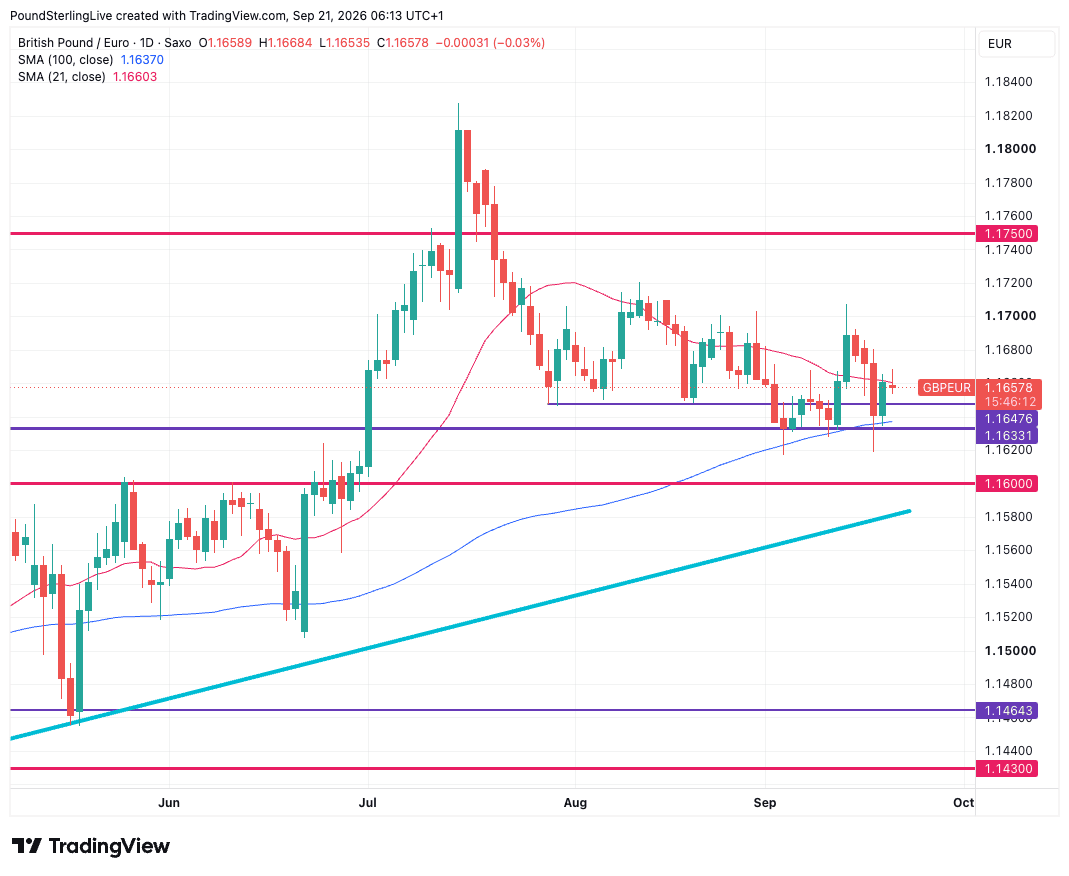
The 100-day moving average has spent the spring and summer rising and is now flattening out, and it is likely to act as a centre of gravity that draws the market back towards it this week:
Above: GBP/EUR daily chart. Image © Pound Sterling Live, chart created with TradingView.
GBP/EUR fell to 1.1615 after the Bank of England held interest rates on Thursday, recovered to 1.1661 by Friday's close, and trades at 1.1658 on Monday.
We got last week's call wrong: we looked for the recovery to extend towards 1.1708 and then 1.1750, and instead the Bank's decision sent the pair back down and the week ended flat.
However, downside is proving limited. What does a flattening long-term average denote? A rising 100-day tells us buyers are in control of the medium-term trend; once it levels off that control has lapsed, and the average becomes a pivot the market trades either side of, pulling prices back each time they stray.
With that in mind, we think the Pound drifts back towards the 100-day this week, with falling oil the likeliest trigger, and a daily close back above last Monday's high at 1.1708 would put the recovery back on track. That makes for a softer Pound to Euro forecast than a week ago, although nearby support and a Euro carrying its own baggage should limit how far any decline can run.
Oil and Bond Yields Set the Pound's Course
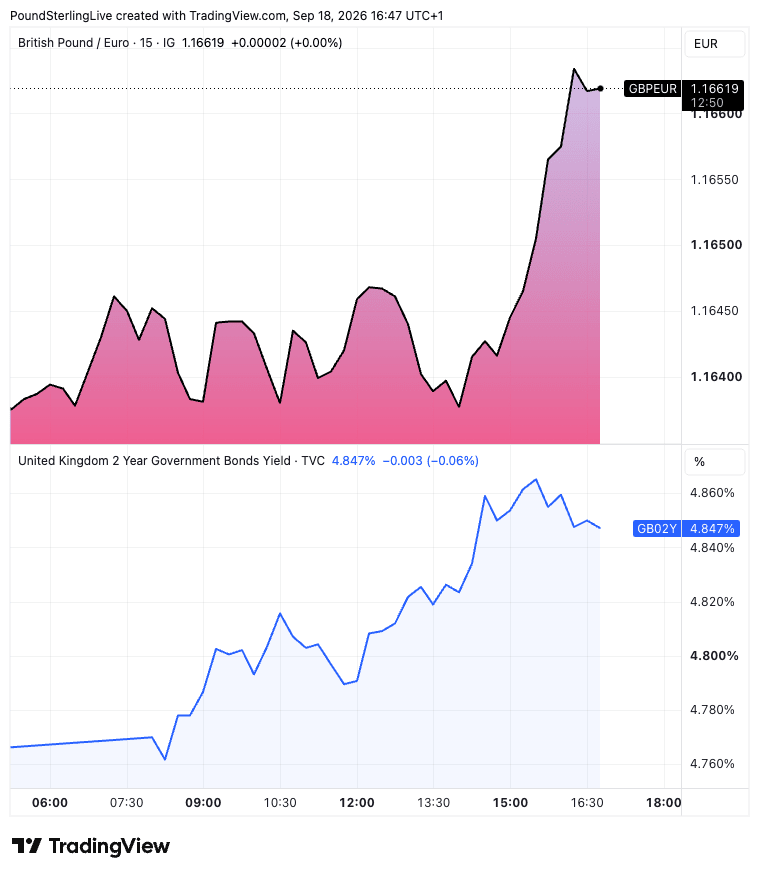
The short-term chart is consistent with a drift lower, and the fundamental driver behind it sits in the bond market, where the Pound has been tracking the UK two-year bond yield:
Above: GBP/EUR plotted against the UK two-year bond yield. Image © Pound Sterling Live, chart created with TradingView.
Friday's late bid for Sterling came as a fresh selloff in global bonds lifted yields, a move tied to rising oil prices, as we reported at the time.
Brent crude opened higher on Monday but fell to a ten-day low at $102.70 by mid-morning in London, and the immediate risk is a break below $100 a barrel.
"Now that a week has passed since the pipeline attack in Saudi Arabia, there is more evidence that the supply disruption is less significant than feared," says a morning note from Julius Baer on Monday.
Since the Middle East conflict began, GBP/EUR has tended to rise alongside oil, suggesting the market sees the eurozone as more exposed to energy costs than the UK; run in reverse, the same relationship would weigh on the Pound if Brent breaks lower.
Market pricing for a November Bank of England rate hike stands close to 90% after last week's 6-3 vote, in which three members favoured an immediate move, and softer oil chips away at the case for one.
"Bottom line: GBP remains vulnerable to a dovish BOE repricing," says Elias Haddad, Global Head of Markets Strategy at Brown Brothers Harriman.

Daniella Arcadipane, Senior Currency Specialist at Indigo
Moving a life-changing sum abroad? You won’t be doing it alone.
Wednesday's PMI Surveys Are the Calendar Highlight for Pound-Euro
Wednesday's flash PMI surveys for September are the top-tier releases for this pair, and they will show how far the renewed rise in energy prices is biting into activity on both sides of the Channel.
The FX rule of thumb applies: a reading above expectations tends to lift the relevant currency, while a miss weighs on it.
Lloyds Bank's Market Insights team forecasts the UK composite PMI edging up to 52.7 from 52.5, which would point to resilient activity despite a more uncertain backdrop, while the eurozone readings will be watched for the toll higher energy costs are taking on new orders.
A UK beat set against a eurozone miss would be the Pound's best chance of holding its ground, but it would likely do no more than slow a drift that softer oil prices look set to drive. On balance, that keeps our Pound to Euro forecast pointed gently lower, towards the flattening 100-day.
Daniella Arcadipane, Senior Currency Specialist at Indigo
Moving a life-changing sum abroad? You won’t be doing it alone.
One specialist explains every step in plain English and stays with it until the money lands. FCA authorised, FRN 594433.
Talk to a specialist