
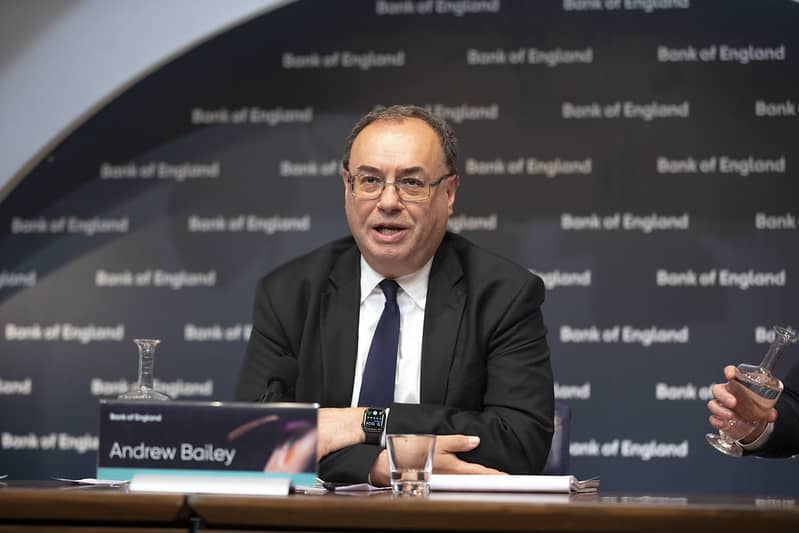
Andrew Bailey, Governor of the Bank of England. Image courtesy of the Bank of England.
The Bank of England walks a dovish path that diverges from its peers, pressuring the British pound against the euro and dollar.
The outlook for pound sterling has softened after the Bank of England voted 6-3 to maintain Bank Rate at 3.75%.
That's dovish; if it was an on-the-cusp decision of 5-4, we would have received a 'hawkish' steer.
But this is a central bank that is going it's own way and not following other central banks like the ECB and Fed in tightening policy over the course of the past week.
"The Bank of England is the exception this time around: In a 6-3 vote by its Monetary Policy Committee, the Bank held interest rates steady at 3.75%. With the Bank of Japan expected to hike tomorrow, and both the Federal Reserve and the European Central Bank having already raised rates, the BoE is alone among the major central banks in holding off this month," says the economist Mohamed A. El-Erian, adivsor to Allianz and former CEO of PIMCO.
For the pound, that's a dovish steer, and initial foreign exchange price action reflects that:
The pound-to-euro exchange rate drops a quarter of a per cent to 1.1640, the pound-to-dollar adds to its post-Fed losses to 1.3359.
Pound Sterling Live's reading from the decision and guidance is that the Bank doesn't think surging fuel and gas prices will influence wage and price-setting trends in a meaningful manner, even if it thinks there is a risk this will be the case the longer the crisis in the Middle East continues.
They are therefore not ready to take a proactive risk management approach to the question of energy and fuel prices embedding rises in core measures of inflation.
That's confirmed in the statement: "There has been little evidence so far of material second-round effects in price and wage-setting"
And it's clear the Bank is relying on external factors to do the 'dirty work' that is tightening conditions: "soft labour market conditions, and the higher interest rates faced by households and businesses since the conflict began, will act to reduce inflation over time."
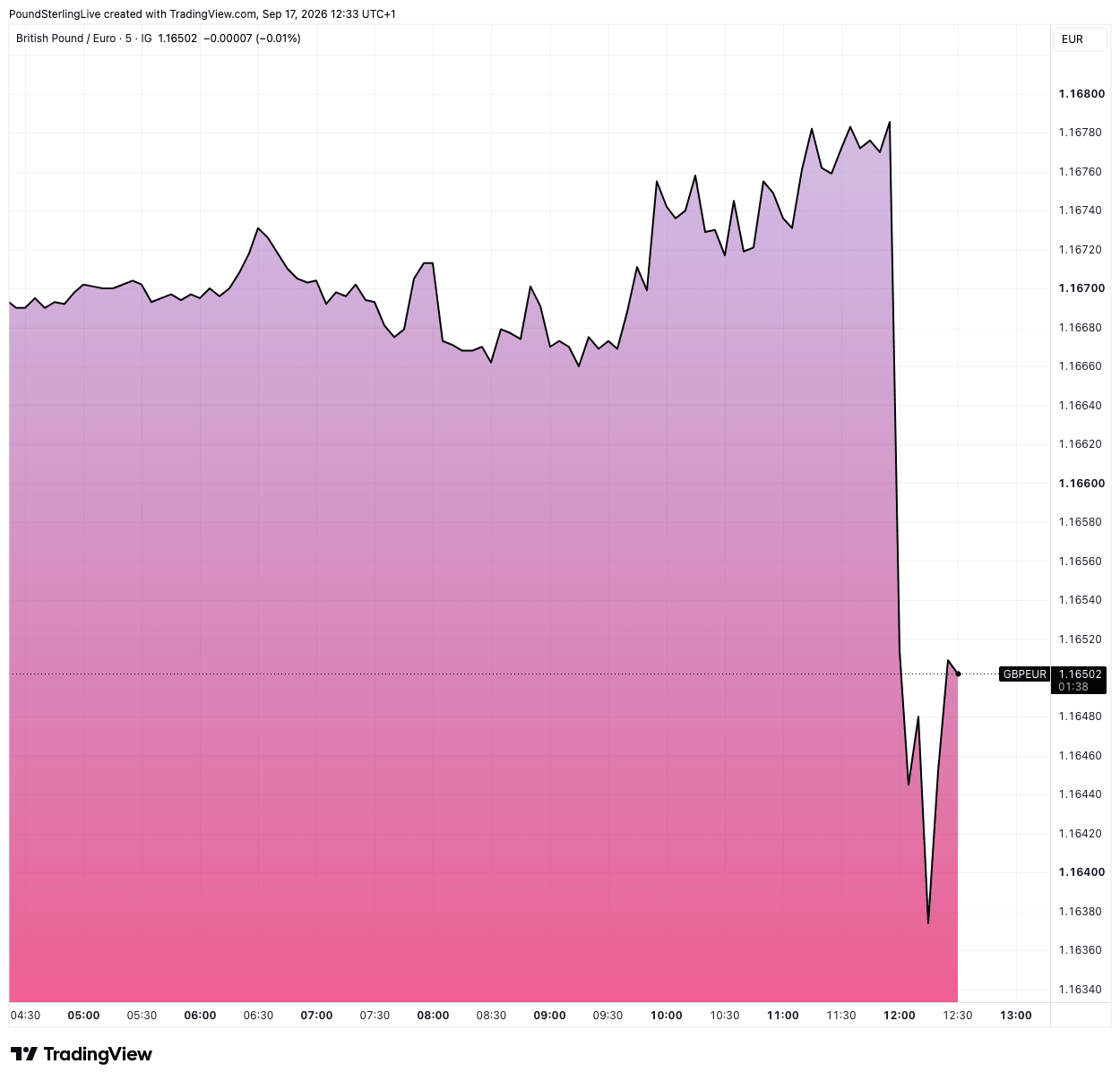
Above: GBP/EUR at 5-minute intervals.
In short, pulling the interest rate lever is not required as households are being squeezed by higher interest rates determined by bond markets where yields have surged (look at mortgage rates over the past week), and workers don't have the job opportunities available to them to command higher wages.
The risk with this strategy is the Bank is seen as not willing to counter inflation which now runs at 3.1%, well above its target. There's a real risk that perceptions of the Bank's reaction function and willingness to fight inflation shift to the extent that its credibility is questioned.
When the Bank loses that hard-won credibility, inflationary risks begin to unanchor.
The ONS told us on Wednesday inflation is at 3.1%, very much above the 2.0% the Bank is mandated to target.
"The BoE has historically maintained looser policy than traditional rules would imply, and we continue to expect rates to remain unchanged this week," points out a recent note from investment bank CIBC.
Pound sterling entered the Bank's decision on the back foot in the wake of Wednesday's inflation release which was in line with consensus expectations. Indeed, the underlying numbers showed that domestic inflationary pressures are still trending down.
That encouraged a majority of the Monetary Policy Committee (MPC) to hold interest rates. However, in light of last week's ECB hike, and Wednesday's Fed hike, that creates a divergence in policy that should work against the pound.
"We think the risks are actually on the dovish side this week. Unlike the ECB, we suspect BoE doves will hold their ground and stress that there is no evidence price pressures are extending beyond energy prices," says a recent strategy note from ING, the Dutch bank.
ING strategists say they are not minded to trust the recent GBP/EUR recovery. "We struggle to see EUR/GBP falling much further from here," says ING's FX Strategist, Frencesco Pesole.
He explains that most risks appear on the upside for the euro in the coming weeks with the pound facing building downside risks, from the monetary policy story mentioned above to potential fiscal headlines ahead of the late October budget to growing pressure on Downing Street to allow independence referendums in Scotland, Wales and Northern Ireland.
ING's target remains 0.87 for EUR/GBP, which gives a GBP/EUR of 1.15.
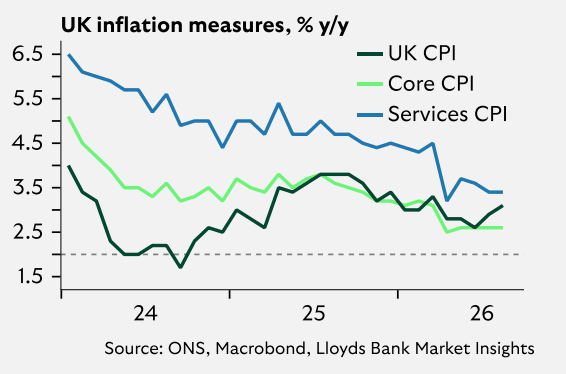
Above: The chart that MPC 'doves' will lean on, it shows underling inflation trends are behaving.
No Desire for Prudent Risk Management
The market entered Thursday expecting up to for four rate hikes, a level that Pound Sterling Live has argued is not a realistic positioning.
Indeed, even one hike might be too much for this most 'dovish' of central banks.
Dr. Savvas Savouri, economist at Quantmetriks, says the Bank should have hiked today as a form of risk management to guard against inflation becoming even more entrenched (as it already is!) in the future.
"The Bank does not need to prove that second-round effects are coming, which unreliable survey data could not show conclusively in any case. It needs to decide whether the data today are sufficient to conclude that the risk of second-round effects becoming embedded is too high to ignore. We judge they most certainly are," he says.
The pound has entered a soft phase with a 'dovish' central bank adding an additional headwind to pre-budget uncertainty.
Only if the budget passes without incident would the conditions for a meaningful recovery start to emerge.

The Bank Consensus, Without the Terminal
The median, mean, highest and lowest from the October survey update, plus named point forecasts out to 2027.
Free information pack, issued by World Wide Currencies.