
Image © Adobe Images
The euro could stay under pressure while Europe's gas bill climbs into a winter it enters with depleted storage.
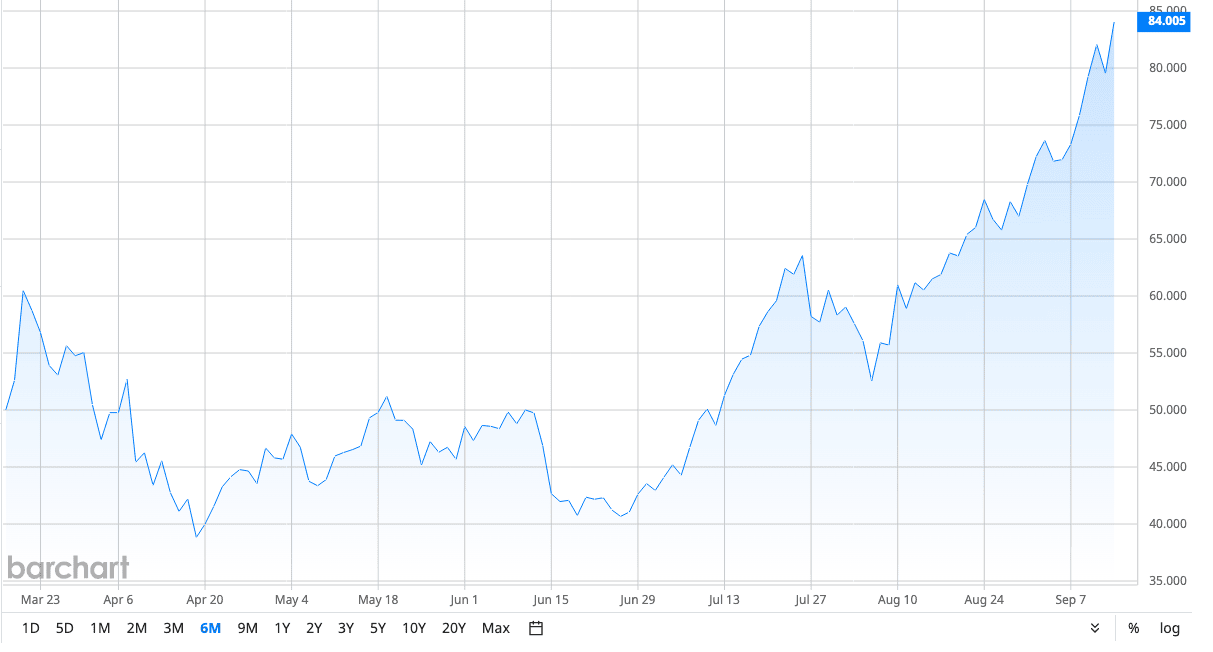
European gas prices rose above €80 per megawatt-hour on Monday, a multi-year high, and the euro has broken support against both the dollar and the pound.
Dutch TTF, the wholesale European benchmark, climbed from €80/MWh to €84 on Monday as Houthi forces extended their grip on Red Sea ports and Iranian-backed militia struck the Saudi East-West pipeline, according to KBC.
Regional officials say repairs to the pipeline could take three to five weeks.
"Natural gas is now around 85% above its late-April level," says a note from Berenberg, the investment bank.
The move in gas is euro-specific in a way the oil price is not, because Europe buys most of its gas from abroad and pays for it in dollars. The Eurozone economy also has a large manufacturing and industrial component, a useful insight when comparing against the services-orientated British economy, which would explain why the EUR is struggling against the GBP.
"Energy shock undermines EUR while USD gains further ground," says Fawad Razaqzada, Market Analyst at StoneX.
Rabobank had named further damage to Gulf LNG infrastructure as the main risk to a slower price normalisation next year.
"Gas will keep power prices high into 2027: low gas storages and disrupted Gulf LNG flows support the near-term outlook," says Rabobank of the outlook for EU wholesale gas prices.
European power prices are running at €130 to €150/MWh across most markets, the same research finds, with stronger wind output lowering day-ahead prices without pulling the forward curve down.
Eurozone storage stood at 65% full at the end of August against a norm closer to 80%, leaving the bloc buying the shortfall in a spot market that is pricing a supply disruption.
EUR/USD and EUR/GBP: Where the Levels Sit
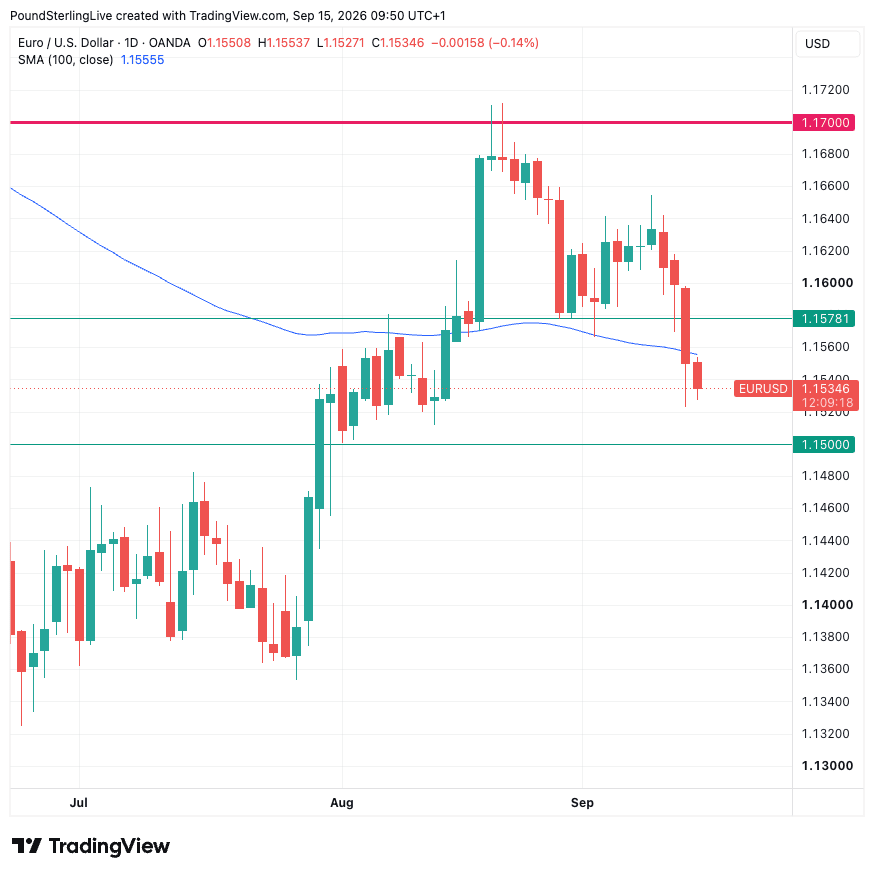
The euro-to-dollar rate trades at 1.1537 on Tuesday, a one-month low, having closed Monday beneath the 100-day moving average at 1.1557 that had been the floor of the range.
"The EUR/USD has broken below the lower trendline of its triangle pattern today, taking support around the 1.1565 to 1.1580 area," says Razaqzada.
The early-August consolidation near 1.1500 is the first structure beneath the market, and under that the chart stays empty until the July low near 1.1320.
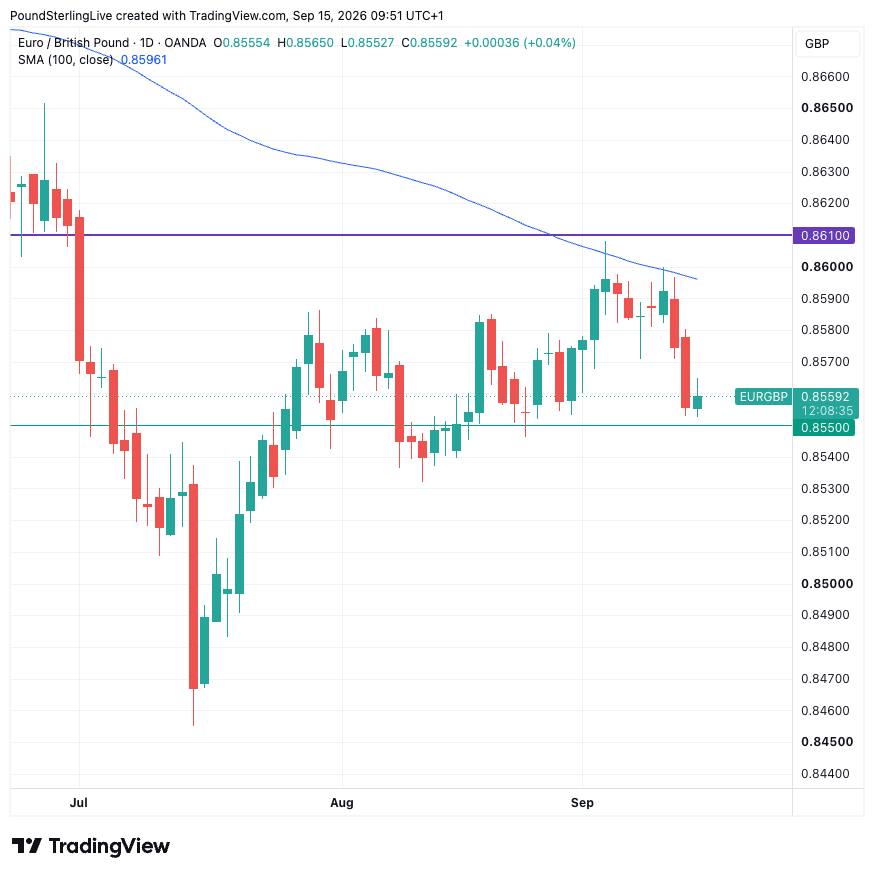
The euro-to-pound rate trades at 0.8563, equivalent to 1.1678 in pound-to-euro terms, after failing at the 0.86 resistance KBC had flagged as under test.
"GBP showed resilience on Monday, with EUR/GBP down to 0.856, supported by strong pricing of BoE rate hikes," says Natixis.
However, CIBC looks for the euro-to-pound rate to correct back towards support at 0.8532, which inverts to 1.1721 on the pound-to-euro chart, having rebounded from its 100-day average at 0.8598.
EUR/USD and EUR/GBP: The ECB Response Cuts Both Ways
The gas shock is what keeps the European Central Bank hawkish, and that is the euro's one source of support.
Isabel Schnabel called energy price developments quite concerning on Monday, while Martins Kazaks warned that restrictive rates may be needed and said the case is building for more tightening, according to KBC.
Peter Kazimir repeated that markets understand the ECB responds to data, a remark Christine Lagarde declined to make at last week's press conference.
Money markets now price nearly four ECB hikes by July 2027, says Natixis.
Morgan Stanley changed its call on Tuesday and now expects a 25bp hike in December, taking the deposit rate to 2.75%, followed by a single cut in December 2027.
ABN AMRO expects 50bp from both the Fed and the ECB before year end.
Higher rate expectations should support a currency, yet the euro has fallen anyway, suggesting the market sees rate hikes and higher gas prices as descructive for the economic outlook.
It raises the point that there are 'good' and 'bad' rate hikes: the former being a response to a strong economy that's increasingly inflationary, the latter being a response to an external shock.
"EUR/USD slips to 1.1538 despite firmer ECB rate hike expectations," says Natixis.
Berenberg cut its 2027 eurozone growth forecast to 1.1% from 1.3% on the double squeeze of higher energy costs and higher interest rates, and raised its 2027 inflation call to 2.6% from 2.2%.
Rate Hike Bets Overdone
"I remain sceptical that the ECB will actually deliver further rate increases," says Razaqzada.
Against the pound that scepticism matters less, because the market is pricing five Bank of England hikes over the next twelve months and analysts doubt those too.
ABN AMRO holds its end-2026 euro-to-pound forecast at 0.87, or 1.1494 against the pound, and expects the pair to rise modestly from here.
EUR/USD and EUR/GBP: Two Central Banks This Week
The dollar has strengthened this week, suggesting the market views an energy shock as being less of an issue for the U.S., which is a net exporter of oil and gas.
The dollar index rose to 99.6 on Monday, its strongest session since Federal Reserve Chairman Kevin Warsh's Jackson Hole speech, with the 10-year Treasury yield touching 5.00% for the first time since October 2023.
Markets price a 93% chance of a Fed hike on Wednesday, according to CBA.
"A risk-off, hawkish hike by the Fed tomorrow could easily take the pair to our 1.150 short-term target," says Francesco Pesole, FX Strategist at ING.
The Bank of England follows on Thursday, and Tuesday's UK labour market data showed conditions softening further, which leaves the euro-to-pound rate exposed to whether the vote split endorses the hikes priced.
Our house view for the short-term is that the gas story stays in charge this week, and that makes for a down week in euro-dollar, whatever the Fed delivers.
A Fed that raises rates and signals it has finished gives the euro a shot at recovery against the dollar, with the broken band at 1.1557 to 1.1578 the level such a recovery would be tested at.
Against the pound the equivalent test is 0.86, or 1.1628, which capped the euro on Monday and would need to give way before the gas shock could be said to be driving this cross too.
Lagarde speaks in Vienna on Tuesday afternoon, and with the 29 October decision now priced as a live meeting, her reading of the gas shock matters more to the euro than the rates she has already delivered.

The Bank Consensus, Without the Terminal
The median, mean, highest and lowest from the October survey update, plus named point forecasts out to 2027.
Free information pack, issued by World Wide Currencies.