

Image © Adobe Images
Pound sterling can build on recent gains against the euro say the charts, but inflation data and the Bank of England decision could be spoilers.
The pound-to-euro exchange rate has started the new week on a strong footing, courtesy of a big sell-off in the euro owing to a surge in gas prices. As a result, the pair has now won back everything it lost in the first days of September and pushed through the shelf that gave way on the way down, with Monday adding a run to 1.1708 in early Asia trade before the market settled back.
That means last week's forecast for a corrective bounce towards 1.1648 and then 1.1675 was on the money and we would be more inclined to think the post-July correction lower is drawing to a close:
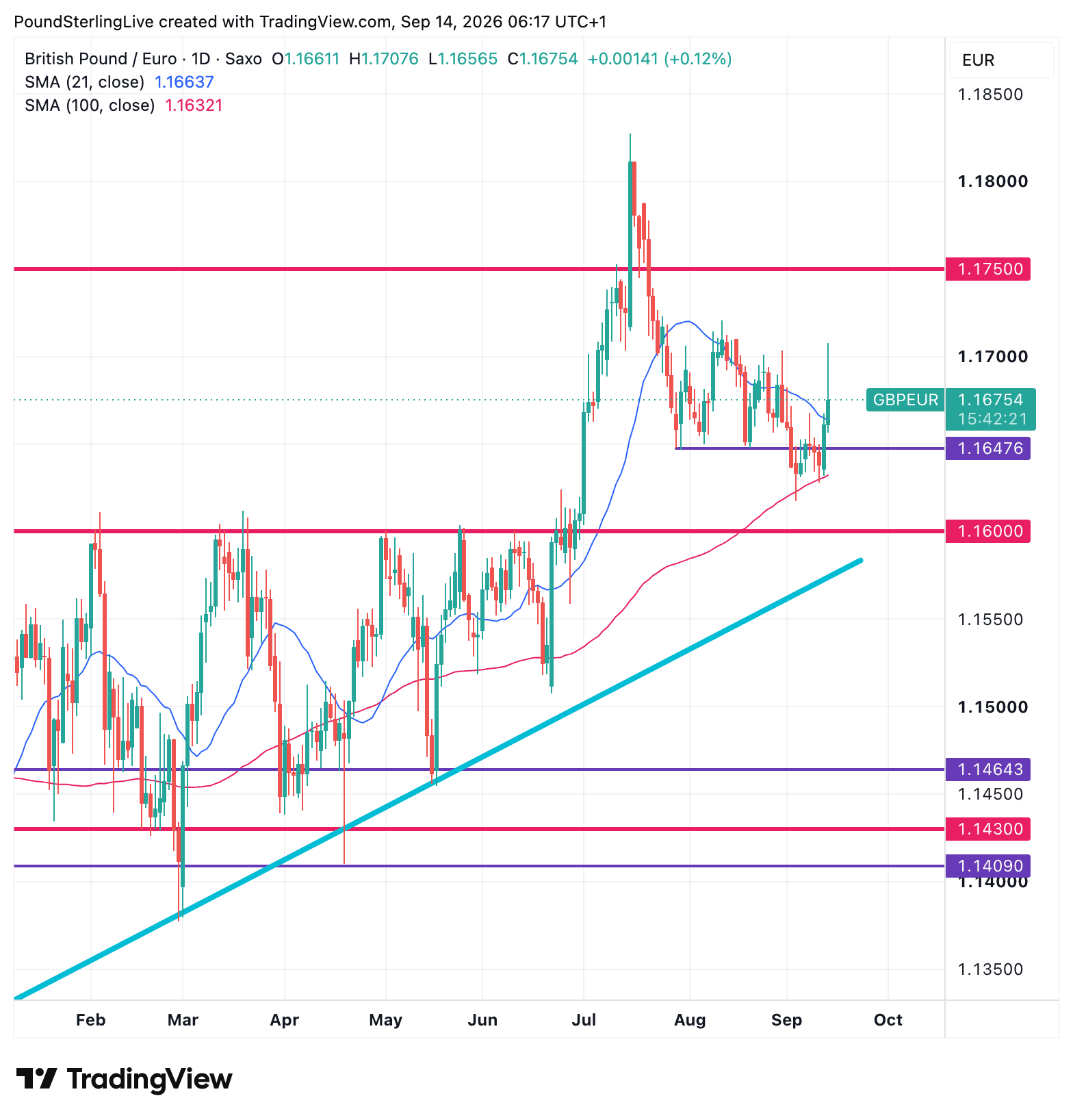
Above: GBP/EUR daily chart. Image © Pound Sterling Live, chart created with TradingView.
All in all, it's a constructive setup underpinning GBP/EUR: looking at the chart, Monday's break through the 21-day moving average - currently at 1.1664 - is interesting; if it can hold the close above here, the prospect of further gains becomes possible. Note that since the middle of July this indicator has turned back every recovery attempt through August.
The post-July decline meanwhile caught the rising 100-day moving average at 1.1632, that MA has risen and held GBP/EUR aloft since April, and it caught the fall in the first days of September. A rising long-term average that stops a decline is doing the job the medium-term uptrend needs of it, and this one has now done exactly that.
1.1648 floored the market through August, gave way at the start of September and has now been won back. A level recovered after a break works as support from above, which puts the first floor of this recovery just beneath the 21-day.
Monday's session ran to 1.1708 before giving most of the gain back; the long upper wick on the green candle says sellers met the move, and it says just as clearly that buyers were willing to chase it well above the open to find them.
This week we forecast the recovery to extend towards Monday's high at 1.1708 and then 1.1750, with 1.1648 and the averages beneath it the support this move can afford to lose. A daily close back beneath the 100-day at 1.1632 would end it and put 1.1600 in play, and our Pound to Euro forecast turns properly constructive once the 21-day flattens.
Jobs, Inflation and Bank of England
It's a busy week for Britain on the financial front.
Tuesday's wage data feeds the Bank of England's judgement on second-round effects, Wednesday's inflation print lands the day before the Monetary Policy Committee's vote on whether or not to raise rates, and Thursday the Bank drops its decision.
The labour market:
The big picture first: the labour market is stabilising and the Bank will be less anxious than it was entering 2026. Consensus looks for private sector wage growth unchanged at 2.8% in the three months to July, unemployment unchanged at 4.9%.
Transmission into GBP: Wage growth above consensus argues inflation has a domestic engine the Bank cannot wait out, lifts gilt yields and Sterling. A miss does the reverse. The specific thing the MPC is reading this for is second-round effects: easing wage growth is the evidence base for the hold, so an upside surprise here is what starts the week moving against the doves who would argue against the need to raise rates.
Stable data at consensus is consistent with a hold and leaves Wednesday and Thursday to carry the week.
Wednesday's August CPI:
Consensus expects headline inflation to edge up from 2.9% to 3.0% compared to the same month last year.
Transmission into GBP. An inflation print above consensus argues the economy can carry higher rates, lifts gilt yields and Sterling with them; a miss does the reverse. The asymmetry this week is that the print lands the day before the decision. At 3.1% the hold is comfortable. At 3.3% the three dissenters have their argument handed to them the evening before they vote, and the market will reprice the November meeting rather than this one.
The Bank of England:
Consensus: hold at 3.75% for a sixth straight meeting, on a 6-3 vote, with Greene, Mann and Pill backing a hike. BofA and BBH agree on both outcome and split.
Select Views:
- BofA: hold through 2026, cut November 2027, but hike risks have become more pronounced. They expect the tone to shift more hawkish than July, flagging greater upside inflation risks with the door kept open, while stressing the Bank is unlikely to out-hawk market pricing.
- Pantheon moved on Friday to 25bp hikes in November 2026 and February 2027, citing solid growth, surging energy prices and an expected strong August print. Their preview title is the argument in six words: holding on for dear life and signalling a hike.
- BBH argues the curve is too hot. Swaps imply 125bp of hikes to 5.00% over twelve months, against the negative output gap, a policy rate already near the top of the 2% to 4% neutral estimate, and tighter fiscal policy ahead. That leaves GBP exposed to a dovish repricing.
Transmission into GBP. The hold is priced, so Sterling moves on the vote split and the statement. A 7-2 split or softer language on upside risks reads dovish and unwinds part of the 125bp. An 8-1 or a shift in the guidance toward an explicit hike signal validates it. On BBH's reading the risk is skewed toward the first.
Gas Price Headache for the Euro
The euro is particularly sensitive to global gas price developments, and weekend news that the Houthis are increasing their stranglehold over key shipping routes in the Middle East has pushed oil and gas costs higher.
The UK is of course also exposed, but what's important is that the EU has a higher beta to the issue, most likely because of the zone's greater manufacturing and industrial base than that of the UK.
TTF front-month gas prices, the Eurozone benchmark, have surged to 83.77 euros per megawatt-hour on Monday. That comes against Eurozone gas storage being just 65% full at the end of August, compared with a norm closer to 80%, ensuring the bloc is going into winter with a deficit it has to buy in the spot market.
"The price of diesel and natural gas in Europe are climbing at faster rates than the oil price, for example, Brent crude futures climbed 13% last week, and Brent is above $107 per barrel, this is the highest level since May. In contrast, the price of European Natural Gas is at its highest level since 2023," says Kathleen Brooks, analyst at XTB.
The euro is lower across the board as a result, and it's not hard to see this issue pipping central banks and UK data in the coming week.

The Bank Consensus, Without the Terminal
The median, mean, highest and lowest from the October survey update, plus named point forecasts out to 2027.
Free information pack, issued by World Wide Currencies.