File image of Mark Carney. Image source: WORLD ECONOMIC FORUM/swiss-image.ch/Photo Moritz Hager.
One of Canada's most important banks has set out its playbook for the Canadian dollar under expected trade war scenarios.
CIBC Capital Markets has attached probabilities to the three outcomes it sees arising from the Canada-US trade war and finds the Canadian Dollar's losses contained in each of them.
The Canadian bank's worst case is a full tit-for-tat escalation, given a 35% chance, that carries USD/CAD to 1.41 and no further.
"We don't think the tariff premia will be large even in a worst-case-scenario," says Sarah Ying, strategist at CIBC Capital Markets.
"This is not like February 2025 where the market panicked to 1.4793 on Trump's initial 25% tariff threat (which were assumed to cover all goods including those under USMCA)," she adds.
Ying's template is 2018, when Washington announced 25% steel tariffs on Canada and Mexico on 31 May and Ottawa retaliated on 1 July.
"USD/CAD rose around 4 big figures (around 1.30 – 1.34), BUT this also coincided with a Fed hike," she explains.
CIBC expects the Fed to stay patient through the rest of this year, which is why Ying is "comfortable calling a top in USD/CAD at 1.41".
The scenarios arrive as Ottawa prepares to show its hand, with Finance Minister François-Philippe Champagne and three cabinet colleagues due to unveil Canada's countermeasures.
Relations deteriorated through Monday after President Donald Trump told Canadian leaders to "fall in line" or face consequences "far WORSE" than the duties already in place.
Trump also threatened to lift tariffs on Canadian cars, trucks, auto parts and steel to 50% from 1 January 2027, putting Ontario's assembly plants at the centre of the dispute.
Prime Minister Mark Carney said the US demands showed Washington wanted to "destroy our major industries", and that Canada would not negotiate as a subsidiary of the United States.
USD/CAD trades at 1.3859 in response, up from the three-month low at 1.3760 posted on 21 August, while the Pound to Canadian Dollar exchange rate holds close to 1.89.
Escalation Is More Than a Tail Risk
Ying rates escalation above a tail because both capitals have now committed themselves in public.
"This is because Greer already stated the US will 'not tolerate' Canada's retaliatory measures so there could be more to follow," she says, a reference to the warnings issued by U.S. Trade Envoy Jamieson Greer.
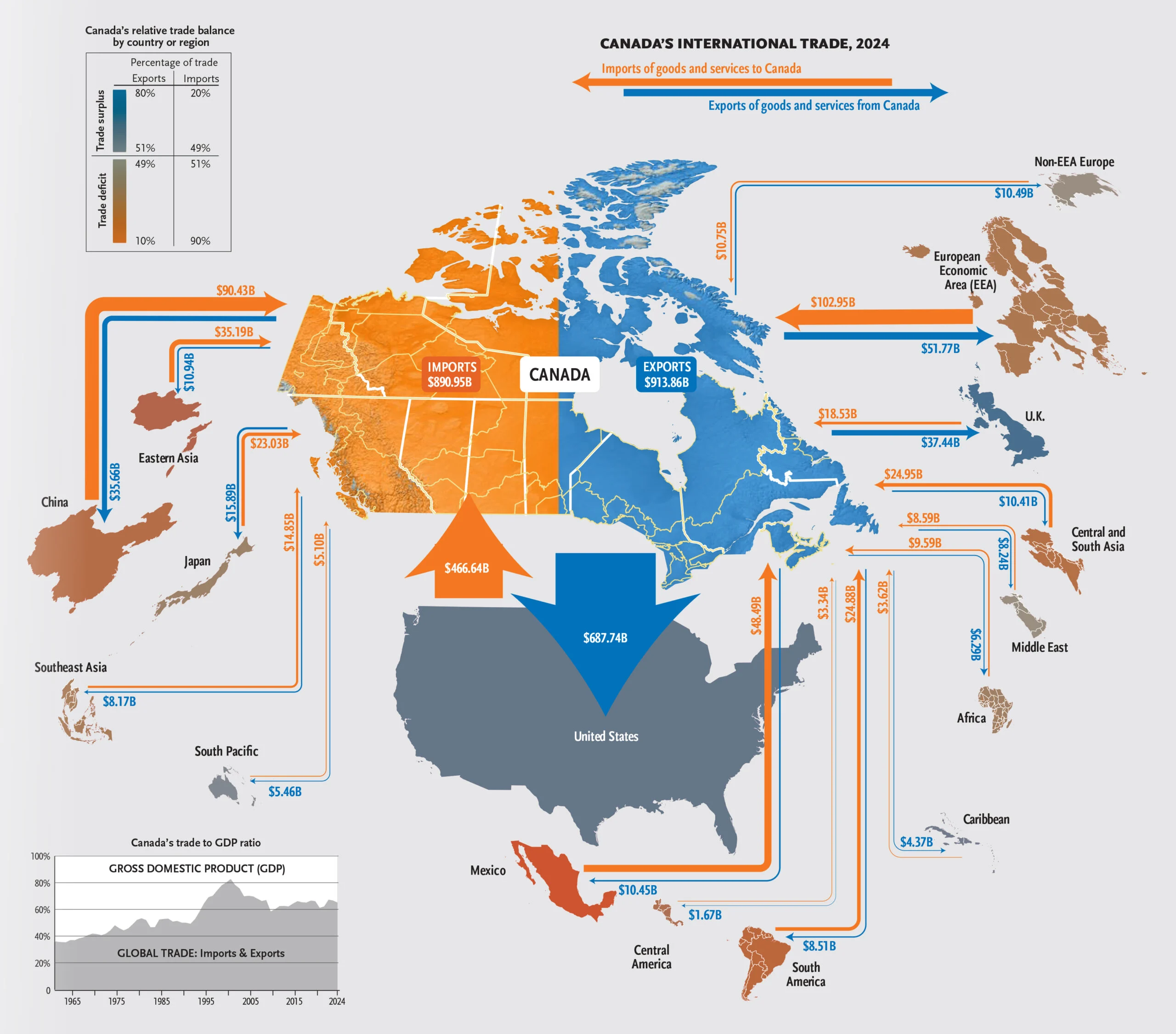
Image source: Canada Geographic.
Set against that is CIBC's read that the market will not pay much of a premium for tariffs it expects to be temporary.
"We believe that the market is reluctant to price in further tariff premia given that these tariffs seem to have a political lean (targeting hockey sticks for example), and therefore, are unlikely to be permanent at current levels of 50%," says Ying.
She points out that Washington was willing to drop the tariffs immediately before talks broke down, "and this could still occur in calmer waters again".
The calendar forces contact in any case, because mandatory USMCA trilateral talks have to take place at least once a year even if formal negotiations wait until after the US midterms.
Mark Wiseman, Canada's ambassador to the United States, has said the two sides will continue to talk.
"While it is not trade related for now, we suspect the topic will come up sooner or later," says Ying.
The Base Case
CIBC's 60% scenario is one where the story loses the market's attention and USD/CAD drifts to 1.37.
"At current moment, no talks are scheduled for the foreseeable future," says Ying.
Assuming the US does not retaliate too heavily against Canada's US$20bn countermeasures, "in all likelihood, the market will likely move on to other things - such as Jackson Hole, the August data cycle, or the September FOMC meeting," she adds.
CIBC Economics estimates the current round of tariffs will not be detrimental to Canadian GDP this year, with four months of the calendar left and affected industries having front-run measures announced on 20 July with the product list already known.
The damage lands in 2027 instead, and even then the estimate is a hit of around 0.5% of GDP.
"Nearer-term, we still think US macro is the signal and trade volatility is the noise," says Ying.
"The tariff premia priced in today likely erodes if the US data continues to slow down, and discourages the Fed to hike this year."
Resolution Would Restore the Recovery Story
The third scenario, at 5%, is a quick settlement that takes USD/CAD to between 1.35 and 1.36.
Ying says the trajectory of weekend events argues against it, although both parties announced on Friday that they were close to cementing a deal.
"In this case, we immediately unwind the move in USD/CAD, and the pair continues its trajectory downwards."
The Canadian recovery survives intact in that outcome, with the divergence between a slowing US and a heating Canada becoming more stark.
"Everything we have previously said about positive CAD fundamentals remain true and unimpacted by weekend events which go away," says Ying, citing the recovery, a central bank more accommodative than its developed market peers, and positioning.