
Image: CC licensing, source: recon456, Flickr.
Canadian separation referendums are a tail risk for the Canadian Dollar, says a leading investment bank.
The Canadian Dollar's autumn now contains two dates capable of injecting a political risk premium into the currency: October 5, when Quebec votes in a provincial election, and October 19, when Albertans vote in a separation referendum.
"Potential separation referendums in Canada remain a tail risk for CAD," says Samara Hammoud, an analyst at Commonwealth Bank in a note dated August 11.
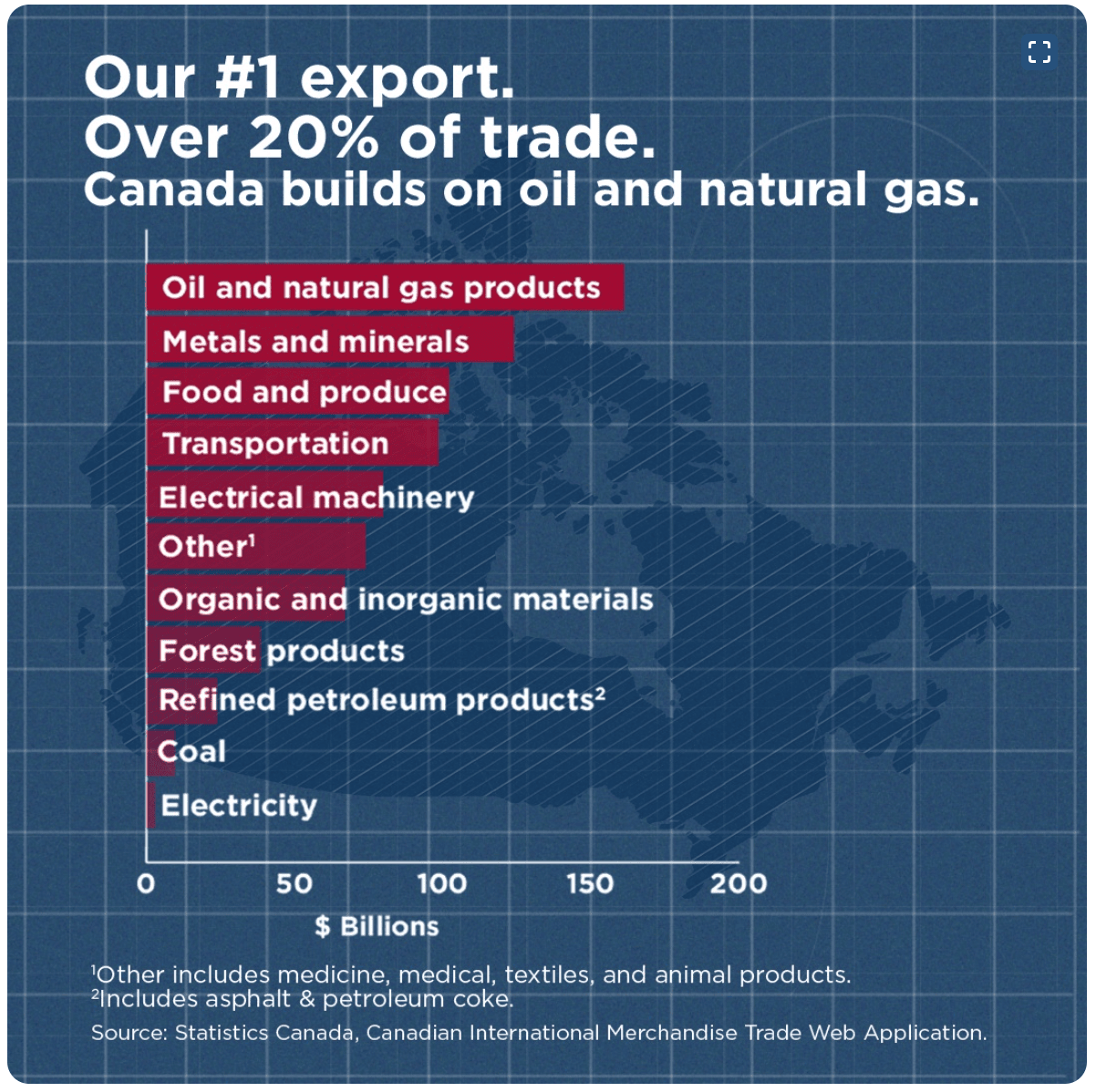
She explains that the Alberta vote matters well beyond the province's borders: "Alberta has accounted for around 90% of Canadian crude oil exports since 2020, making the province central to Canada's external trade position and North American energy security."
Canada relies heavily on crude oil exports to underpin its balance of payments, to the extent that the CAD is oftentimes referred to as a petrocurrency.
The Quebec vote is not short of longer-term implications:
"The Parti Québécois is positioning itself for a third attempt at Quebec independence, with a referendum possible within four years if the party returns to power following the 5 October elections," says Hammoud. She notes Quebec's roughly C$670BN economy and its major aluminium, metals and aerospace industries.
History shows what these campaigns can do to the currency, with Hammoud recalling that "the narrow result of the 1995 Quebec referendum weighed heavily on CAD."
For foreign exchange markets, the Brexit referendum that separated the United Kingdom from the European Union offers a more recent template.
"Public support for separation remains limited in both provinces, suggesting neither outcome is a base case," says Hammoud.
The Brexit referendum adds further relevance, given that the vote to leave the EU was not predicted by polling, which should ensure some lingering risk premium for the currency.
"However, referendum campaigns alone can add a risk premium to Canadian assets and weigh on the CAD," she adds.
What the Polling Says
The polling currently supports the reassuring half of that assessment.
In Alberta, an Ipsos survey for Global News found just 18% of Albertans would vote for separation, against 72% who would vote to remain in Canada, with support down ten points from 28% at the start of the year.
The picture is not uniform across pollsters, however: Pollara's tracking recorded support at 27% in April, a five-year high, and warned that if protest voters minded to "send a message to Ottawa" followed through, the yes share could exceed 40%.
The spread partly reflects question wording, and the October 19 ballot itself asks Albertans whether the province should commence the legal process towards a binding separation vote, a step removed from separation itself.
In Quebec, Léger polling puts support for sovereignty below 30%, the lowest since the era of the 1995 referendum, while the Parti Québécois' once-commanding lead over the Liberals has narrowed to a few points ahead of the October 5 election.

The Bank Consensus, Without the Terminal
The median, mean, highest and lowest from the October survey update, plus named point forecasts out to 2027.
Free information pack, issued by World Wide Currencies.
Support is also heavily concentrated, running at around 44% among francophone voters but just 10% among non-francophones, according to Liaison Strategies.
Pollster David Coletto of Abacus Data argues the structural conditions for a successful sovereignty push are weaker than in the 1990s, with anxious voters placing a higher value on national cohesion.
The forward-looking read is therefore not that either vote succeeds, but that the campaigns themselves are the risk: a single poll showing Alberta's yes vote climbing towards 30%, or the PQ pulling clear towards a majority, would be the trigger for markets to start pricing what Hammoud calls the tail.
GBP/CAD: What It Means for Payments
For readers with Canadian Dollar payment requirements, the referendum calendar reshapes the risk map around a pair already trading at elevated levels.
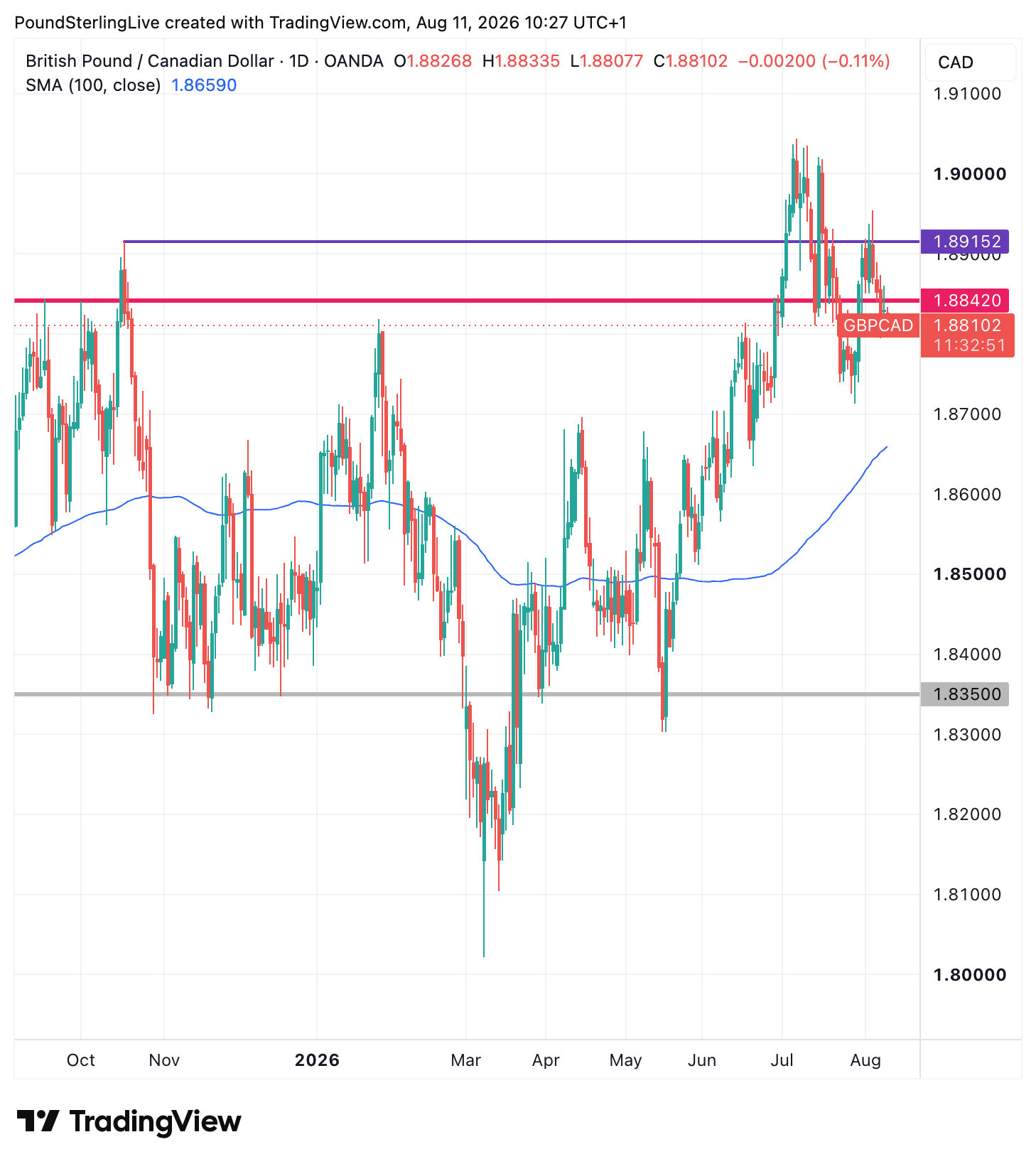
Above: GBP/CAD at daily intervals with the rising 100-day moving average and the levels that frame the outlook. Chart: Pound Sterling Live / TradingView.
The Pound-to-Canadian Dollar exchange rate trades at 1.8810 at the time of writing, in the upper reaches of a twelve-month range that spans the March low near 1.8020 and July's peak just above 1.9000, and above the levels institutional forecasters expect to prevail through early 2027, with even the most Sterling-friendly projection in the latest consensus round sitting beneath the current market.
The near-term technical picture shows a pair consolidating its July advance: the rally stalled above 1.90, and the subsequent pullback has left the market trading just below resistance at 1.8842, with a recovery through that level needed to reopen 1.8915 and, beyond it, the July high.
The medium-term recovery remains intact, however, with the pair holding comfortably above its rising 100-day moving average at 1.8659, the first meaningful support, ahead of the more significant 1.8350 floor that repeatedly held through late 2025 and the early summer.
The referendum risk skews the distribution: any Canadian political wobble would weaken the Canadian Dollar and argue for a retest of 1.90 and the July highs, while a smooth passage through October, or a tariff de-escalation, would see the consensus gravity reassert towards the 100-day average and below.
Note, though, the calendar's final twist: October also delivers the UK's own budget on the 28th, meaning both currencies in this pair face their defining political test in the same month.
For those with payments to plan, that argues for treating October as a volatility event to be navigated rather than predicted, with current levels near the top of the range offering CAD buyers a historically favourable starting point.