Image © Adobe Images
The Reserve Bank meets on Tuesday, but the U.S. Dollar's direction is what moves the GBP/AUD pair.
The Pound-to-Australian Dollar exchange rate has slipped back into the middle of the range that has contained it since early July, with last week's recovery attempt losing traction before it reached the ceiling.
Momentum sits just below neutral, and the 100-day moving average has flattened after falling through the first half of the year, leaving the pair holding above it without making progress.
From a tactical perspective, the moving average and the range ceiling mark the boundaries the market has to work within this week.
The Reserve Bank of Australia's decision on Tuesday is the scheduled event, but the more consequential input is what the U.S. Dollar does after Wednesday's inflation release.
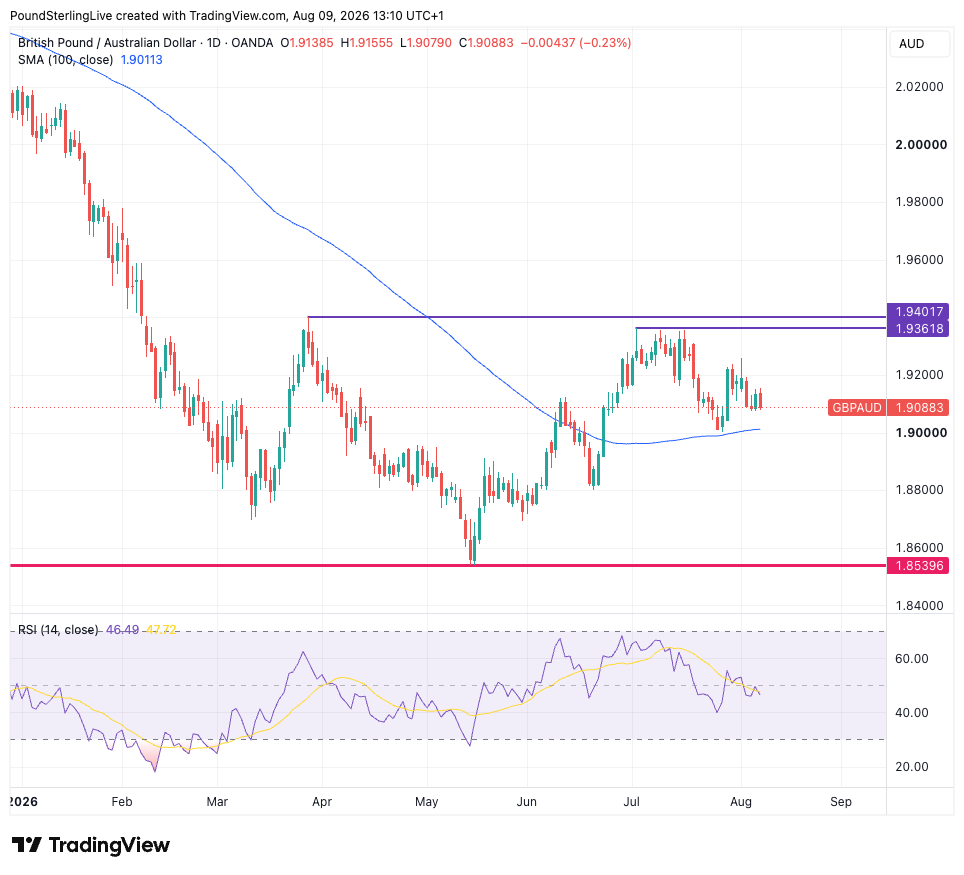
Above: GBP/AUD daily chart. Image © Pound Sterling Live, chart created with TradingView.
Spot at 1.90883 sits above the 100-day moving average at 1.90113, and the relationship between the two is the more informative part of the chart: that average fell without interruption from January through May, and it has now flattened and begun to turn higher, which is the first structural improvement since the decline from above 2.03 began.
RSI reads 46.49 against an average of 47.72, which is a market with no conviction in either direction rather than one under pressure.
The rebound from the early August low stalled beneath 1.9250 and the pair has given the gains back, leaving 1.9200 as the level that separates a range from a recovery.
Above there sits the resistance band at 1.93618 and 1.94017, which capped the July advance and has not been seriously challenged since.
Support starts with the moving average at 1.90113, then the early August low just under 1.9000, and beneath those the May low at 1.85396.
The base case for the week is continued range trade between 1.90113 and 1.9200, with the risk skewed towards a test below the moving average if the U.S. Dollar keeps falling.
The medium-term picture is a stalled downtrend rather than a new uptrend: the pair has built a base above the May low and the moving average has turned, but it has failed twice at 1.93618 to 1.94017 and has not produced the higher high that would confirm a change of direction.
The RBA Decision and What It Settles
Markets expect the Reserve Bank of Australia to leave the cash rate unchanged at 4.35% on Tuesday, and the interest lies in the framing rather than the decision.
"While we expect the hold decision to be unanimous, the Board is likely to explicitly consider both a rate hike and a hold," says ANZ in its RBA preview.
ANZ's economists expect the combination of a higher-than-expected unemployment rate, lower-than-expected inflation relative to the RBA's May forecasts, and softer activity data to support keeping rates where they are.
On inflation, ANZ expects the RBA to remain hawkish and to want to retain the option to hike further, with the characterisation of the activity side consistent with Governor Bullock's recent speech to the Anika Foundation.
That matters for the Australian Dollar because a hawkish hold preserves the rate support that has underpinned the currency, whereas an explicit shift towards neutrality would remove it.

The Bank Consensus, Without the Terminal
The median, mean, highest and lowest from the October survey update, plus named point forecasts out to 2027.
Free information pack, issued by World Wide Currencies.
The accompanying forecasts carry their own signal, with ANZ expecting the trimmed mean inflation forecast to be lowered over 2026 while remaining unchanged over 2027 and 2028, as a lower starting point and a slightly higher near-term unemployment rate are offset by marginally faster GDP growth.
"We don't expect any further increases in interest rates and see a mild (two 25bp rate cuts) easing cycle over the second half of 2027," says ANZ.
That is a call that frames the Australian Dollar's rate support as something to be defended rather than extended.
The near-term risk sits with the tone offered by the RBA, and the market has already been caught out once on this.
Governor Bullock declined to deliver the hawkish signal traders had positioned for at the previous outing, and the Australian Dollar slumped on the omission.
Why the Big Dollar Sets the Direction
Overarching the domestic calendar is the U.S. Dollar:
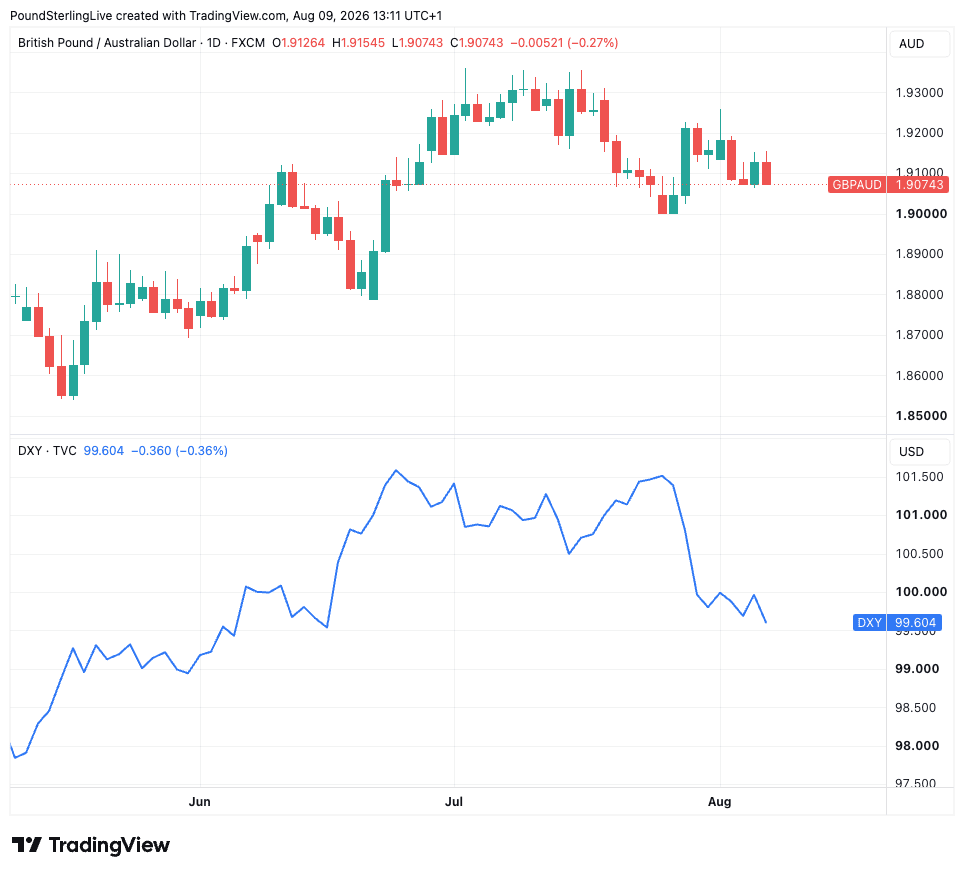
Above: GBP/AUD (top) and the Dollar index (bottom), daily. Image © Pound Sterling Live, chart created with TradingView.
The relationship is visible without any statistical work: the Dollar index climbed through June and peaked in early July, and GBP/AUD did the same. The index rolled over in late July and fell hard at the start of August, and GBP/AUD followed it down.
The mechanism runs through the Australian Dollar rather than the Pound, and it has three parts.
The first is risk appetite. The Australian Dollar is the highest-beta currency in the G10, meaning it gains more than its peers when global conditions improve and loses more when they deteriorate. A falling Dollar usually reflects improving risk appetite or receding Federal Reserve rate expectations, and both are conditions in which the Australian Dollar outperforms.
The second is commodities. Iron ore, copper and coal are priced in Dollars, so a weaker Dollar mechanically lifts the local-currency value of Australia's exports and improves its terms of trade.
The third is China. A softer Dollar eases financial conditions across emerging markets and China in particular, which is the destination for the bulk of Australian resource exports.
Sterling has none of this. The Pound responds to gilt yields, Bank of England expectations and domestic politics, and its sensitivity to global risk conditions is middling rather than extreme.
The consequence is that GBP/AUD trades as a proxy for the Dollar's direction: when the Dollar falls, the Australian Dollar gains more than the Pound does and the cross declines, regardless of what either economy has produced that week.
That is why Wednesday's U.S. inflation release matters more to this pair than Tuesday's RBA decision.
A soft print extends the Dollar's decline, lifts the Australian Dollar with it, and puts the 100-day moving average under pressure.
A firm print reverses the move and gives the Pound the room it needs to attack 1.9200.
The Pound has its own input on Thursday, when second-quarter UK GDP is published, and consensus expects growth of 0.4% against the 0.3% the Monetary Policy Committee assumed.
A print in line with that would give Sterling something to work with, though on the evidence of recent weeks it will be the smaller of the two influences.
For those with Australian Dollar payment requirements, the pair remains closer to the top of its 2026 range than the bottom, and the technical structure has improved without yet becoming constructive.