
Image © Adobe Images
Pound sterling has reclaimed ground through the second half of July; Wednesday's U.S. inflation print decides the week.
The Pound-to-Dollar exchange rate has arrested the decline and that defined price action through the latter half of July and is building a more constructive short-term setup.
The pair has reclaimed the 100-day moving average, momentum has turned higher, and it is now pressing against the ceiling that has capped every advance since May.
From a tactical perspective, that ceiling will dominate considerations in the coming week, while Wednesday's U.S. inflation release will contribute to determining whether the increasingly constructive setup is confirmed or reversed.
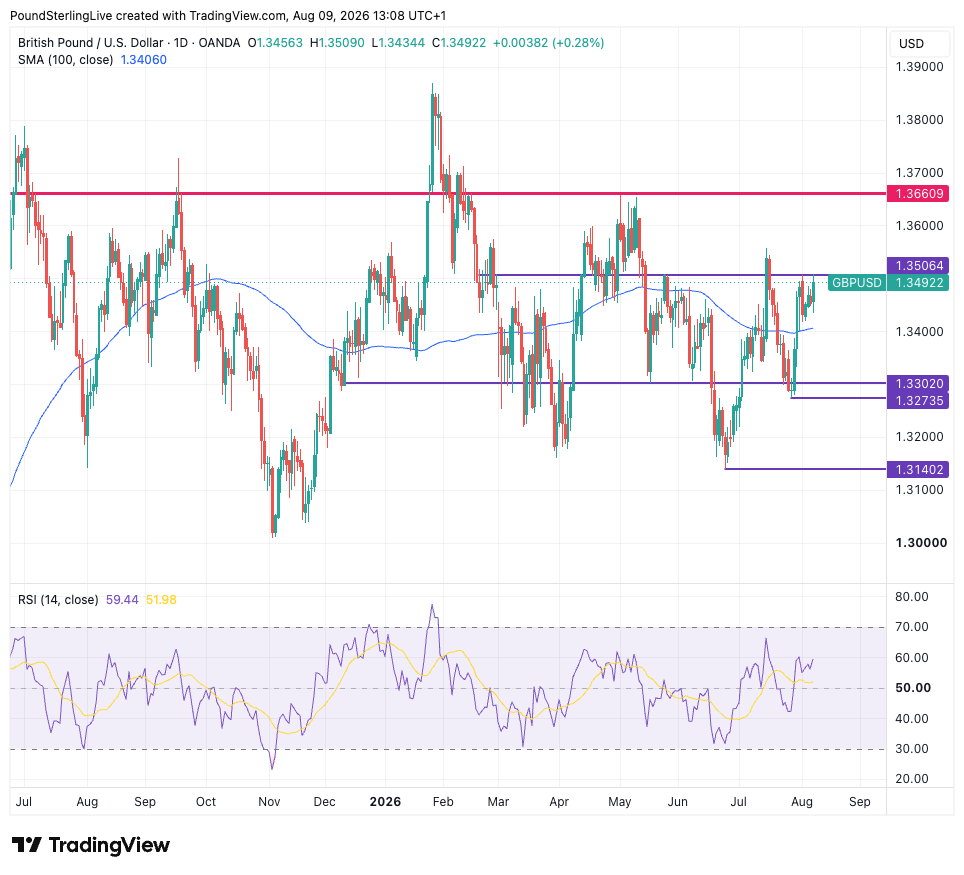
Above: GBP/USD daily chart. Image © Pound Sterling Live, chart created with TradingView.
Spot at 1.34922 sits above the 100-day moving average at 1.34060, having traded as high as 1.35090 on Friday.
That is a material change from a fortnight ago, when the market was repeatedly rejected beneath a declining average and the risks pointed lower.
RSI reads 59.44 against its own 51.98 average, so momentum is with the buyers, and the reading leaves room before the market looks stretched.
The obstacle is 1.35064, the shelf that has capped this market in May, June and July.
Friday's high of 1.35090 tested it and failed to close above, so the level has held on first attempt.
A daily close above 1.35064 clears the way to 1.36609, which has contained every rally since July 2025 and is the level that defines the whole range.
Support begins at the 100-day moving average at 1.34060, then 1.33020 and 1.32735, which is where July's decline turned.
Beneath those sits 1.31402, the July low.
The medium-term picture is a range: this pair has traded between roughly 1.31402 and 1.36609 for more than a year, and nothing about last week's move changes that.
What has changed inside the range is the sequence of lows, with 1.32735 marking a higher low than 1.31402 and the market now working from the upper half.
The base case for the week is a test of 1.35064 that requires U.S. inflation to cooperate.
Failure there leaves a range between 1.34060 and 1.35064, and only a break back below the moving average would restore July's defensive setup.
The Bank Consensus, Without the Terminal
The median, mean, highest and lowest from the October survey update, plus named point forecasts out to 2027.
Free information pack, issued by World Wide Currencies.
U.S. Inflation Prints In Focus
The Dollar side of the pair retains the driving hand, and all eyes are on this week's inflation numbers.
U.S. consumer price inflation is released on Wednesday, followed by producer prices on Thursday, with retail sales and the University of Michigan survey later in the week.
June's CPI report was weaker than expected, driven by soft core inflation and a sharp fall in energy prices, which pulled the headline annual rate to 3.5% from 4.2% and the core measure to 2.6% from 2.9%.
Energy prices swung through July, rising from their lows as the Hormuz conflict escalated before falling back towards the end of the month.
Economists expect further downward pressure from gasoline prices to pull the annual headline rate to 3.4%, with core inflation rising 0.2% on the month and the annual core rate easing to 2.5%.
A second inflation report for August lands before the Fed's next policy update, which limits how much Wednesday alone can settle.
For Sterling, Thursday carries a domestic input as well, with UK second-quarter GDP published the same morning as U.S. producer prices.
Consensus expects quarterly growth of 0.4%, above the 0.3% the Monetary Policy Committee assumed, and a print in line with that would give the Pound support of its own rather than leaving it dependent on Dollar weakness.
Why the Dollar Has Softened of Late
The Pound's recovery against the dollar built fresh momentum following Friday's surprisingly soft U.S. labour market print, which showed the economy shed jobs in July.
"The dollar initially fell sharply after the labour market data as Fed hike expectations were pared back. GBP/USD rose briefly above 1.35, while EUR/USD climbed towards 1.16," says a market note from Lloyds Bank.
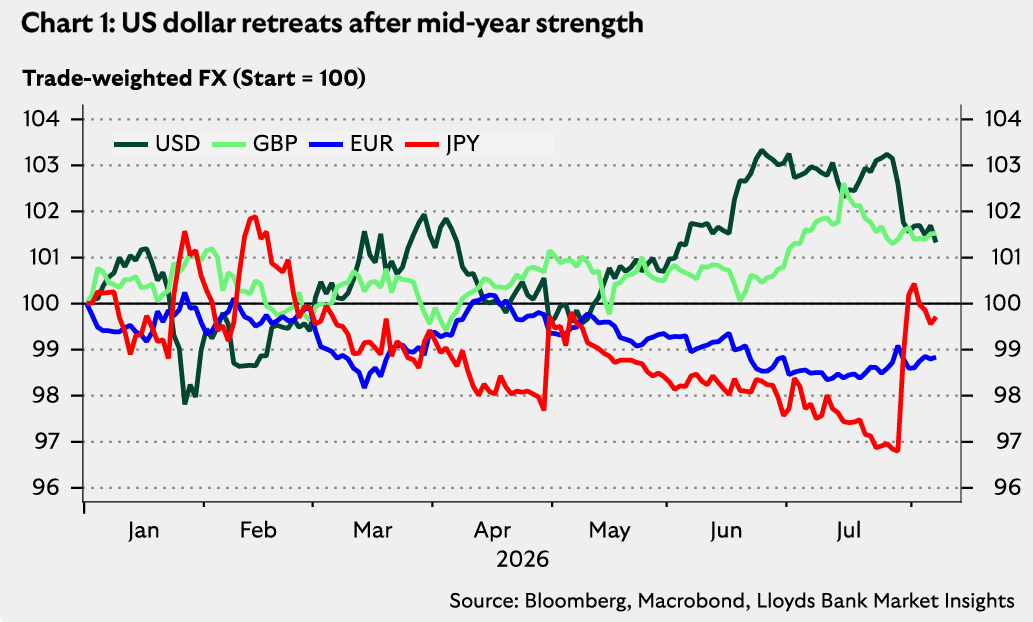
Sterling spiked to 1.35 on the report of U.S. job losses, and the move has largely held since.
The broader driver is the market reaction that followed July's Federal Reserve meeting, when expectations for a further interest rate rise were pared back.
Recent data has validated that repricing, and the risk for Dollar bulls is that Wednesday's CPI adds to the evidence.
A softer print pushes the remaining hike premium out of the Dollar and gives the Pound the push it needs through 1.35064.
An upside surprise does the reverse, and would arrive with Sterling sitting directly beneath resistance rather than with room to absorb it.
The complication is that Sterling's own rate story has been working against it, with the gap between UK and U.S. two-year yields compressing over recent weeks.
That is why this rally reads as a Dollar story rather than a Pound one, and why the Sterling side of the pair needs Thursday's GDP release to carry any of the weight.
For those with Dollar payment requirements, the pair is trading in the upper half of a range it has held for over a year, and a sustained break higher needs 1.36609 to give way rather than 1.35064.