
Image © Adobe Images
The Euro has tentatively broken a six-month downtrend, Wednesday's U.S. inflation release determines whether the breakout holds.
The Euro-to-Dollar exchange rate has broken the descending trendline that has capped every recovery attempt since February, and is now testing the 100-day moving average.
This is the first serious challenge to the downtrend that has defined the pair all year, with the rally from July's low carrying price through the ceiling that contained the summer range and taking momentum with it.
From a tactical perspective, the moving average is the level that will dominate considerations in the coming week.
And, Wednesday's U.S. inflation release will contribute to determining whether it gives way, while the Middle East provides a second and considerably less predictable input.
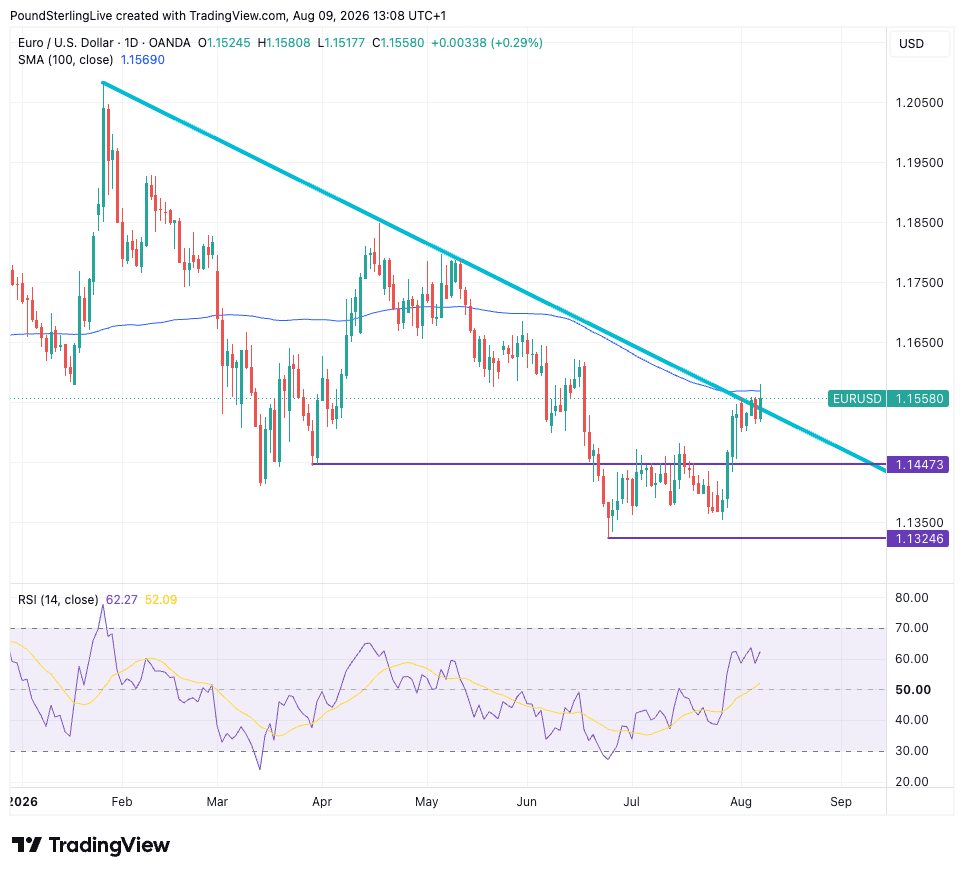
Above: EUR/USD daily chart. Image © Pound Sterling Live, chart created with TradingView.
Spot at 1.15580 sits just beneath the 100-day moving average at 1.15690, having traded as high as 1.15808 on Friday (in the wake of the soft U.S. jobs print) before closing back below it.
RSI reads 62.27 against its own 52.09 average, having recovered from below 30 in July, so momentum is firmly with the buyers and that's a reading that leaves room for further gains before the market looks stretched.
The descending trendline drawn from February's high near 1.2060 has been cleared, albeit tentatively, and it now runs through the 1.14473 region.
That matters because 1.14473 is also the horizontal level that capped this market through June and July, which gives the area two separate reasons to act as support on any pullback.
Beneath it sits 1.13246, the July low.
The obstacle overhead is the 100-day MA itself, and Friday's rejection there confirms it is doing work rather than sitting as a line on the chart.
A daily close above 1.15690 opens the way towards 1.16500, where the average flattened out through the first half of the year and where the April and May declines found their footing.
The base case for the week is consolidation beneath 1.15690 with an upward bias, and only a return below 1.14473 would put the downtrend back in charge.
The medium-term picture has not reversed yet, because a broken trendline is a warning rather than a confirmation, but this is the first higher high the pair has produced in six months and the structure improves materially if 1.14473 holds on the next test.

The Bank Consensus, Without the Terminal
The median, mean, highest and lowest from the October survey update, plus named point forecasts out to 2027.
Free information pack, issued by World Wide Currencies.
A Return to Trend for U.S. Inflation
The Dollar side of the pair carries the week's scheduled event risk, and the inflation numbers are what the market is positioned for.
U.S. consumer price inflation is released on Wednesday, followed by producer prices on Thursday, with retail sales and the University of Michigan survey later in the week.
June's report was weaker than expected, led by soft core inflation and a sharp fall in energy prices, which pulled the headline annual rate to 3.5% from 4.2% and the core measure to 2.6% from 2.9%.
Bank of America expects July to look more ordinary, forecasting a 0.20% monthly rise in core CPI and an annual rate of 2.5%, which would be the softest reading since January.
The bank's more consequential call is on the Federal Reserve's preferred measure.
"We expect core PCE to be firmer than core CPI at 0.24% m/m (3.3% y/y), keeping a Sep hike firmly in play," says Bank of America.
If that assessment is correct, the dollar will surely find itself with some renewed vigour in the wake of Wednesday's data drop.
That is the detail that complicates the Euro's case, because the market has spent the past fortnight pricing hike risk out of the Dollar and a firm core reading would begin pricing it back in.
Bank of America expects headline inflation to have risen 0.1% on the month for an annual rate of 3.4% as gasoline prices fell again, with core goods subdued and core services rebounding towards trend after June's decline.
Energy prices swung through July, rising from their lows as the Hormuz conflict escalated before falling back towards the end of the month.
A second inflation report for August arrives before the Fed's next policy update, which limits how much Wednesday alone can settle.
Why Hormuz Matters More for the Euro
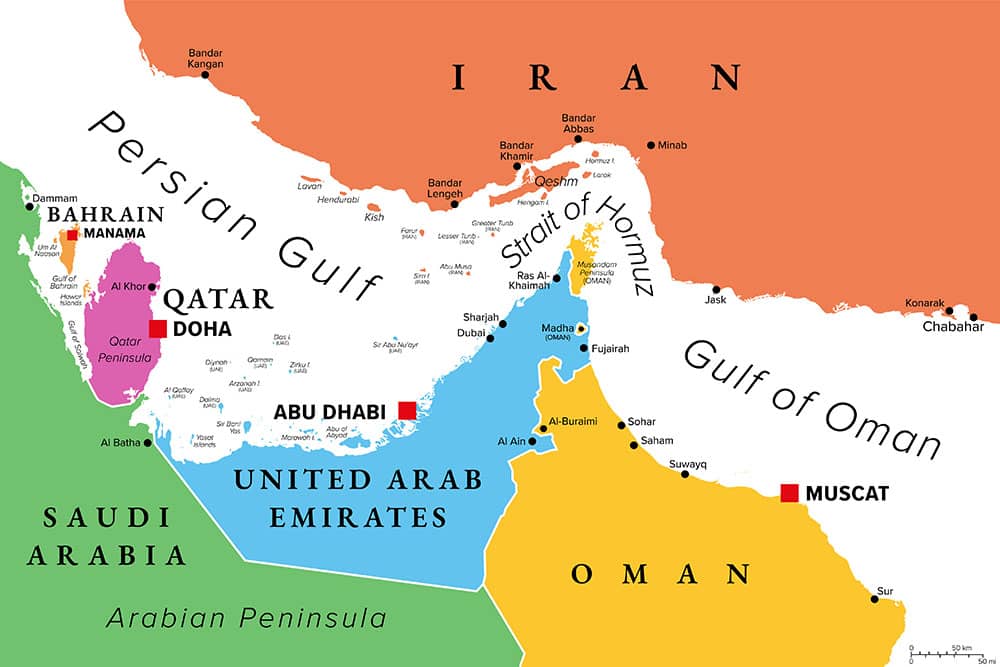
Image © Adobe Stock
Overarching the calendar risks are geopolitical exposures:
"While ECB rate expectations also appear somewhat stretched, the euro is likely to benefit more than the US currency from a resolution of the US-Iran conflict," says Thu Lan Nguyen, Head of FX and Commodity Research at Commerzbank.
The Gulf situation is therefore particularly important to the euro because the Eurozone is a net energy importer and the U.S. a net exporter, so a reopening of the Strait of Hormuz removes a cost from one economy and a support from the other.
A resolution to the latest shuttering of the Strait will therefore bolster the euro's budding ascent against the dollar.
Whether that breakthrough arrives this week is doubtful as the weekend's news flow urges caution.
Iranian Foreign Minister Abbas Araghchi said direct talks with Washington are currently impossible, citing U.S. violations of the short-lived interim peace agreement.
A separate deal between Iran and Oman on the Strait is described as very close, but Tehran has renewed a list of demands for Washington as conditions for a full reopening.
Meanwhile the security picture continues to deteriorate, with Iranian-backed Houthi rebels claiming a strike on Saudi Aramco's Jizan refinery and Abu Dhabi National Oil Co. reporting that one of its vessels was targeted by missiles.
The practical read is that the Euro holds an option on de-escalation that has not been exercised, which argues against chasing the pair higher while the headlines remain this contradictory.
For those with Dollar payment requirements, the Euro is in a better technical position than at any point this year, but the trendline break needs a close above the moving average to become a trend change rather than a rally.