
Image © Adobe Images
The British pound has been turned back at the ceiling again, with New Zealand inflation expectations due on Thursday.
The Pound-to-New Zealand Dollar exchange rate has been rejected at the top of its year-long range for the third time, and the subsequent retreat has been sharp enough to cost it the 200-day moving average and turn the medium-term trend bearish.
Momentum is soft and the pair now sits below the midpoint of the range that has contained it since last autumn.
From a tactical perspective, reclaiming the moving average is the task facing the market in a week that also brings the quarterly Reserve Bank of New Zealand survey of inflation expectations, a release carrying more weight than usual with the tightening cycle underway.
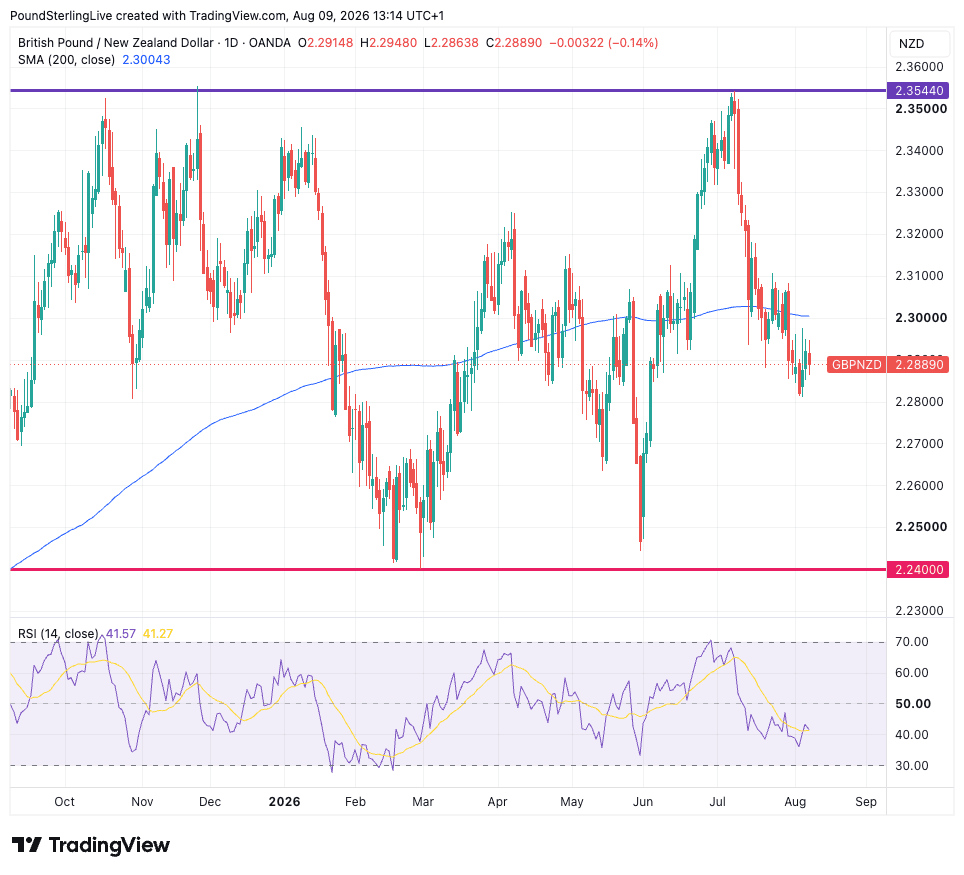
Above: GBP/NZD daily chart. Image © Pound Sterling Live, chart created with TradingView.
Spot at 2.28890 sits below the 200-day moving average at 2.30043, having lost it during the decline from July's high.
That average climbed steadily through the winter, flattened through the spring and has now turned lower, which removes the modest structural support Sterling had been carrying into the second half of the year.
RSI reads 41.57 against its own 41.27 average, so the downside momentum that drove the July decline is decelerating rather than building, but the absolute reading remains soft and there is nothing here demanding a bounce.
The first obstacle is the moving average at 2.30043, and above it the congestion left by late July's decline between 2.3050 and 2.3100.
Beyond that sits 2.35440, which has capped this market in November, December and again in July.
Three failures at the same level is the most informative fact on this chart, because it tells us the range ceiling is being defended rather than tested.
Support begins at the early August low at 2.2830, then June's spike low near 2.2450, and beneath those the range floor at 2.24000.
Our Pound to New Zealand Dollar forecast for the week is a range between 2.2830 and 2.30043, with the burden on Sterling to reclaim the moving average before anything more constructive can be argued.
The medium-term picture is a market without a trend: this pair has traded between 2.24000 and 2.35440 for a year, and the July reversal has returned it to the middle of that band rather than establishing a new direction.

The Bank Consensus, Without the Terminal
The median, mean, highest and lowest from the October survey update, plus named point forecasts out to 2027.
Free information pack, issued by World Wide Currencies.
Inflation Expectations In View
The New Zealand side of the pair carries the week's scheduled event risk, and it arrives on Thursday with the third-quarter RBNZ survey of inflation expectations.
The two-year measure was last recorded at 2.53%, and the survey has become one of the more closely watched releases on the New Zealand calendar.
"Inflation expectations are a key focus for the RBNZ right now, with concerns that the oil-related rise in inflation will result in a broader and more enduring lift in pricing behaviour," says Westpac.
The bank notes that expectations already stepped higher in the second-quarter survey, and that oil prices have swung widely since while headline inflation has climbed back to 4.1%.
Westpac expects a further rise at the closely watched one and two-year horizons, though it looks for more stability at the five and ten-year horizons given that the Reserve Bank has already begun tightening.
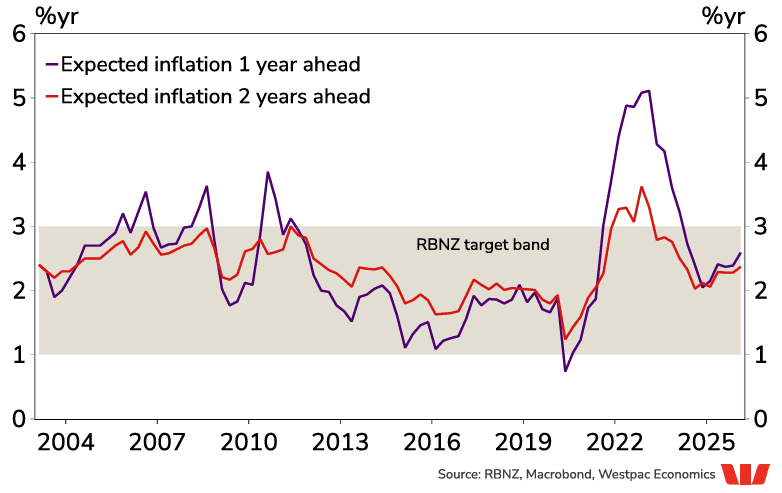
Above: New Zealand inflation expectations, one and two years ahead. Source: RBNZ, Macrobond, Westpac Economics.
The chart puts the release in proportion. Expectations at both horizons remain inside the Reserve Bank's one to three percent target band, and nowhere near the levels reached in 2022 and 2023.
What has changed is the direction. Both measures bottomed out in 2025 and have been rising since, and it is the trajectory rather than the level that will concern the Reserve Bank.
For the New Zealand Dollar, that makes an upside surprise supportive: a further lift in expectations strengthens the case for the tightening cycle to continue, and the currency's rate support with it.
A softer print would be the more interesting outcome, because it would suggest the oil-driven rise in inflation is not feeding through into pricing behaviour and would give the Reserve Bank room to slow down.
Sterling has its own input the same morning, with UK second-quarter GDP published on Thursday and consensus looking for growth of 0.4% against the 0.3% the Monetary Policy Committee assumed.
Why the Rate Gap Is Moving Against Sterling
Overarching the calendar is the divergence in central bank direction:
The Reserve Bank of New Zealand is tightening policy (raising rates) and the Bank of England is not, which is the simplest explanation for why this pair failed at 2.35440 and has spent the past month giving back ground.
Rate expectations drive currencies through the relative return on holding them, and a central bank that is raising rates into rising inflation expectations offers a return that a central bank on hold does not.
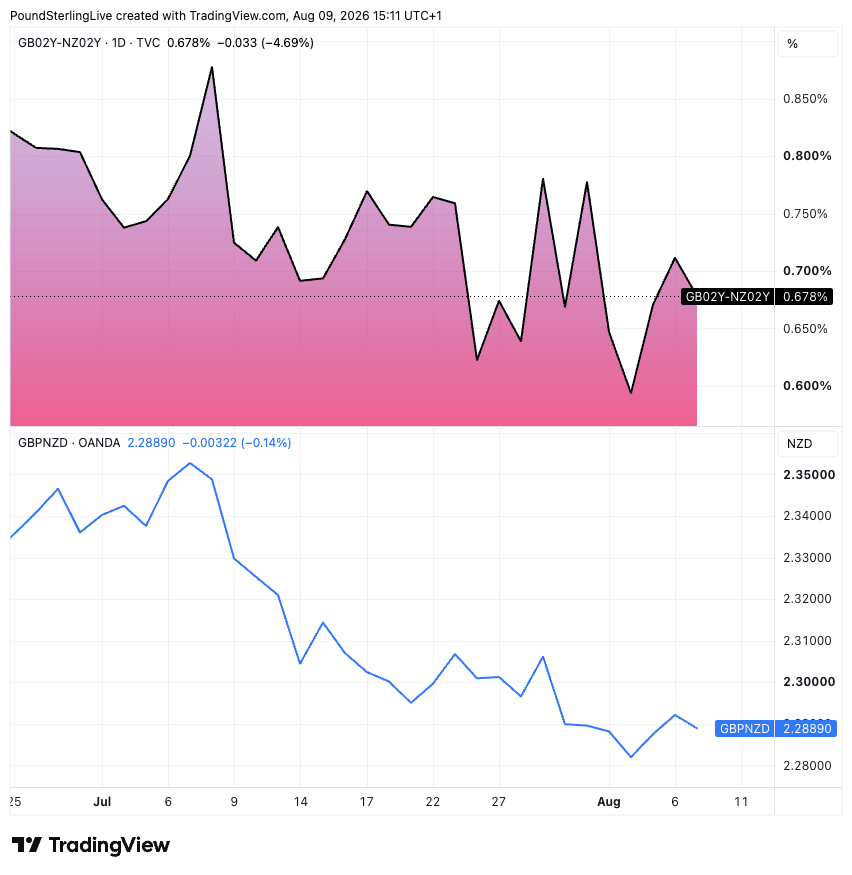
Above: GB minus NZ two-year bond yields (top) and GBP/NZD since the start of July.
That gap has been widening in the New Zealand Dollar's favour since July, and nothing in the UK data flow this week is likely to close it.
The oil connection makes the relationship tighter than it first appears.
The rise in New Zealand inflation that has the Reserve Bank tightening is substantially oil-related, which means the Middle East situation feeds directly into the New Zealand Dollar's rate support.
An escalation that lifts crude prices further reinforces the case for continued RBNZ tightening and works against Sterling on this cross.
A de-escalation and a fall in oil prices would relieve the pressure on New Zealand inflation, soften the tightening case and give the Pound the opening it needs to attack the moving average.
That is an unusual position for Sterling to be in, because it means the Pound on this cross benefits from the same de-escalation that would hurt it elsewhere.
For those with New Zealand Dollar payment requirements, the pair sits below the midpoint of a range it has held for a year, and the medium-term Pound to New Zealand Dollar forecast stays neutral while 2.24000 and 2.35440 remain intact.