Image © Pound Sterling Live
The Pound-Euro pullback has held its key support, leaving Thursday's UK GDP release as the week's key test.
The Pound-to-Euro exchange rate has given back most of July's advance without breaking anything that matters.
Momentum has therefore certainly weakened, but the market is still trading above the level it broke through on the way up, and it still holds above a key rising moving average.
That points to stabilisation this week rather than a fresh leg lower.
The calendar is thin until Thursday, when second-quarter GDP tests whether the UK economy's 2026 outperformance is still running.
The Technical Setup
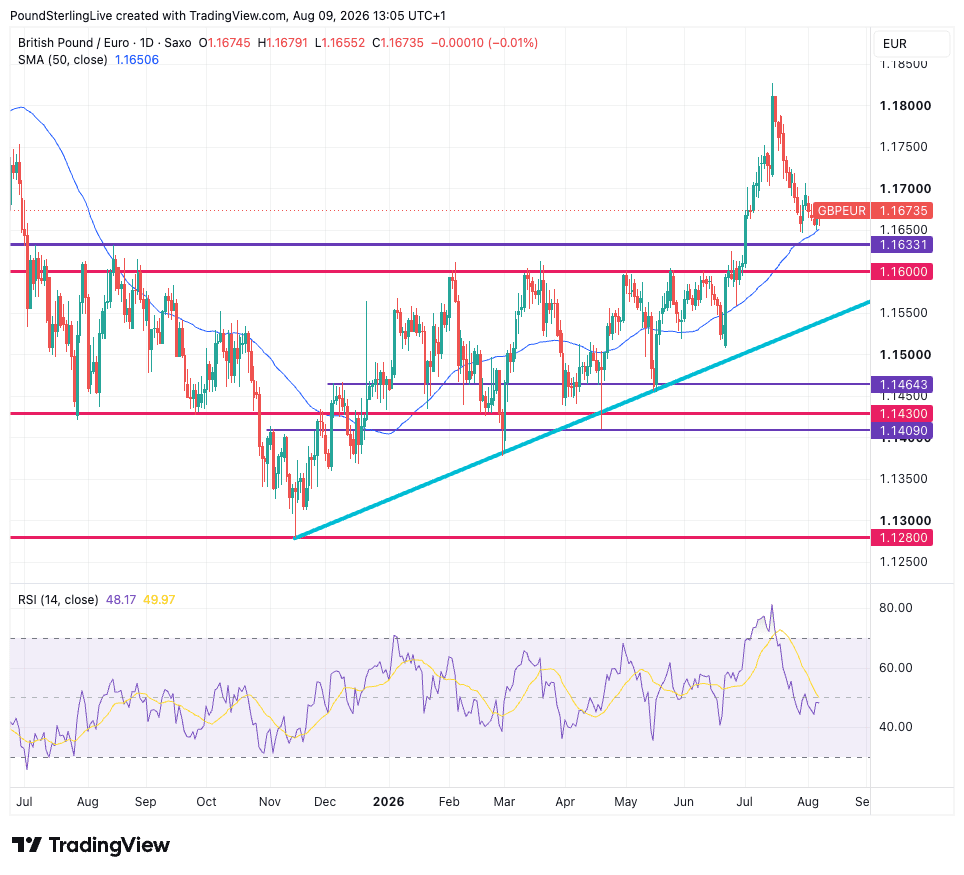
Above: GBP/EUR daily chart. Image © Pound Sterling Live, chart created with TradingView.
Spot at 1.16735 sits above the 50-day moving average at 1.16506, and that average is rising.
July's push to 1.1810 took RSI close to 80 and left price stretched well above its averages.
The decline since has unwound that: RSI now reads 48.17 against its own 49.97 average, so momentum is still with the sellers, but the market is nowhere near oversold.
Support starts with the moving average at 1.16506 and the graphical level at 1.16331.
Beneath both sits 1.1600, which capped this market repeatedly between February and June before July's breakout cleared it.
Old resistance becomes support, and 1.1600 is the level that decides whether July's breakout can hold and eventually allow a new leg higher to evolve.
The decline has thus far held above it, and until that gives way this remains a pullback inside an uptrend.
Below 1.1600 lies the trendline drawn from November's 1.1280 low, currently running through 1.1560.
On the upside, 1.1700 is the first hurdle, and the congestion left by late July's decline at 1.1750 is the harder one.
The base case for the week is a range between 1.16331 and 1.1750, with a mild upward bias while the moving average holds.
A daily close below 1.1600 changes that, turning July's breakout into a failed one and putting the trendline in play.
What Thursday Tests
The Office for National Statistics publishes June monthly GDP and the second-quarter aggregate on Thursday.
Economists expect June output to fall 0.1% month-on-month, leaving quarterly growth at 0.4%.
That still beats the 0.3% the Monetary Policy Committee assumed, which is what makes the release relevant to rate expectations and therefore to the Pound.
"We expect GDP to fall by 0.1% month-to-month in June, as noisy service-sector gains in May unwind," says Pantheon Macroeconomics.
The Bank Consensus, Without the Terminal
The median, mean, highest and lowest from the October survey update, plus named point forecasts out to 2027.
Free information pack, issued by World Wide Currencies.
The consultancy expects output to rise 0.4% on the quarter regardless, and sees the risks to that call skewed to the upside from mining, healthcare and hospitality.
Consensus attributes the quarterly gain mainly to services, with wholesale and retail trade providing the bulk of the support and consumer-facing sectors holding up through the month.
Industrial production is forecast to have risen 0.4% despite an expected 0.5% fall in manufacturing output, the gap explained by a rebound in oil and gas extraction as seasonal maintenance shifted following earlier disruption.
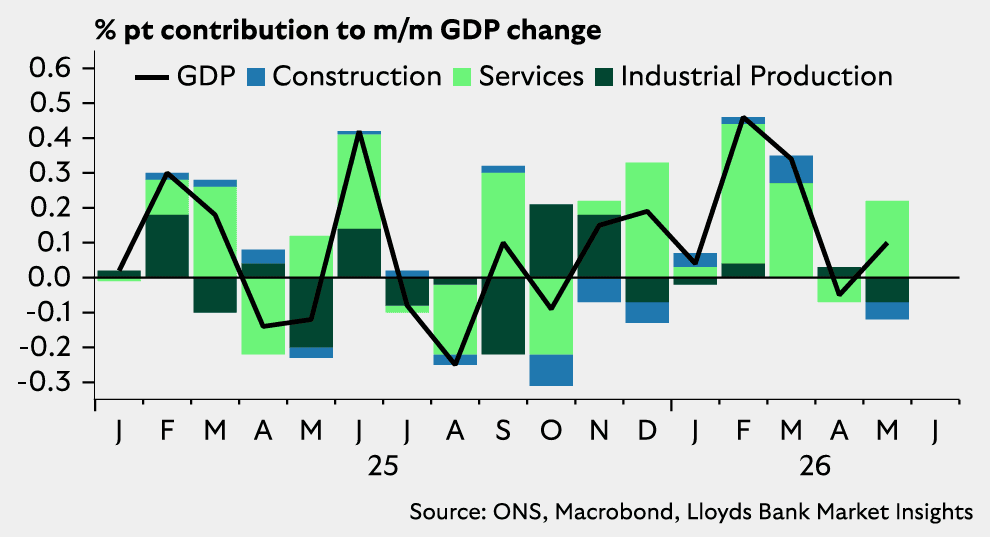
Above: percentage point contributions to monthly GDP change. Source: ONS, Macrobond, Lloyds Bank Market Insights.
The composition chart shows why the monthly prints swing so widely while the quarterly trend holds: services have carried the expansion almost alone, with industrial production and construction alternating between small drags and small supports.
An in-line or stronger print confirms the economy is running hotter than the Bank of England assumed, supports short-dated gilt yields and gives Pound sterling bulls something to work with.
A downside miss lands on a currency that has been looking vulnerable on short-term timeframes this month.
Spreads and Politics Provide Headwinds
The pullback has a cause outside the chart, and it is in the bond market rather than in UK data.
The gap between UK and German two-year yields has compressed towards the lows of the year, and that spread has tracked this pair closely through 2026.
Most of the compression comes from the European side, where markets have moved to price an interest rate rise from the European Central Bank and lifted short-dated German yields.
This year's Pound-Euro rally was built on that spread widening, so its reversal matters more than anything the UK produces on Thursday.
Should the gap close further, GBP/EUR could find itself on the cusp of 1.16 before long.
Politics still bears worth watching, with the Autumn budget now slated for October.
Rabobank says that domestic politics will reassert itself as a Sterling negative and drive a multi-quarter decline in the Pound-Euro rate.
That is a call measured in quarters, not days, and nothing on this week's calendar settles it.
For those with Euro payment requirements, the pair still sits near the upper end of its 2026 range, and the institutional consensus continues to see it lower over the coming year.