
Image © Adobe Images
EUR/USD has dismantled the downtrend that governed its year and the advance has further to run once consolidation completes.
The Euro-to-Dollar exchange rate spent August breaking the descending trendline that turned back every rally since February, then added the 200-day moving average to the levels it has conquered.
It now trades above both for the first time this year, making for a constructive setup:
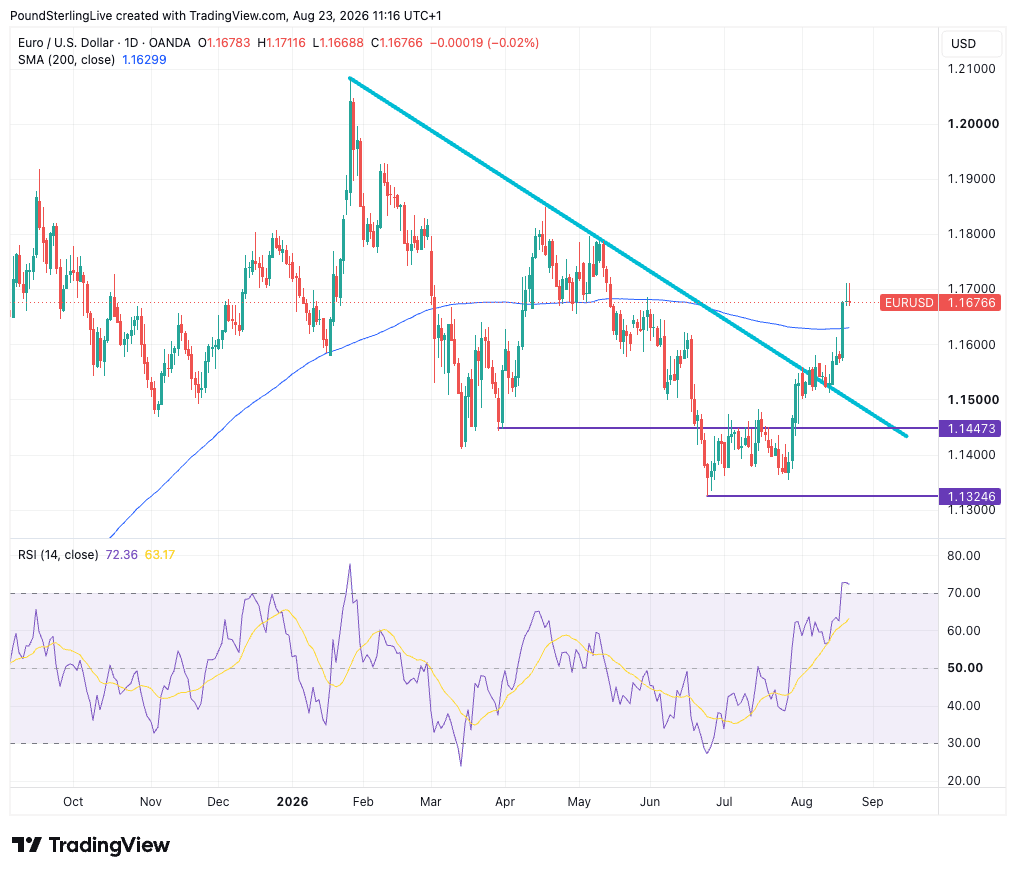
Above: EUR/USD daily chart. Image © Pound Sterling Live, chart created with TradingView.
From a tactical perspective the single currency needs a pause before it can extend, and the calendar offers a clean sequence for one: Wednesday's US inflation report, then Friday morning's flash inflation prints from Spain and France, then Federal Reserve Chair Kevin Warsh at Jackson Hole on Friday afternoon.
As the chart indicates, the pair closed the previous week at 1.16766, after trading as high as 1.17116 and as low as 1.16688.
Spot now sits above the 200-day moving average at 1.16299, a line that has been flat since April and which the market crossed decisively in mid-August after eleven weeks beneath it. A flat average that price crosses from below stops being a trend signal and becomes a floor, and it has not been retested since the crossing.
Overbought, Pullback and Consolidation Needed
The one note of caution for those bullish on euro-dollar comes from the Relative Strength Index (RSI), which reads 72.36 against a signal line at 63.17, the highest since February, above the 70 threshold that signifies overbought,
Friday's candle put its high above the entire week's range and closed near the bottom of the day's move, which is the mark of a market meeting sellers rather than one running out of buyers.
Those two readings together argue for consolidation ahead of continuation, because the structure beneath is unbroken: higher lows through August, a floor established at the 200-day, and the February trendline broken outright rather than merely tested.
Resistance is Friday's high at 1.17116 and then the 1.18 area, which strategists at CIBC Capital Markets identify as the practical ceiling for this move.
Support is the 200-day average at 1.16299, then the broken trendline now falling through the 1.1500 area and converging with the horizontal shelf at 1.14473 through September, then the July low at 1.13246.
Our Euro-to-Dollar forecast for the week ahead is therefore for consolidation between 1.16299 and 1.17116 followed by a fresh attempt on 1.18, with a daily close back beneath 1.16299 the development that would put the breakout itself in question.
According to analysis from CIBC Capital Markets, upside above 1.18 is limited, because elevated natural gas prices remain a growth risk and raise the danger of a policy error should the ECB continue tightening into a weakening economy.
Elsewhere, Westpac sits in similar territory, forecasting 1.17 by year-end, which is roughly where the market already trades.

The Bank Consensus, Without the Terminal
The median, mean, highest and lowest from the October survey update, plus named point forecasts out to 2027.
Free information pack, issued by World Wide Currencies.
The Euro: Spanish Inflation Prices the Repricing
The European calendar bears watching in the context of the European Central Bank's policy: how does the data encourage the market to build bets that the ECB will raise rates on a number of occasions in the coming months?
Germany's IFO business climate survey is released Tuesday at 09:00, with consensus at 87.2 after 86.6 in July, and the European Central Bank publishes the account of its July meeting on Thursday at 12:30 alongside July M3 money supply data.
Spain's flash harmonised inflation reading for August is expected to read at 4.6% year-on-year when released on Friday at 08:00, up from 3.9%.
France's flash print follows at 07:45, expected at 2.6% year-on-year, with the German lender looking for 2.85%.
These numbers give hints at where the July Eurozone-wide CPI number will land.
A September rate hike is already fully discounted, says a daily market note from KBC, so the flash prints determine the scale of repricing beyond September rather than the September decision itself.
That framing is what makes the Spanish number the one to watch, because consensus already carries a jump of seven tenths and a print that beats it starts pricing meetings the market has not yet reached.
The Dollar This Week: Bond Market Shenanigans and Warsh Speech
The Dollar's most recent leg lower looks to be linked to questions about the credibility of American policy after the Treasury's unanticipated move to buy long-dated bonds.
The U.S. Treasury announced that it is increasing, by at least double, the size of liquidity support buyback operations for longer-dated nominal coupon securities (10y to 20y and 20y to 30y) in response to the hefty selloff of recent days.
The current maximum size of $2BN per operation will be at least $4BN per operation, effective September 9 and in effect for the remainder of the current refunding quarter.
Why is the buying of U.S. bonds by the Treasury a negative?
Because, "if the market price of USTs is not allowed to adjust down, the foreign exchange price of UST owned by foreign investors has to adjust via a weakening in the dollar," explains George Saravelos, lead FX analyst at Deutsche Bank.
July PCE and Then Warsh
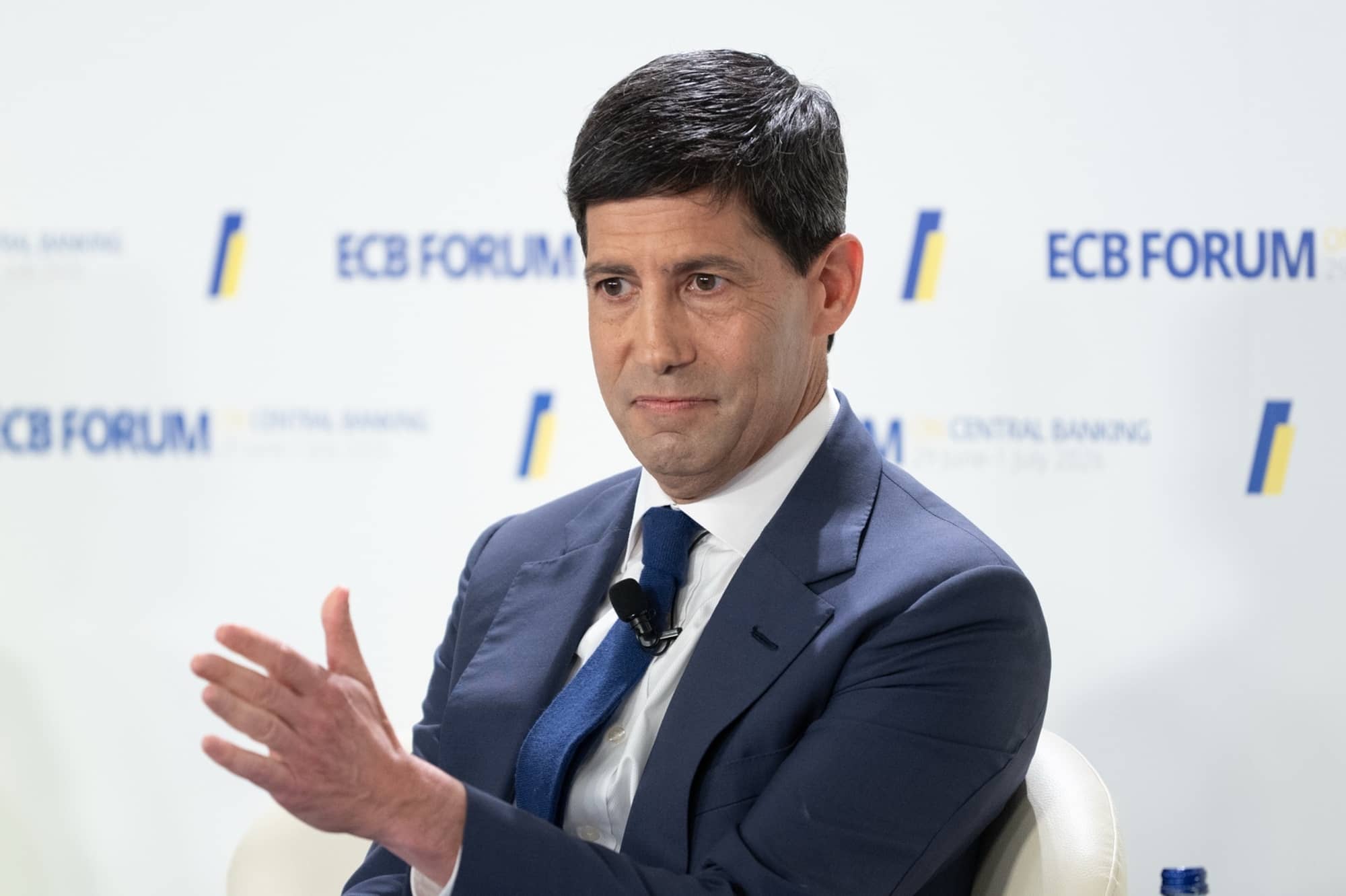
File image of Kevin Warsh. Sérgio Garcia/Your Image for ECB. Copyright: European Central Bank 2026.
Turning to the week's U.S. calendar, the July personal consumption expenditures deflator arrives on Wednesday at 13:30, with headline inflation expected to ease to 3.6% from 3.7% and the core rate to hold at 3.3%.
This should remind markets that inflation remains uncomfortably high.
The second estimate of Q2 GDP is expected to confirm annualised growth of 1.5% in the same release.
The annual Jackson Hole symposium runs from 27 to 29 August under the theme "Financial Innovation: Implications for Payments and Policy", with Warsh speaking on Friday at 15:00.
This year's event comes just days after the Treasury's intervention in the market and we will be very alert to communications from Warsh. Indeed, the Fed will be under increasing pressure to raise rates in light of the developments.
However, markets could yet be deprived of meaningful guidance as the theme looks to be a steer away from the 'bread and butter' that is interest rate discussion. The Chair looks set to use the platform to set out his proposed Federal Reserve reforms.
Yet, any mis-steps in communication by Warsh on the matter of rates would lend the euro-dollar a leg up ahead of the weekend.