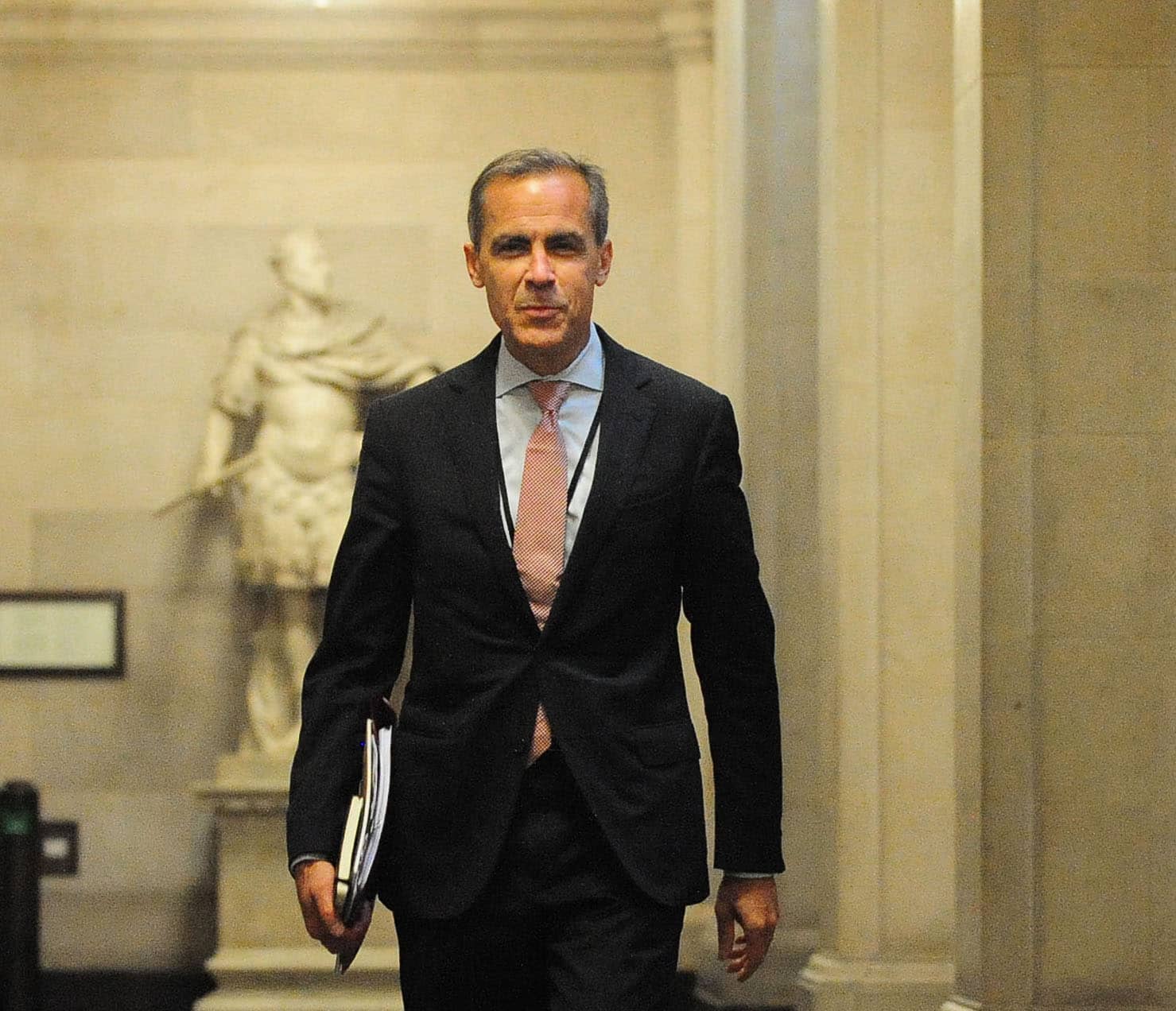
Mark Carney's budget passed, just. File image: Bank of England.
GBP/CAD looks set to break higher on news that arrived after the previous week's market closed.
The Pound-to-Canadian Dollar exchange rate has narrowed for three weeks into the space between the shelf at the top of its range and the shelf at the bottom, with every rally stopped at the same place and every decline halted at the same place:
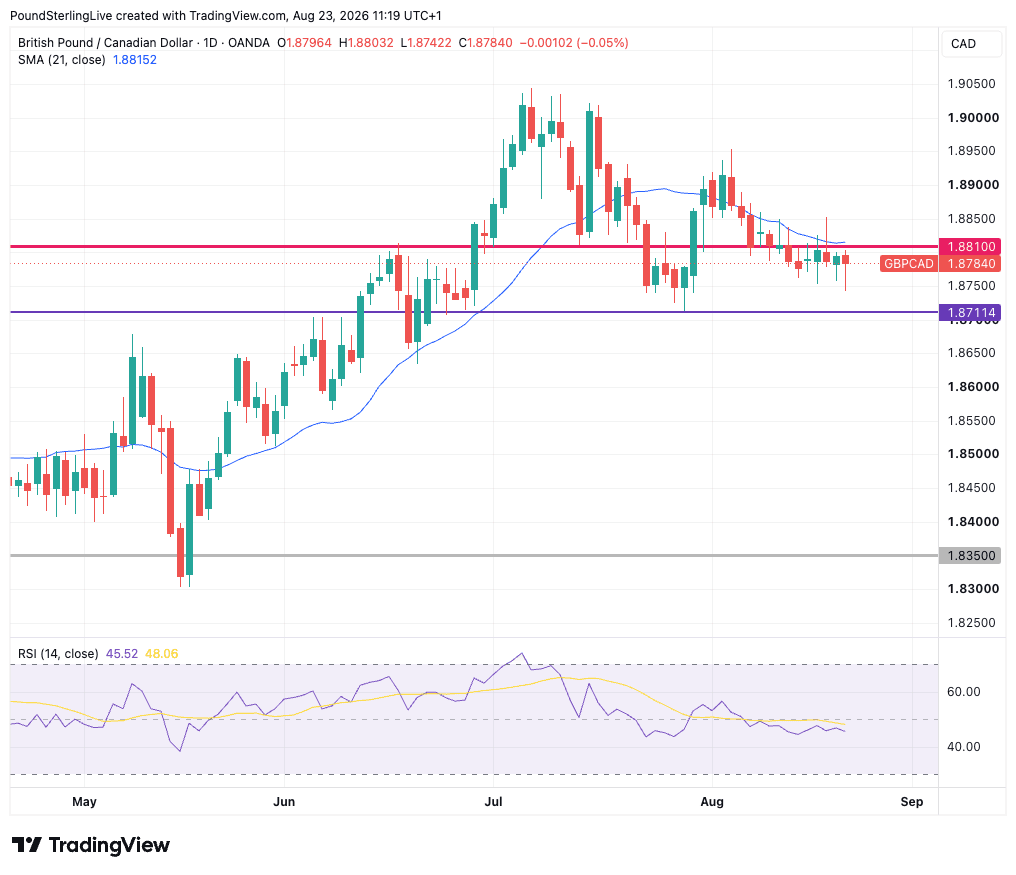
Above: GBP/CAD daily chart. Image © Pound Sterling Live, chart created with TradingView.
A ceiling that falls towards a market holding its ground is a ceiling the market can clear by standing still, and GBP?CAD now has a reason to do considerably more than stand still, because trade talks between Ottawa and Washington collapsed on Friday night and tariffs took effect at midnight, hours after this chart printed its final candle.
From a tactical perspective the coming week is the first opportunity to price that collapse, which makes the three-week range stale information and puts Canada's own data calendar, ordinarily the lead of this section, behind a retaliation date of 8 September that the market has yet to think about.
The pair closed Friday at 1.87840, leaving it beneath the 21-day moving average at 1.88152, which peaked at the start of August and has been declining since, and which now runs a hundredth of a percentage point above the horizontal resistance at 1.88100.
The market has been turned back from this resistance area four times in three weeks without managing a daily close above.
The distinction that matters is that the average is falling into the horizontal rather than rising away from it, so the band tightens each session and the resistance it offers weakens rather than strengthens.
Support is the shelf at 1.87114, which has held every decline over the same period, and Friday's low of 1.87422 stopped three tenths of a cent above it.
The RSI reads 45.52 against a signal line at 48.06, below the midpoint and below its signal, which is a mild downward bias and the one element of this chart arguing against the break higher.
A range of under a cent held for three weeks stores energy, and ranges of that description resolve with a move worth several times their own width.
Our Pound to Canadian Dollar forecast for the next five days is for an upside break of the 1.88100 to 1.88152 band during the coming week that opens the 1.8900 area, with a daily close beneath 1.87114 the development that would invalidate it and expose 1.8600 and eventually 1.83500.
The medium-term trend supports that direction, with the advance from March's 1.80 base intact and 1.88100 the level deciding whether July's peak near 1.9040 returns to view.
Tariffs Land at 50% and Canada Retaliates on 8 September
The Canadian Dollar enters this week on a materially different footing to the one it held on Friday morning.
Trade negotiations between Ottawa and Washington collapsed late on Friday 21 August, shortly before the midnight deadline on the Section 338 tariffs.
Duties of 50% took effect at midnight on roughly $20bn of Canadian goods, covering dairy products, alcoholic beverages, cement, building materials, certain clothing and hockey sticks.
Prime Minister Mark Carney called the outcome a miscalculation and said Canada would match the measures dollar for dollar.
The retaliatory package takes effect on 8 September and will concentrate on steel, dairy, appliances, agricultural equipment, pulp and paper, and electronics.
The collapse reverses a position that looked settled midweek, when President Trump paused the tariffs for three days and declared a deal had been reached.
Ottawa blamed terms it described as uneconomic and unfair, while US Trade Representative Jamieson Greer said Canada had declined to finalise the agreement on the terms already agreed.
That resolves a binary Morgan Stanley set out in its latest currency scorecard, where the US bank argued that a deal before the deadline would lift the Canadian Dollar and that without one USD/CAD heads towards 1.41, while maintaining that Canadian fundamentals improve either way.
The scorecard's no-deal branch is now the live one, and a weaker Canadian Dollar against the greenback translates into a firmer Pound-to-Canadian Dollar exchange rate.
Two things temper it:
- The tariffs cover about 5% of Canadian exports and 0.4% of GDP on RBC's arithmetic, which is manageable and had been priced through the summer, so the collapse confirms a risk the market already carried rather than introducing a new one.
- The second is that the Canadian Dollar has firm oil prices behind it, which has offset the trade story all summer and continues to do so.
Neither argues against the break, and both argue for a break measured in cents rather than in figures.