Image © Adobe Images
GBP/CAD has lost the 50-day average against a firming Canadian Dollar, with tariffs and inflation stacking this week's calendar.
The pound-to-canadian dollar exchange rate is in retreat, with the pullback from July's high deepening through a break of the 50-day moving average and the pair now pressing on the levels that arrested the last decline.
The sequence since July's peak is a deteriorating one, with a lower high printed in August and the latest sessions surrendering horizontal support, which shifts the short-term risks lower even though the advance from March's base remains intact further down.
From a tactical perspective the burden has moved to Sterling to reclaim what it has lost, and it must do so in a week that is heavy on both sides: Canadian inflation on Monday and a U.S. tariff deadline on Wednesday, against UK jobs, inflation and PMI data through the week.
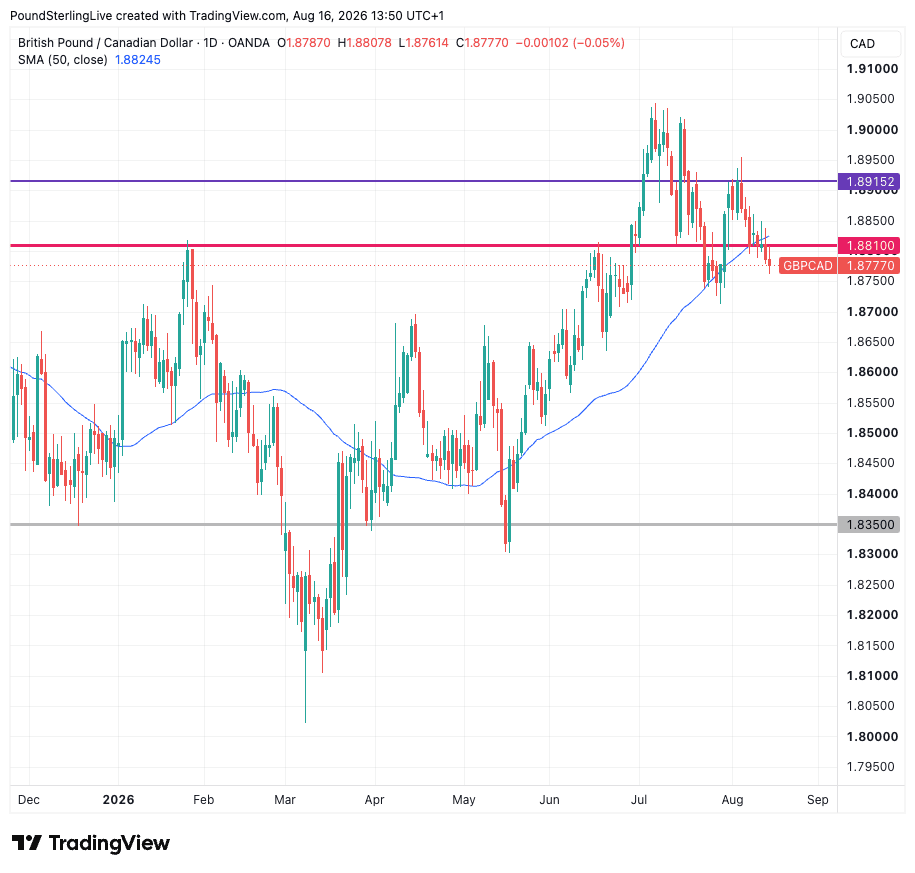
Above: GBP/CAD daily chart. Image © Pound Sterling Live, chart created with TradingView.
Spot at 1.87770 sits below the 50-day moving average at 1.88245, and below the 1.88100 level that had provided the floor through late July and early August.
Both breaks came in the latest sessions, and together they mark a change of character: the market spent six weeks finding buyers at 1.88100, and it is now finding sellers beneath it.
The decline from July's peak just above 1.9050 has also printed a lower high, with the August recovery stalling beneath 1.89152 before turning back down, and a falling sequence of highs against broken support is the structure of a correction gathering pace rather than one completing.
Support is the early August low at 1.8760, which is close enough that it could be tested in the opening sessions, then 1.8700, and beneath those the more substantial 1.83500.
Resistance is the broken 1.88100, then the moving average at 1.88245, with 1.89152 the level that would need to give way before the July highs came back into view.
Our Pound-to-Canadian Dollar forecast for the coming week is for a test of 1.8760 early in the week, with a daily close back above 1.88245 the development that would signal the correction has run its course.
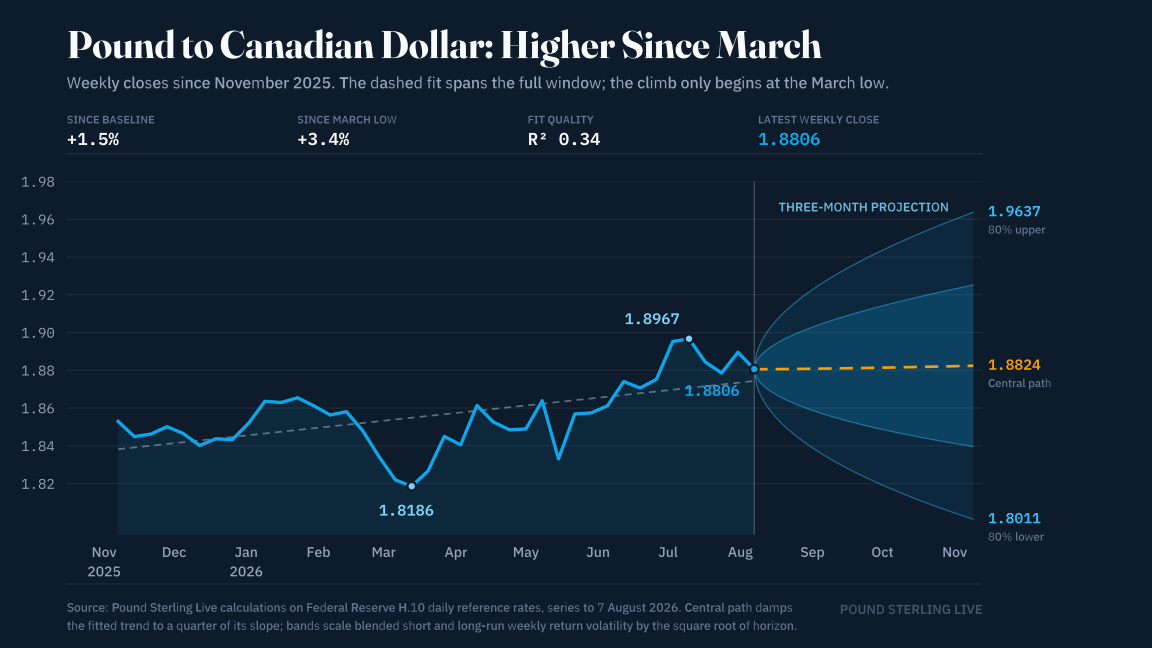
Taking a step back, the medium-term uptrend from March's lows near 1.8000 is still in play, which suggests the current sequence of weakness is corrective, but its first line of defence has gone, and the structure now depends on the 1.8700 to 1.8760 area holding.
Canadian Inflation Opens the Week
The Canadian Dollar's calendar begins immediately, with July consumer price data due on Monday.
Royal Bank of Canada expects year-over-year price growth to rise to 2.9% from 2.8% in June, driven by a reacceleration in energy prices.
"Oil prices are still lower than peaks in April and May, but bounced higher in July as conflict in the Middle East continued to disrupt transportation through the Strait of Hormuz," says Nathan Janzen, Assistant Chief Economist at Royal Bank of Canada.
Gasoline prices averaged 25% above year-ago levels in July, up from a 20% rise in June.
The detail that matters for the Bank of Canada is that the energy strength is not spreading. "We expect pass-through from higher energy prices to broader consumer prices have remained limited," says Janzen.

The Bank Consensus, Without the Terminal
The median, mean, highest and lowest from the October survey update, plus named point forecasts out to 2027.
Free information pack, issued by World Wide Currencies.
The Canadian lender looks for prices excluding food and energy to tick up to 1.9% from 1.8%, with the Bank of Canada's preferred median and trim measures holding near similar rates, all in the neighbourhood of the 2% target.
A headline rise built on energy with core measures anchored is not the kind of print that forces the Bank of Canada's hand, which limits how much support Monday can offer the Loonie beyond confirming the status quo.
Tariff Deadline Lands Wednesday
The more important thematic development of the week arrives on Wednesday, when U.S. Section 338 tariffs targeting about 5% of Canada's exports are set to take effect.
The deadline has fast-tracked trade talks between Canada and the U.S., but Janzen says the odds of a full resolution of all trade irritants before Wednesday remain low.
The impact on the U.S. is negligible, with the targeted products representing a small and highly substitutable 0.5% share of U.S. imports from the world.
For Canada, RBC estimates the new tariffs target 0.4% of the country's gross domestic product and jobs, an impact the bank describes as bigger but still manageable.
"The economy wide impact may be small, but reduced foreign demand for these products would still hurt production and jobs in key manufacturing industries-notably apparel and electrical equipment and appliances manufacturing—mirroring effects from past U.S. Section 232 tariffs," says Janzen.
For the currency, the setup is asymmetric.
A manageable tariff hit is largely in the price, so confirmation on Wednesday should pass without much damage to the Canadian Dollar, whereas a late breakthrough in the fast-tracked talks would remove a known negative and give the Loonie a lift that GBP/CAD is poorly positioned to absorb.
The backdrop is doing the Canadian Dollar no harm either, with Brent crude recovering to the 92 dollar area and firm energy prices supporting the currency of a major oil exporter.
Sterling's Chance to Answer
The Pound has the means to respond, with labour market figures on Tuesday, inflation on Wednesday and the flash PMIs on Friday.
Wednesday's inflation release is the one with the power to move rate expectations, with consensus looking for annual CPI to rise to 2.9% and some forecasters expecting 3.0%, a result that would firm the case for a September rate increase at the Bank of England.
Our house view is that the UK economy can continue outperforming expectations in the coming months, and further positive data surprises can bolster the Pound into year-end.
That is the route back above the moving average, but it requires the data to deliver, because the chart says the Canadian Dollar currently holds the momentum.
For those with Canadian Dollar payment requirements, the pair has come off its best levels of the year and the near-term risks point to lower still, which argues for covering requirements in stages rather than waiting on a recovery the chart does not yet support.