Image © Adobe Stock
The pound has made lower highs against the Loonie since July, and Canada's trade war has not interrupted them. The Bank of Canada and Canadian jobs are in focus this week.
The pound-to-Canadian dollar exchange rate slipped lower in the week it was meant to move higher, holding within a few pips of the shelf it has traded around all month while Ottawa and Washington's tariff dispute ran on without it.
From a technical perspective, the descending line drawn from July's peak has now come all the way down to meet the market, which leaves this pattern at the point where it has to resolve:
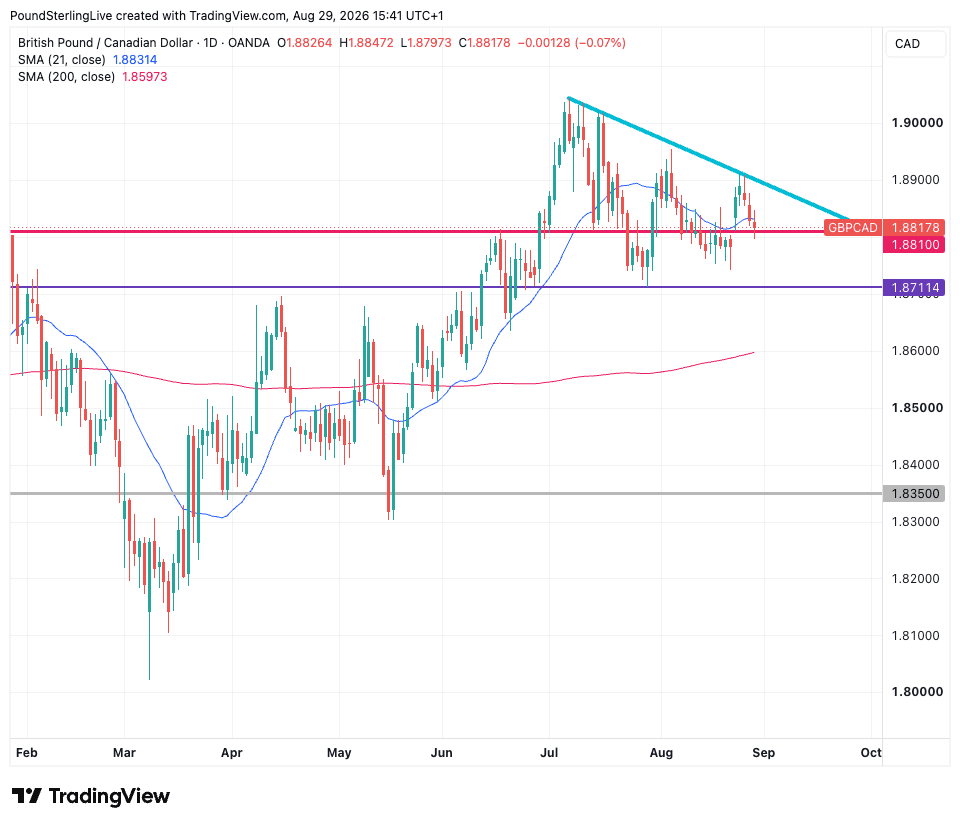

Above: GBP/CAD daily chart. Image © Pound Sterling Live, chart created with TradingView.
Spot at 1.8818 sits eight pips above the 1.8810 shelf and thirteen beneath the 21-day moving average at 1.8831, with the descending trendline running through much the same ground.
Two months of lower highs against a floor that has not moved is a descending triangle, and the apex has arrived. There is no room left in the pattern for another lower high.
What does a descending triangle tell us? Sellers keep acting at progressively lower prices while buyers keep defending the same one, so every rally is sold sooner than the last while the floor stays exactly where it was.
That asymmetry usually resolves downwards, because the buyers are the side with a fixed line to hold and the sellers are the side free to move.
Talks collapsed, duties of 50% took effect on roughly $20bn of Canadian goods and Ottawa announced retaliation for 8 September, and the pair finished the following week 34 pips higher. This suggests the tariff news is in the price.
A week ago we called for an upside break of the 1.8810 band that would open 1.8900, with a daily close beneath 1.8711 as the invalidation.
Neither happened. The range held for a fourth week and the market declined the opportunity we said it had. The instructive part is that the same article contained the reason, noting that the tariffs had been priced through the summer so the collapse confirmed a risk the market already carried.
For now we look for the triangle to break lower, with 1.8711 the first objective and the rising 200-day at 1.8597 the support beneath it. A daily close above the 21-day at 1.8831 would end the sequence of lower highs and put July's peak near 1.9040 back in the conversation.
Set against that, the medium term still runs the other way: the advance from March's 1.80 base is intact, the 200-day has been rising since May and sits more than two cents below the market, so what the chart describes is a correction working inside a longer uptrend.

The Bank Consensus, Without the Terminal
The median, mean, highest and lowest from the October survey update, plus named point forecasts out to 2027.
Free information pack, issued by World Wide Currencies.
Why the Trade War Has Not Moved the Loonie
Q2 GDP rebounded to 3.3% annualised, the fastest since the third quarter of 2024, and the first quarter was revised back into positive territory, which National Bank of Canada say confirms it was premature to talk about a technical recession at all.
The tariffs themselves cover about 5% of Canadian exports and 0.4% of GDP on RBC's arithmetic, and firm oil prices have offset the trade story through the summer.
The four-month lead time attached to the threatened January auto and parts tariffs reads as a deliberate window for talks, says Avery Shenfeld at CIBC, who points to remarks from U.S. Trade Representative Jamieson Greer hinting at a willingness to back down on side issues.
Shenfeld notes too that the new 50% duties rest on century-old legislation never applied this way, and that some legal scholars argue the grounds and the magnitude do not line up with the statute.
None of which makes the dispute harmless: CIBC's own forecast had assumed partial relief from the 2025 sectoral tariffs, so a standstill at today's rates still dents the 2027 outlook, and Shenfeld warns an escalating trade war risks a U.S. exit from the North American trade agreement.
Tariffs collected at today's rates on 2024 volumes would weigh more heavily on Canada as a share of GDP than on other major economies, because the rest of the G7 have larger domestic markets to fall back on.
That is a 2027 problem in a market trading a five-day horizon, and the Loonie has not paid for it yet.
The Bank of Canada Holds on Wednesday, Jobs Due Friday
A hold at 2.25% on Wednesday is the settled expectation, and there's limited prospect of the decision moving the market.
Friday brings the Labour Force Survey, where forecasts cluster in the low tens of thousands with unemployment expected to hold at 6.4%. National Bank of Canada attribute the modest expectations to the end of the World Cup costing accommodation and food services positions, which makes a soft print easier for the market to look through.
A jobs number that beats expectations supports the case for the Bank of Canada holding rates where they are for longer, lifts Canadian bond yields and draws buyers to the Loonie, pushing this exchange rate lower.
A miss does the reverse.
The complication is that the U.S. employment report lands the same morning, and the Loonie takes a large share of its direction from the American economy, so a strong Canadian number arriving alongside a weak American one will not read cleanly in either currency.
On balance our pound-to-Canadian Dollar forecast leans on the chart this week, because a market that would not rise on a trade war is unlikely to find its bid in a labour market survey.
The Bank Consensus, Without the Terminal
The median, mean, highest and lowest from the October survey update, plus named point forecasts out to 2027.
Free information pack, issued by World Wide Currencies.