
Image © European Commission Audiovisual Services
The euro's advance stalled on a 'hawkish' reading of Warsh's speech, this week's inflation and jobs data could settle the direction.
The euro-to-dollar exchange rate's pullback from 1.17 accelerated in the wake of last Friday's 'hawkish' read of Federal Reserve Chair Warsh's Jackson Hole speech that lit a fire under the dollar.
From a technical perspective, buyers will be immediately tested at a nearby support band where we see a confluence of moving averages and graphical horizontal support forming:
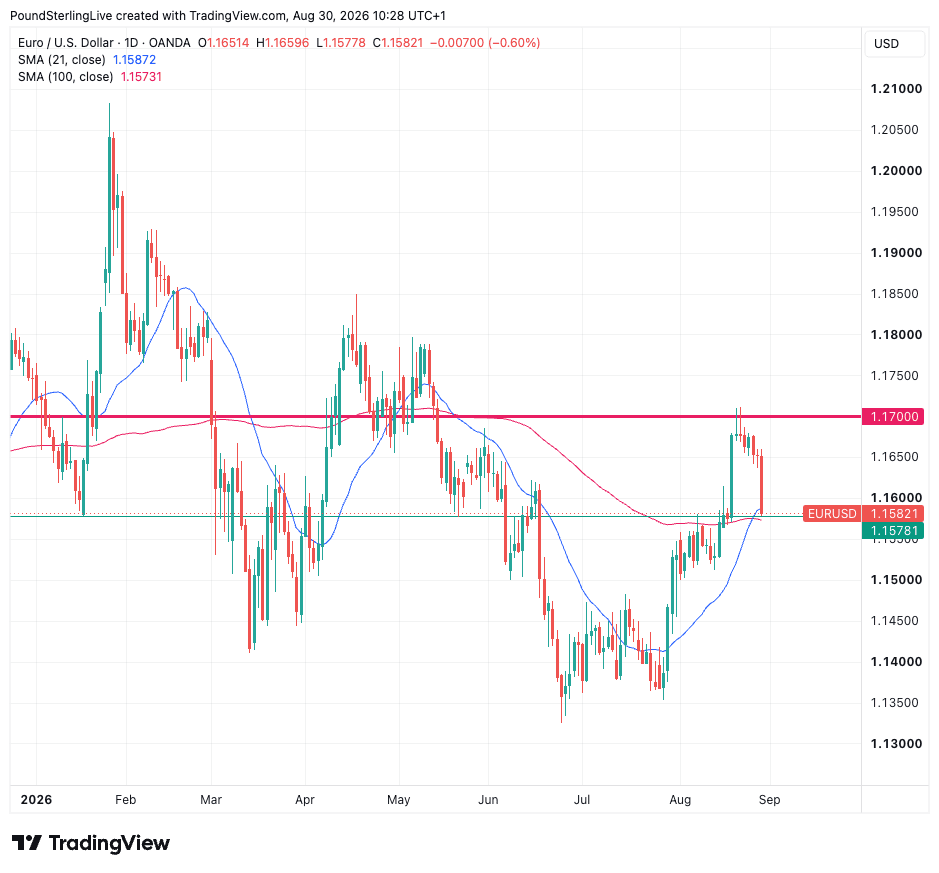
Above: EUR/USD daily chart. Image © Pound Sterling Live, chart created with TradingView.
The pair closed Friday at 1.1582, down 0.60% on the day, having traded down to 1.1578, which is a sizeable daily move that could well see some follow-through in early trade during the coming week.
From a directional perspective, there is the chance that the euro does end the week higher as it retraces some of its Friday losses, but we think we're in a new short-term phase of USD resilience ahead of the September Fed decision, and any euro-dollar rebounds will be shallow as a result.
The prospect of a weak retracement rests with the presence of that nearby support: the 100-day moving average lies at 1.1573, which has been pointing higher over the past fortnight.
Also nearby is the 21-day MA at 1.1587, the short-term trend indicator. That the market is back at the trend could be consistent with the market mean-reverting to the 21-day, which is the way we like to think exchange rates tend to behave.
So the selloff could be set to fade, but we think any euro-positive price action should be tepid and cluster around the identified technical support levels.
Warsh Reopens the Fed Question
The Dollar's recovery is Warsh's doing.
Policymakers must be confident inflation is moving to target "clearly and at sufficient speed," he said in his Jackson Hole speech, or else "we have work to do".
He would be "hard pressed to describe broad financial conditions as restrictive", and he affirmed 2% as a "firm, fixed target" after July's press conference had raised doubt about the metric. He committed himself to "a discipline, not to a decision".

The Bank Consensus, Without the Terminal
The median, mean, highest and lowest from the October survey update, plus named point forecasts out to 2027.
Free information pack, issued by World Wide Currencies.
The speech then went systematically through every potential reason not to hike and dismissed each one, says Christian Keller at Barclays, so the discipline he described made the hike seem inevitable.
Pricing for a September hike moved from 35% to a little over 40%, and National Bank of Canada judged the speech hawkish on the surface while stopping short of putting hikes explicitly on the table.
Barclays now looks for 25bp hikes in September and December that would take the funds target range to 4.00-4.25%.
July's personal consumption expenditures report gave Warsh nothing to argue with, headline holding at 3.7% and core at 3.3%, both monthly readings at 0.2%.
Euro this Week: Inflation Will Verify ECB Hike Bets
Turning to the calendar, Tuesday's euro area flash inflation reading forms the euro's main calendar event of the week.
How does an inflation print move a currency? An outcome above expectations raises the odds the central bank keeps tightening, which lifts that country's bond yields and draws money towards the currency paying them.
A print below expectations does the reverse. How durable will any currency reaction to the data be? We don't think it will be significant because an ECB hike this month is now fully discounted and for EUR/USD, the dollar leg of the equation is dominant.
Payroll Currency Risks Asymmetric
Friday's U.S. employment report is the week's calendar highlight for euro-dollar.
A payrolls print that beats expectations tells the Federal Reserve the economy can carry higher interest rates, which lifts U.S. yields and the Dollar and pushes this pair lower.
A miss pushes back against the case for tightening and lets the euro recover some of the previous week's losses.
Sentiment heading into the July release is important as the market has a relatively low bar set on this month's release courtesy of recent developments in the jobs market: July payrolls unexpectedly fell 23k, May and June were revised down by a combined 103k, and average growth has slowed to 20k a month over the three months to July.
Over the past six months the payrolls survey has averaged a gain of 44k a month while the household survey shows an average decline of 153k.
With the market having been primed to expect the slowdown story to extend, we think risks are asymmetric to a lower euro-dollar in the event of a better-than-expected outcome.
The Bank Consensus, Without the Terminal
The median, mean, highest and lowest from the October survey update, plus named point forecasts out to 2027.
Free information pack, issued by World Wide Currencies.