Image © Adobe Images
The Pound's push above its yearly ceiling has failed, and Friday's payrolls could decide how far the retreat runs.
The pound-to-dollar exchange rate broke above the ceiling of its yearly range last week but could not hold the ground it took and reversed to close beneath the short-term average that has carried it higher since July.
In short, the technical setup has deteriorated and the coming week could augur further weakness.
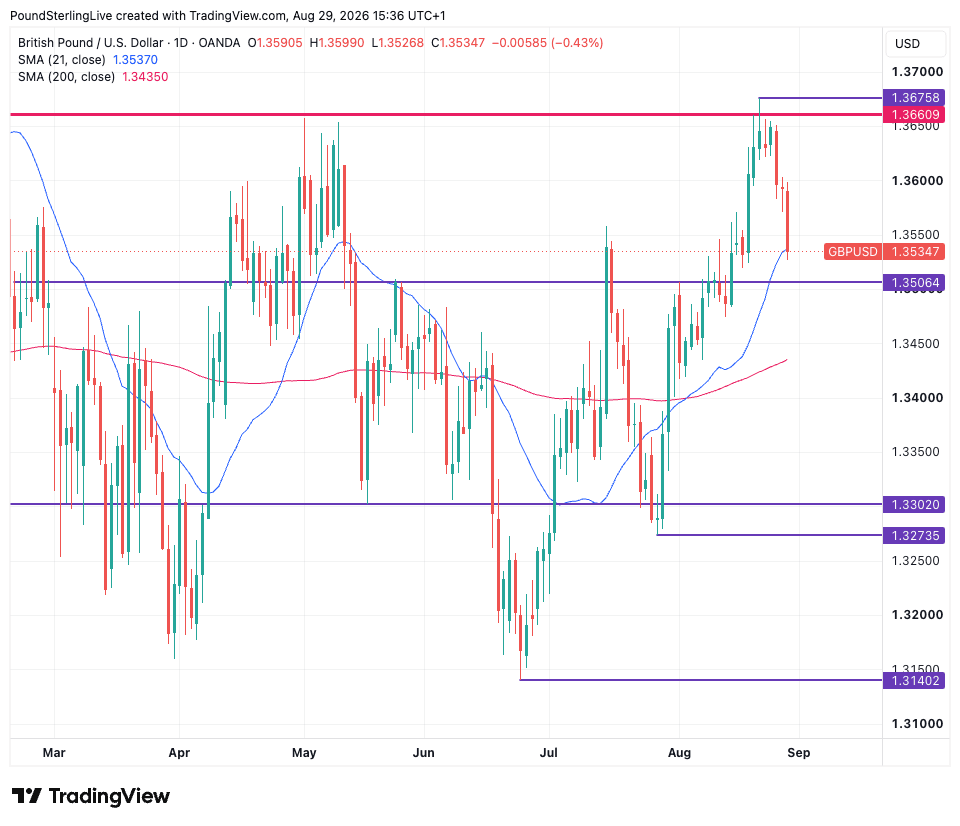
Above: GBP/USD daily chart. Image © Pound Sterling Live, chart created with TradingView.
From a technical perspective, buyers must reclaim the 21-day moving average - the blue line in the chart - which Friday's close slipped beneath for the first time since the middle of July.
The pair closed Friday at 1.3535, down 0.43% on the day, with the 21-day moving average at 1.3537 now sitting directly overhead as resistance. The high of the move was 1.3676, clear of the 1.3661 horizontal drawn from February's highs, held above it for three sessions, and then gave way.
What does a failed breakout tell us? Traders who bought above 1.3661 are now holding losses and tend to sell into any bounce back towards their entry, while the sellers who defended the level have been proved right and press the advantage.
Failed breakouts therefore tend to travel, and they usually carry price back through the range they briefly left.
A week ago we forecast a break above 1.3660 opening the 1.3680 to 1.3690 band, and said a failure at the first attempt would produce a pullback towards 1.3506.
We got the break and we did not get the follow-through.
The high at 1.3676 stopped four pips short of the band we named, and the second branch of that forecast is the one now in play. The overbought momentum reading we flagged at 70.90 did its work too, though the pause it argued for arrived as a reversal.
For now we look for a test of 1.3506 this week, the shelf that gave way in the middle of August and which we named last week as our invalidation level.
A daily close beneath it would open the 200-day average at 1.3435.

The Bank Consensus, Without the Terminal
The median, mean, highest and lowest from the October survey update, plus named point forecasts out to 2027.
Free information pack, issued by World Wide Currencies.
Warsh Puts a September Hike Back on the Table
Warsh's Jackson Hole speech is the reason this pair turned.
In principle the speech only set out the conditions to hike, and Warsh said he was committed to "a discipline, not to a decision", but it went systematically through every potential reason not to hike and dismissed each one, according to Christian Keller at Barclays, so the discipline he described made a hike seem inevitable.
Policymakers must be confident inflation is moving to target "clearly and at sufficient speed," Warsh said, or else "we have work to do". He would be "hard pressed to describe broad financial conditions as restrictive", and he affirmed 2% as a "firm, fixed target" after July's press conference had raised doubt about the metric.
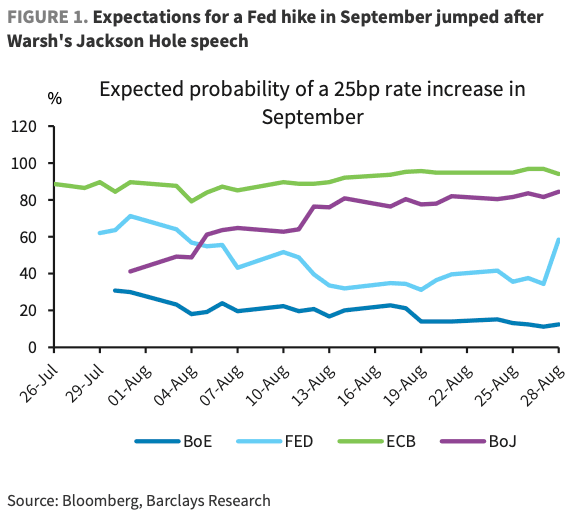
The probability of a 25-basis point rate hike at the September meeting rose from roughly a third before Warsh’s speech to about 60% in response to Warsh’s concerns about inflation still being too high.
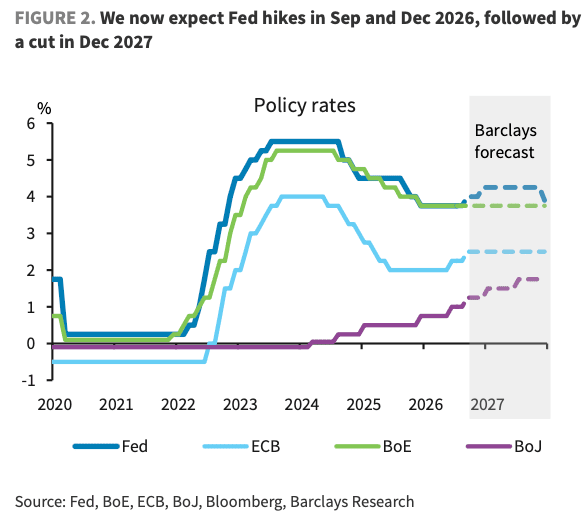
Barclays have responded by moving their house call to 25bp hikes in September and December, taking the funds target range to 4.00-4.25%.
Economists at National Bank of Canada read the same speech as hawkish on the surface while stopping short of putting hikes explicitly on the table, which is roughly where pricing has settled.
GBP/USD Squeezed: Why the Bank of England Need Not Follow
Pound serling's side of this pair has a framework for standing still while the Fed moves, a classic policy pincer that pushes the pound-dollar lower.
Andrew Bailey, speaking at Jackson Hole and reported by Bloomberg, said current evidence on second-round effects supports the view that they are "subdued", which allows him to "watch this situation for the moment".
Asked how Fed policy would influence the Monetary Policy Committee, he made clear the Bank does not feel it has to follow the Fed, and takes the external situation as one input among others.
Barclays connect that to an earlier Megan Greene speech, which showed that tightening global financial conditions are balanced against, and can even dominate, the currency effects of a surprise Fed tightening.
In plain terms, a hawkish Fed tightens conditions worldwide and does some of the Bank's work for it, which offsets the exchange rate argument that would otherwise push the Bank to match the move.
How Payrolls Could Bolster the USD Recovery
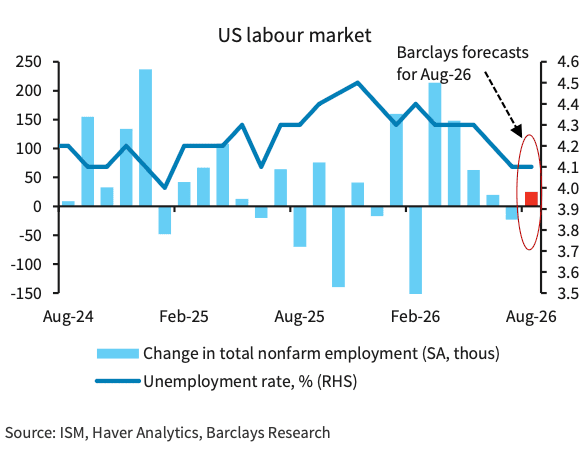
Friday's U.S. employment report is the week's decider, and the forecasts are further apart than usual.
Bloomberg consensus looks for a 55k rise, we suspect that anything on target would do enough to bolster that September rate hike pricing and help the dollar higher.
A reading above consensus could materially bolster the dollar.
The backdrop is already soft, which means an on-target or above-target outcome would register particularly hawkishly; July payrolls unexpectedly fell 23k, May and June were revised down by a combined 103k, and Lloyds note average growth has slowed to 20k a month over the three months to July.
Claims sit near their lows and job availability is improving, so this is a labour market cooling gradually.
The Bank Consensus, Without the Terminal
The median, mean, highest and lowest from the October survey update, plus named point forecasts out to 2027.
Free information pack, issued by World Wide Currencies.